Item 3. Presentation and recommendation to support Academia Cuahtli’s FY 2026–2027 budget recommendation — original pdf
Backup
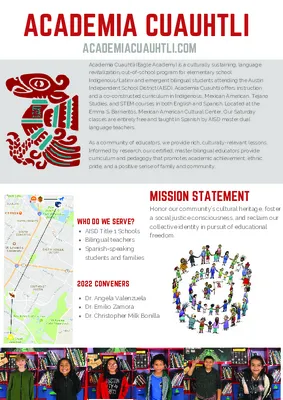
ACADEMIA CUAUHTLI ACADEMIACUAUHTLI.COM MISSION STATEMENT WHO DO WE SERVE? 2022 CONVENERS Academia Cuauhtli (Eagle Academy) is a culturally sustaining, languagerevitalization, out-of-school program for elementary schoolIndigenous/Latinx and emergent bilingual students attending the AustinIndependent School District (AISD). Academia Cuauhtli offers instructionand a co-constructed curriculum in Indigenous, Mexican American, TejanoStudies, and STEM courses in both English and Spanish. Located at theEmma S. Barrientos, Mexican American Cultural Center, Our Saturdayclasses are entirely free and taught in Spanish by AISD master duallanguage teachers. As a community of educators, we provide rich, culturally-relevant lessons.Informed by research, our certified, master bilingual educators providecurriculum and pedagogy that promotes academic achievement, ethnicpride, and a positive sense of family and community.Honor our community’s cultural heritage, fostera social justice consciousness, and reclaim ourcollective identity in pursuit of educationalfreedom.AISD Title 1 SchoolsBilingual teachersSpanish-speaking students and familiesDr. Angela ValenzuelaDr. Emilio ZamoraDr. Christopher Milk Bonilla TESTIMONIALS NUMBER OF LIVES IMPACTED Teachers 72 Students 429 NUMBER OF PD CLASSES 200 Teachers completed professional development workshops with Academia Cuauhtli YEARS OF TEACHING EXPERIENCE MENTORSHIP 3-21 yrs. 40+ Mentored successfully graduate students of color. Three whom are now professors. academiacuauhtli.ut@gmail.com │ 512-364-0700 https://www.facebook.com/AcademiaCuauhtli"As teachers, we get to teach for the sheer joy of teaching and the students get to learn just for the sake of acquiring knowledge. The students do not have to worry about standardized tests here. We cover topics thatare near and dear to their hearts—their language and culture." - Cuauhtli Teacher"Academia Cuauhtli is a place for kids to learn about their culture, roots, and reinforce their identity. I want my children to learn values and other important lessons so when they grow upthey are confident. Cuauhtli teaches them values that they may not fully understand now but I am sure they will remember these lessons later on and understand." - 2017-18 ParentAcademia Cuauhtli is part of NLERAPP, a tax-exempt under Internal Revenue Code section 501(c)(3) About Academia Cuauhtli & Nuestro Grupo Nuestro Grupo, meaning "Our Group," originated from a pivotal meeting held at the Emma S. Barrientos Mexican American Cultural Center (ESB-MACC) on September 20, 2013. This gathering, organized by the University of Texas at Austin's Texas Center for Education Policy (TCEP) under the leadership of Dr. Angela Valenzuela, brought together seasoned community leaders to address literacy and curriculum issues within Austin's Mexican-origin community. Against the backdrop of a statewide movement for Mexican American studies, Nuestro Grupo emerged as a response to the expressed needs and disparities in education. Read more: https://academiacuauhtli.com/about/ This collaborative effort ensured the development of a curriculum aligned with state and district standards, tailored to each grade level. Comprising scholars, Master dual language public school teachers, community members, graduate students, and parents, Nuestro Grupo volunteers their time to guide Academia Cuauhtli, strategically working towards providing high-quality education programs and services to bilingual students in the Austin Independent School District. In Kind Services provided by Nuestro Grupo Name Title at Academia Cuauhtli Title Hourly Rate Total Hours per week average Dr. Angela Valenzuela Dr. Emillio Zamora Director, Academia Cuauhtli Professor, University of Texas at Austin, Education Leadership and Policy 200.00 10 Researcher & Development Director Professor, University of Texas at Austin, Department of History 200.00 10 Patricia Nuñez La Collaborativa Director Lauren Mena Shook Qualitative Research Associate Lizeth Lizarraga- Dueñas Qualitative Research Associate Doctoral Student, University of Texas at Austin College of Education Doctoral Student, University of Texas at Austin, Department of Educational Leadership and Policy Doctoral Student, University of Texas at Austin, Department of Educational Leadership and Policy 200.00 10 60.00 10 96,000.00 (12 months) 96,000.00 (12 months) 96,000.00 (12 months) 28,800.00 (12 months) 60.00 10 28,800.00 (12 months) Dr. María Del Carmen Unda Qualitative Research Associate + grant writer Lecturer, California State University Los Angeles, Department of Latinx Chicanx Studies 100.00 10 48,000.00 (12 months) Mateo Villafuerte Social media manager and Texas State University, B.A. 40.00 10 19,200.00 (12 months) Langford website developer Rosa Tupina Yaotonalcuauh tli Danza Mexica Spring Teacher Clinical Social Worker and Therapist, LCSW 100.00 10 Martha Cotera Community Librarian and Writer 200.00 10 Specialist Dr. Blandina Cardenas Community Specialist Former President, University of Texas Rio Grande Valley 200.00 10 48,000.00 (12 months) 96,000.00 (12 months) 96,000.00 (12 months) TOTAL $652,000.00 Summary of Select Findings from Dr. Anthony Martinez Study on Academia Cuauhtli Citation - Martinez, A. (2025). The Effect of Academia, A Culturally Relevant Pedagogy, on English Language Learner Achievement [Unpublished Doctoral Dissertation, University of Texas at Austin]. Note: Dr. Anthony Martinez defended his dissertation on March 31, 2025 at the University of Texas at Austin, College of Education and was supervised by Dr. Pedro Reyes, Professor Department of Educational Leadership and Policy. His dissertation should be published on Texas Scholarworks in the next couple of months. Summary: Dr. Martinez’s research compared elementary students who participated in Academia Cuauhtli’s culturally relevant programming (AC students) with similar students who did not (non-AC students). The study focused on fourth- and fifth-grade students’ test scores in core subjects and their school attendance. Research 2 question: What is the difference between fourth- and fifth-grade ELL Academia Cuauhtli students and their fourth- and fifth-grade ELL counterparts who were not Academia Cuauhtli students with respect to the following outcomes of interest: three subject based standardized exam scores and attendance records? Summary of findings: Overall, the analysis of all fourth-graders’ scores combined from 2016 to 2019 indicates a statistically significant difference in math, reading, writing, science, and attendance rates with AC students outperforming non-AC students in all subjects and metrics analyzed. Similarly, the analysis of all fifth-graders’ scores combined from 2016 to 2019 reveals statistically significant differences across all subjects, with AC students again surpassing their non-AC counterparts in math, reading, writing, science, and attendance rates. Findings: Overall, the analysis of fourth-graders’ scores from 2016 to 2019 indicates a statistically significant difference in math (p = .010), reading (p = 0.018), writing (p = .003), and attendance rates (p < .001), with AC students outperforming non-AC students in all subjects and metrics analyzed. Findings: Similarly, the analysis of fifth-graders’ scores from 2016 to 2019 reveals statistically significant differences across all subjects, with AC students again surpassing their non-AC counterparts: math (p = .002), reading (p = 0.003), science (p = .002), and attendance rates (p < .001). The overall scores and rates analysis for both fourth- and fifth-graders provides quantitative evidence that reinforces previous research, demonstrating that incorporating CRP tenets creates a supportive framework for all students, particularly historically marginalized groups such as ELLs, to thrive academically (Abdulrahim & Orozco, 2020; Charleston et al., 2014; Christianakis, 2011; Ebe, 2010; Langlie, 2008; Rodriguez et al., 2004; Soldner et al., 2012; Szlenyi & Inkels, 2011; Tate, 1995). March 4, 2026 Dear Emma S. Barrientos Mexican American Cultural Center Advisory Board, We come before you in full support of Nuestro Grupo, a nationally recognized, community-rooted language and culture revitalization program that has served Austin’s emergent bilingual youth for over a decade. We respectfully urge your Commission to support our FY 2026–2027 budget recommendation of $130,000 and the creation of a full-time Program Director position. Nuestro Grupo, a community-based organization, founded as Academia Cuauhtli in 2014, in collaboration with Austin ISD and the Emma S. Barrientos Mexican American Cultural Center. Since then we have expanded and restructured as Nuestro Grupo with three components: Academia Cuauhtli (a regular school term summer academic program for fourth, fifth, and sixth graders), La Colaborativa (a teacher development program that collaborates with institutions in both the U.S. and Mexico to recover heritage resources), and a teaching Laboratory that seeks to partner with the teacher training program at the University of Texas at Austin. Our mission is to honor our community’s cultural heritage, foster social justice, and reclaim our collective identities in pursuit of educational freedom. Over the past ten years, we have: ● Served over 800 AISD students and their families through Saturday classes and summer STEM programs; ● Trained more than 250 Latinx and Indigenous educators; ● Developed 18 state-aligned, culturally relevant curricular units; ● Secured more than $500,000 in in-kind professional volunteer hours annually; ● Conducted community-based research in partnership with the University of Texas at Austin. Our funding request (via a larger operating budget by the Emma S. Barrientos Mexican American Cultural Center) is vital to expanding our services to additional neighborhoods and sustaining the academic, cultural, and social supports our program provides. This request directly aligns with the Advisory Commission’s mission to advise City Council on improving the quality of life for Austin’s Hispanic/Latino community and addressing inequities in education, youth services, and cultural access. Beyond your support for the ESB-MACC’s budget, of which the $130K Academia Cuauhtli program budget (see attached budget proposal). Sincerely, Dr. Angela Valenzuela, co-founder Academia Cuauhtli Dr. Emilio Zamora, co-founder Academia Cuauhlti Dr. María Del Carmen Unda, Academia Cuauhtli Program Manager On behalf of Nuestro Grupo https://academiacuauhtli.com/ Fiscal Year 2025 - 2026 Budget Recommendation Academia Cuauhtli seeks support for its FY 2025-2026 budget recommendation aimed at serving predominantly indigenous, Hispanic, Spanish-speaking youth in Austin. We are requesting on-going funding for culturally and linguistically diverse programs with an annual allocation of $125,000.00 and a full time Program Director position. Below is a concise outline of our minimal operating costs derived from the fiscal year 2023-2024, along with a proposal for additional funds to initiate our programmatic expansion. Detailed program descriptions, budgets, and material costs can be found on the following pages. Minimal Operational Costs ❖ Academia Cuauhtli (Eagle Academy) - Saturday Arts Program ❖ Parent Support Program ❖ Bilingual Summer Program ❖ Teacher Stipend ★ Teacher Professional Development Total Fund Request Amount $40,000 $20,000 $40,000 $20,000 $10,000 $130,000 Academia Cuauhtli and the Eagle: Danza Mexica and the Epistemology of the Circle Angela Valenzuela, Emilio Zamora, and Brenda Rubio An out-of-school program for fourth-grade English learners in Austin, Texas – jointly developed by the school district, the City of Austin and a local community group – has co-constructed a curriculum that incorporates the Aztec dance or ceremony Danza Mexica as a core component. English learners are best support- ed when they receive culturally relevant content-area instruction in their first language. Numerous studies (e.g., Lindholm-Leary 2001) support this approach, and bilingual and dual language teachers in our community of Austin, Texas, have called for curricular resources. In response, a group of researchers, community advocates, and former public school teachers established Angela Valenzuela is a professor in the Educational Policy and Planning Program, Department of Educational Administration, and the Cultural Studies in Education Program, Department of Curriculum & Instruction, at the University of Texas at Austin and is director of the University of Texas Center for Education Policy and of the National Latino/a Education Research and Policy Project. Emilio Zamora is a professor in the Department of History and faculty associate in the Center for Mexican American Studies at the University of Texas at Austin. Brenda Rubio is a doctoral student in the Educational Policy and Planning Program, Department of Educational Administration at the University of Texas at Austin. 46 Annenberg Institute for School Reform the community-based organization Nuestro Grupo (“Our Group”) in September 2013 to lead the effort. Through a series of partnerships that included Nuestro Grupo, the school district, the City of Austin, university faculty and students, Mexican American scholars, civic and cultural organizations, indigenous leaders, and many others, we co-constructed a Mexican American history curriculum for fourth-grade Austin Independent School District (AISD) students who attend a Saturday morning school that we created and named Academia Cuauhtli (“Eagle Academy”). In the process, we – the researchers and community leaders – were transformed, and the curriculum we developed evolved into a deeper learning experi- ence than we ever imagined. This article explains how this happened. HON ORING THE CULTUR AL WEALTH OF OUR ST UD ENT S Rather than treating the symptoms and purporting to “fix” our children to make them higher achievers and more engaged in school, we sought to advance learning in our schools and district through an academy and curriculum project that values and honors the cultural wealth of our participating students, parents, teachers, and local arts institutions in Austin (Yosso 2005). Our evolving curriculum includes lessons on migration, civil rights, indigenous heritage, cultural arts, and local history within the broad context of U.S., Mexican, and transnational history, but with a focus on Mexican- origin people and other Latinas/os from the Austin area. This article is informed by the more recent lesson plans on indigenous heritage, cultural arts, and the Aztec dance or ceremony Danza Mexica, which we also sometimes simply refer to as danza. THE DANZA CU RRIC ULU M EM ERG ES: DE EP LEARN ING AN D CO NN ECTION TO FAMILY A ND CO MMU NITY We found that valuable learning often takes place while learners are doing things that might not have initially occurred to us as we prepared the curriculum on topics like danza. Danza is not a relic of a distant past nor simply a source for teaching a dance and musical repertoire; it is a form of cultural maintenance and survival with a lineage that survived the genocide of native people throughout what is known today as modern Mexico (Aguilar 2009; Colín 2014). These learnings have gradually come into greater focus as we contemplate the meaning of the circle as a funda- mental aspect of danza (Stone 1975; Colín 2014). Rather than simply a geometric symbol, the circle as con- veyed through the danza performance is powerful as an epistemology, or way of knowing, that simultaneously expresses a host of communitarian values and speaks to a potentially deeply felt history among the mostly Mexican children who are historically connected to the Mesoamerican peoples that originated danza. While introducing children to ancient ways of knowing and experiencing life, family, and community – some are already familiar with danza through community and school events – the dancing in circle form also reenacts a sense of unity that pulls the concentric lines of formation into a sacred center of spiritual oneness. This contrasts with more typical individualistic experiences and feelings of isolation and estrange- ment from schools and society – and perhaps especially so in a city that is deeply stratified by race and class (Weldon 2015). Angela Valenzuela, Emilio Zamora, and Brenda Rubio VUE 2015, no. 41 47 Guided by the idea of revitalizing the Spanish language and Mexican American culture in our school district and city, Nuestro Grupo entered into a legal partnership in December 2014 with AISD and the City of Austin to house Academia Cuauhtli on the beautiful grounds of the city’s Emma S. Barrientos Mexican American Cultural Center (ESB-MACC). The ESB-MACC is a community-based cultural arts institution located along the Colorado River in the heart of downtown Austin and directly across the highway from historic East Austin, where a low- income, segregated, Mexican American community has resided for decades, but which is currently undergoing a contentious process of gentrification (Ward 2015). Academia Cuauhtli opened its doors on January 17, 2015 to predominantly Mexican-origin, fourth-grade children and their parents from three nearby elementary schools. “THE Y FAI L TO A CK NOW LEDG E THAT WE HAVE A H IS TORY ”: NUESTRO GRUPO IS BO R N The decision to establish Academia Cuauhtli occurred when a group of seasoned community leaders convened at the ESB-MACC on September 20, 2013. The University of Texas at Austin’s Texas Center for Education Policy (TCEP), headed by co-author Angela Valenzuela, organized the meeting to discuss the issues of literacy, curriculum, and Austin’s Mexican- origin community. The event took place against the backdrop of a growing statewide, grassroots move- ment to develop Mexican American studies in Texas (Diaz 2014, 2015), as well as major critiques leveled at the Texas State Board of Education, legendary for its conservative defense of a statewide curricula that systemati- cally excludes historical content related to Mexican American, African Ameri- can, and indigenous heritage (Erekson 2012; Zamora 2012a, 2012b). TCEP invited two speakers to the September 20 meeting: Armando Rendón, a Latino children’s book author; and Oralia Garza de Cortés, a renowned children’s book advocate, founder of the national Pura Belpré Children’s Book Award, and now a Nuestro Grupo member. Before an audience of Mexican American historians, archivists, librarians, scholars, local leaders, elders, and teachers within the district’s dual language program, Garza de Cortés offered the following critical commen- tary with respect to children’s book publishers located in the Northeast: They do not seek to publish our work because they see [Mexican Americans] as a regional minority, and whenever they do publish us, they either portray us in ways that reinforce negative stereotypes or narrowly – always as immigrants embarking on citizenship. They fail to acknowledge that we have a history. In reference to books in English and Spanish, Garza de Cortés added that these publishers overwhelmingly get the language and, frequently, the aesthetics wrong, too. . . . They will contract out with a translator from Argentina, and their Spanish is different from ours, making the readings of these texts stilted. Yet the problem overall, literally for more than thirty years, is a sheer lack of books for our children. The dual language teachers in the audience supported Garza de Cortés’ commentary, saying that despite the district’s claim to be a “dual language school district,” there are a lack of books and other curricula available to them. In this vein, another teacher offered, “We may as well be in the 1940s. All we have is what we develop for our children in our classrooms.” The teachers added that in instances where such materials are present, they 48 Annenberg Institute for School Reform still do not feel confident using them. Lastly, they maintained that the children are alienated from school because of a lack of curriculum and teaching that speaks to their cultures, experiences, or history. Elders from the community, including advocate – and now Nuestro Grupo member – Martha P. Cotera, responded by pointing to the originating docu- ments of the ESB-MACC. Established in 2005, the idea of a Saturday school had always been envisioned. Expres- sions of disparity and needs motivated those present to form an organization, Nuestro Grupo, that would continue to work to address these problem areas. The planners of the September 20 event expected a lively discussion on literacy, curriculum, children’s litera- ture, and the urgency for action, since our two major speakers – Garza de Cortéz and Rendón – and many members of the audience were known for their critical views on the subjects. But the meeting turned even more constructive when members of the audience began to ask what we could do. Co-author Emilio Zamora pointed out that “we have so many persons with the skills to offer solutions, all we need is to come together committed to creating change.” A group of us decided to convene after the meeting and prepare a plan for curriculum writing that would also attach to the teaching of Mexican American history and culture in the context of a Saturday school. THE PARTNERS HI P W IDENS Key to the success of Academia Cuauhtli were converging interests and broad-based support. Our budding project fell on fertile ground in two significant ways. First, district leader- ship – notably former Chief Academic Officer Pauline Dow – wanted to expand curricula for a district demographic that is increasingly Latino. According to the AISD website, Latinos constitute 60 percent of youth in schools, as compared to 24 percent Anglo and 9 percent African American (AISD n.d.). A full 24 percent of AISD students are English learners, a good number of whom are immigrants. The ESB-MACC was equally motivated due to concerns that gentrification is impeding their efforts to optimize audience participation at its events and programs, including its after-school program put in place to ostensibly serve children attending nearby East Austin schools. In addition to support from the district and a welcoming, accommodating space, our project included faculty with expertise in content and provided teachers with relevant professional development and flexible schedules. The development of our curriculum relied heavily on the efforts of Zamora, a history professor at the University of Texas at Austin. He had previously initiated the one-year Tejano History Curriculum Project as an extension of the Tejano Monument project, which erected a statue in 2012 at the Texas State Capitol as a tribute to Tejano contributions to Texas history and culture (Zamora 2012a). In the district, we worked closely with the Office of Academics, the Bilingual Education Of- fice, the Fine Arts Office, and the Curriculum Writer’s Cadre (CWC) of AISD teachers, which meets every June to develop curriculum for multiple subjects – increasingly in English and Spanish for the district’s dual language program. Zamora, Valenzuela, co-author Brenda Rubio, members of the CWC, and the selected Academia Cuauhtli teachers also offered profes- sional development workshops for AISD teachers. Zamora, the project’s principal content specialist, developed the first iteration of the curriculum, which the CWC subsequently aligned to state and district standards. This process ensured Angela Valenzuela, Emilio Zamora, and Brenda Rubio VUE 2015, no. 41 49 50 Annenberg Institute for School Reformthat the curriculum was appropriate for each grade level and elaborated a curricular road map for Academia Cuauhtli teachers. Participating teachers rotated to avoid burnout, since all Cuauhtli teachers also teach full-time in their regular AISD classrooms.ESB-MACC staff worked hard to make the space (two classrooms, a parent classroom, theater, and outdoor space) as accommodating as possible. We cross-promote and attend ESB-MACC events, which are often free and open to the public. This increases the number of opportunities for Nuestro Grupo members, partners, and Cuauhtli families to strengthen our bond and educational partnership.Other key partners that have provided resources to Academia Cuauhtli are the Austin Area Association for Bilingual Education, various sub-units within the AISD, and faculty, undergraduate, and graduate students from five central Texas universities: South University, St. Edwards University, Texas State University, Huston-Tillotson Univer-sity, and the University of Texas at Austin. Nuestro Grupo also contributes to the effort of highly respected community advocates like Martha P. Cotera and Oralia Garza de Cortés, as well as former public school teachers like Modesta Treviño and Velia Sánchez Ruiz, who facilitate Nuestro Grupo’s access to Austin’s local Latino arts community and institutions. They also serve as our group’s deep institutional memory regarding the poor conditions of education for Mexican students in our school district and the stories and histories of advocacy that, despite great hardship, created the political and policy space for bilingual education in our schools. A deep commitment to policy and political struggles related to identity, language, community, and the importance of our local history and institutions on the part of all of those involved in Academia Cuauhtli is foundational to all of our efforts.THE NAMING OF ACADEMIA CUAUHTLIA name like “Cuauhtli” is not auto-matically part of the lexicon for most Mexican Americans, ourselves includ-ed. Very few of us speak Nahuatl, the language of the Aztecs, much less know about important symbols and terms like cuauhtli. This name never-theless came to us through a respected local leader in danza named Rosa Tupina Yaotonalcuauhtli. We were receptive to the idea because of our association with the Mexican Ameri-can social cause for equal rights and dignity, a movement that gives great importance to indigenous symbols and concepts that harken back to Meso-american times and reinforce a sense of collective identity. According to the late Mexican anthro-pologist Guillermo Bonfil Batalla, Mexicans who connect to this indig-enous past constitute “el México Profundo,” or the Mexico that continues to connect with ancient traditions and a concomitant life of social and cultural marginalization ““A deep commitment by all of those involved in Academia Cuauhtli to policy and political struggles related to identity, language, community, and the importance of our local history and institutions is foundational to all our efforts. associated with the modern-day vestiges of colonization (Bonfil Batalla 1998; Colín 2014). Some Mexican people in the United States also identify with a Mesoamerican past. The farmworker’s movement, for instance, adopted the eagle on their union label, banners, leaflets, and correspondence to signify the community’s history of prior occupancy and a longstanding connection to a distant Mesoamerican past that finds expression today in the form of danza and indigenous forms of community organizing (Colín 2014). The danza tradition has therefore taken root in Mexican-origin communities in the United States, and the increasing numbers of danza groups are an artifact of migrations and transnational ties with their counterparts in Mexico (Colín 2014; Aguilar 2009; Poveda 1981). A friend, Yvette Mendez, referred us to Rosa Tupina Yaotonalcuauhtli in July 2014 so that she could advise us on how to inaugurate our Saturday academy – and specifically whether the danza group that she directs, el grupo de Danza Méxica Xochipilli, could carry out this task. Yvette explained to me (Angela Valenzuela) that to make this request, I needed to contact Yaotonalcuauhtli in person and that I should meet her with a gift of tobacco. All along, my intentions were for our inauguration to invoke through ceremony the spirit of hard work, reciprocity, and good intention that had guided the partnership through the many months leading up to our opening ceremonies on January 17, 2015. Mendez subsequently invited me to join her at a workshop that was being delivered on the meaning of the Aztec calendar by Abuela (“Grandmother”) Tonalmitl, a keeper and elder of the Mexica traditions for more than forty years, who also happened to be Yaotonalcuauhtli’s teacher of many years in Mexico City (see Círculo Indígena Tlahuicoatl 2015). Abuela and abuelo are terms that convey special significance in the context of Danza Mexica traditions, connoting elder, erudite status. Gonzales (2015) maintains that these terms also reference what we might term an “elder epistemology,” whereby elders are accorded great respect, a phenom- enon frequently observed in Mexican American culture – assuming that assimilation or subtractive schooling (Valenzuela 1999) does not minimize or entirely erase this orientation. In great part due to my motivation to get to know Yaotonalcuauhtli, I found myself in the workshop that Abuela Tonalmitl was delivering at Alma de Mujer, a local retreat camp located on the outskirts of Austin. She spoke for several days regarding ancient knowl- edge that was at once expansive, complex, multi-layered, and complete. I mistakenly had thought that this ancient knowledge was fragmentary and that most of what is known about the Mexica came from the work of archeologists, anthropologists, and scholars who study the ancient codices. While much knowlege has indeed been lost as a result of conquest and coloni- zaiton (Colín 2014), a significant amount has been remarkably preserved. This knowledge has been protected to the point of being concealed and passed on from generation to genera- tion. Certain individuals, like Abuelas Tonalmitl and Yaotonalcuauhtli, have dedicated their lives to its study, recovery, and promulgation throughout the hemisphere. Aside from a deep oral and, to some extent, written tradition (Leon-Portilla 1963), such elders have encoded much of the ancient knowl- edge into danza and have helped to preserve it over the centuries. A bit overwhelmed by this discovery, I nevertheless made an important connection to Yaotonalcuauhtli, who agreed to meet with me a few weeks later to discuss the inauguration of our Saturday academy. Angela Valenzuela, Emilio Zamora, and Brenda Rubio VUE 2015, no. 41 51 After giving Yaotonalcuauhtli the gift of tobacco and explaining to her the kind of school that we wanted to become, she suggested the name “Cuauhtli,” which means “eagle” in Nahuatl. She saw that we wanted to cultivate in children critical capacities and analyti- cal power through our curriculum in order for them to effectively combat injustice in their own lives, as well as that of their communities. We discussed the importance of a “bird’s-eye view” that doesn’t get lost in the clouds, but rather is able to zero in on its prey with laser-like precision. “The águila (“eagle”) is also a sign of rejuvenation and is revered across many cultures over time,” she said. I took all of this back to Nuestro Grupo in our first meeting in fall 2014, explaining to them what I had learned. Members of Nuestro Grupo had previously drawn on Mexica symbol- ogy by adopting the concha (“shell”) as our organization’s symbol. We liked that it represented an ancient summon- ing of the community to forge common purpose. The symbol of the eagle seemed a natural extension of that decision, and after voting, we chose the name Cuauhtli. We were drawn to two aspects: the eagle’s capacity for rejuve- nation through the molting process, where they lose a third of their plum- age; and the eagle’s singular, 360-degree vision capacity. We, too, seek to be rejuvenated by our curriculum so that children can experi- ence Academia Cuauhtli as a happy, inspiring place. We feared most the possibility that the children would lose interest or not find our curriculum to be engaging. Yet how could we accomplish this if we ourselves were not also motivated and inspired? We all hold full-time jobs, and the bulk of our efforts to date have been on a voluntary basis. The eagle’s capacity for rebirth has therefore had enduring meaning for us as a symbol of recommitting and re-equipping ourselves for change in the classroom. With these things in mind, we initiated flor y canto, a philosophical statement of beauty and commitment to live life well, originating in Mexica tradition, and that literally translates into “flower and song.” At the beginning of every Nuestro Grupo meeting, someone shares a thought, verse, or song that is personally inspiring together with an explanation of its significance to our lives and work. This practice sets a cooperative tone for every meeting we hold and by all accounts motivates a positive, constructive energy and thought process. Regarding the eagle’s 360-degree vision, we came to see Nuestro Grupo as its embodiment. Because of the intergen- erational makeup of our group, which consists of highly respected elders who are not only deeply interconnected with the Austin community but also com- mand great knowledge, experience, intelligence, and wisdom, we came to realize our capacity as a group to carry out the many tasks associated with this work. In such a space, where each person holds distinct talents and where every talent counts for the overall initiative, the value of each individual is affirmed. P RE PARING CH ILDREN FOR DANZA AN D TH E EP ISTE MO LOGY O F T H E C IRCL E The idea of the 360-degree vision is key to the epistemology of the circle as a way of knowing and being in the world: working together as a commu- nity, accompanied by the implicit protection and clear vision that the bird’s-eye view evokes. Danza came to find a home in our academy, curricu- lum, and praxis that we could not have predicted beforehand. At Academia Cuauhtli’s inaugural festivities, Grupo Xochipilli, with Yaotonalcuauhtli directing, performed a 52 Annenberg Institute for School Reform culminating ceremony to the aromatic smell of copal, burned incense that continues to be used today in a way that is little different from that of our pre-Columbian, Mesoamerican ancestors (Colín 2014). It followed music and dance performances by legendary Tejano conjunto artist Joel Guzmán, adult and student mariachi groups, and student folk dance ensembles. The hour-long ceremony transfixed the audience, particularly the fourth-grade children that we had recruited. One of the parents com- mented that he had participated in danza in his younger years, while growing up in Mexico. Some of us in Nuestro Grupo discussed the possibility of making danza a formal part of the curriculum and invited Yaotonalcuauhtli to attend our Nuestro Grupo meeting. This overture turned out to be very emotional since the direction that we would be taking in the curriculum constituted, for some, a privileging of an indigenous identity from the central part of Mexico over other cultural expressions in Texas. The response represented a recognition of a cultural affinity towards a shared ancient past, as well as the realization that we would be learning and sharing with the children meanings from this valued past. After a deep and frank discussion about the personal and curricular meaning of incorporating danza into the classroom and within Nuestro Grupo, we have come to understand that the 360-degree vision of the eagle not only brought Yaotonalcuauhtli into our orbit, but also brought an entire community of danzantes (“dancers”) to Cuauhtli, who together with Nuestro Grupo have strengthened our bonds of family and community, which now finds expression in our curriculum. While this lesson plan draws organi- cally from the practice of danza, it also borrows from other texts to flesh out basic understandings of indigenous ways of knowing – especially those related to the core concept of the circle in indigenous scholarship and thought (Gunn Allen 1986; Graham Crofoot & Crofoot 2002; Klug & Whitfield 2003). Danza represents not only a form of dance that is integral to ceremony but also a view that is rooted in ancient, Mesoamerican history. The performance acquaints the danzante with not only a different way of knowing – because through danza and ritual, one enacts its coalescing, egalitarian values – but also a different way of being in the world through the tangible experience of connectedness to others, as well as to something much larger than all danzantes combined: a “moving habitat” that danza inspires (Colín 2014). According to Yaotonalcuauhtli (2015), our abuelos and abuelas were very wise and intelligent, and they created danza to acknowledge the importance of the circle and all that it teaches us in order to live our lives – harmoniously, peacefully, and in balance in every way. The first, most inner circle is that of the family. The second circle consists of the schools where students have their teachers, principals, and friends. The third and outermost circle is called the church or community and it includes our Academia Cuauhtli Saturday school. Circles are important to the natural world: the sun, moon, and Earth are circles, with the Earth inside the circles of the sun and the moon. In a circle, all can see each other. No one is greater or lesser. All are equal. There is always an order. Danza requires discipline for entering into that order. If the circle moves to the left, the danzante has to move to the left; if to the right, the danzante must similarly follow. Danza is an implicit and explicit recognition of a divine order based Angela Valenzuela, Emilio Zamora, and Brenda Rubio VUE 2015, no. 41 53 A CO MP ELLIN G CON NEC TION T O AN AN CIEN T PAST When we first reached out to Rosa Tupina Yaotonalcuauhtli, we could not have predicted that she would gift us with our name and ultimately direct our fourth-grade children in danza itself. We also could not have predicted our own transformation that occurred through our deeper engagement with danza. At least one member of our group is now a member of Grupo Xochipilli, and several among us participate in temazkales (“sweats”) that are organized by Grupo Xochipi- lli. In addition, Angela Valenzuela joined members of Grupo Xochipilli at a three-day danza ceremony in Mexico that takes place annually at Cuahte- moc’s grave in Ixcateopan, Guerrero, to celebrate his birthday. Our curriculum writers plan to incorporate this instruction into the road map for the coming year, while others among us continue to study it. Most of all, everyone is celebrating the children’s and our community’s embrace of danza. Through the dance steps, drumbeats, ceremonies, and the cleansing scent of the ever-present copal, what persists, if mysteriously so, is the epistemological power of an ineffable, heartfelt connection to an ancient past. This past not only survives into the twenty-first century, but retains a compelling beauty, authority, and soulfulness to attract a new generation – just as it has for centuries. For more information about Academia Cuauhtli, see http://www.facebook. com/AdacemiaCuauhtli. on an understanding of cycles or circles and the importance of these to health and well-being. According to Yaotonalcuauhtli, Our people loved metaphors and analogies, so the elders say that danza is itself a “living codice.” We are emulating the movement of the planets, stars, animals, and humans. We are communicating when we dance. And we aspire to have order in movement.1 This is a window to the indigenous component of the curriculum that was taught to as many as thirty-three students (when all were in attendance) nominated by the principals from Metz, Sanchez, and Zavala elementary schools. Except for holidays, they attend for three hours every Saturday morning of the school year. Classes are in Spanish and include topics not often taught in depth at the elementary level, such as the various indigenous groups of Texas, the role of Tejanos in the Texas revolution, the Chicano art movement, and the traditions and cultural heritage of their ancestors, of which this lesson on the circle is a part. Members of Nuestro Grupo participate in the learning process primarily with discussions during two types of gatherings. They join in the weekly planning meetings when the curriculum writers and the teachers agree on the classroom activities and their learning objectives. The curriculum writers, teachers, and other members of Nuestro Grupo also convene once a week to address logistical issues and to share the meaning of the work that we do, including the collective spirit embodied in danza as a cultural practice and classroom activity. 1 Yaotonalcuauhtli, R. T. 2015. Personal communication. 54 Annenberg Institute for School Reform RE FE REN CES Aguilar, M. 2009. “The Rituals of Kind- ness: The Influence of the Danza Azteca Tradition of Central Mexico on Chicano- Mexcoehuani Identity and Sacred Space,” Ph.D. dissertation, Claremont Graduate University and San Diego State University, Los Angeles and San Diego. Austin Independent School District (n.d.). “Schools,” AISD website, http://www. austinisd.org/schools. Bonfil Batalla, G. 1998. México Profundo: Una Civilización Negada. México, D.F.: Grijalbo. Circulo Indigena Tlahuicoatl. 2015. “Las Abuelas Mexicas (Visita 2015),” Circulo Indígena Tlahuicoatl website, http:// circuloindigena.blogspot.com/p/la-danza- de-la-luna-xotchilmetzli.html. Colín, E. 2014. Indigenous Education through Dance and Ceremony: A Mexica Palimpsest. New York: Palgrave MacMil- lan. Diaz, T. 2015. “The Race to MAS: Mexican American Studies for 100 Texas School Districts,” Huffington Post (February 18), http://www.huffingtonpost.com/tonydiaz/ mexican-american-studies-_1_b_6689972. html. Diaz, T. 2014. “Mexican-American Studies Needed in Texas,” Houston Chronicle (January 28), http://www.chron.com/ opinion/outlook/article/Mexican-American- studies-needed-in-Texas-5182940.php. Erekson, E., ed. 2012. Politics and the History Curriculum: The Struggle over Standards in Texas and the Nation. New York: Palgrave Macmillan. Gonzales, S. M. 2015. “Abuelita Episte- mologies: Counteracting Subtractive Schools in American Education,” Journal of Latinos in Education 14, no. 1:40–54. Graham Crofoot, T. L., and C. Crofoot. 2002. “Using Reason for Living to Connect to American Indian Healing Traditions,” Journal of Sociology and Social Welfare 29, no. 1:55–75. Gunn Allen, P. 1986. The Sacred Hoop: Recovering the Feminine in American Indian Traditions. Boston: Beacon Press. Klug, B. J., and P. T. Whitfield. 2003. Widening the Circle: Culturally Relevant Pedagogy for American Indian Children. New York: RoutledgeFalmer. León-Portilla, M. 1963. Aztec Thought and Culture: A Study of the Ancient Nahuatl Mind. Norman: University of Oklahoma Press. Lindholm-Leary, K. J. 2001. Dual Lan- guage Education. Bristol, UK: Multilingual Matters. Poveda, P. 1981. “Danza de Concheros en Austin, Texas: Entrevista con Andrés Segura Granados,” Latin American Music Review 2, no. 2:280–299. Stone, M. 1975. At the Sign of Midnight: The Concheros Dance Cult of Mexico. Tucson: University of Arizona Press. Valenzuela, A. 1999. Subtractive Schooling: U.S.-Mexican Youth and the Politics Of Caring. Albany: State University of New York Press. Ward, T. 2015. “Stickers and Their Discontents,” Equilibrio Norte blog, http://equilibrionorte.org/2015/03/20/ stickers-and-their-discontents/. Weldon, K. 2015. “Hispanic Population on the Rise: Southwest Austin Attracts Resi- dents Amid Affordability Roadblocks,” Community Impact Newspaper (20 April), http://communityimpact.com/hispanic- population-on-the-rise/. Angela Valenzuela, Emilio Zamora, and Brenda Rubio VUE 2015, no. 41 55 Yosso, T. J. 2005. “Whose Culture Has Capital? A Critical Race Theory Discussion of Community Cultural Wealth,” Race Ethnicity and Education 8, no. 1:69–91. Zamora, E. 2012a. “Teaching Tejano,” Historian’s Corner, Texas Insights 11, no. 5, http://www. teachingtexas.org/enewsletter/ may2012. Zamora, E. 2012b. “Moving the Liberal-Minority Coalition up the Education Pipeline.” Chap. 6 in Politics and the History Curriculum: The Struggle over Standards in Texas and the Nation, edited by E. Erekson. New York: Palgrave Macmillan. 56 Annenberg Institute for School Reform