ENVIRONMENTAL COMMISSION RECOMMENDATION 20240807-003 Date: August 7, 2024 Subject: Cities Connecting Children to Nature Motion by: Jennifer Bristol Seconded by: Perry Bedford WHEREAS, the Environmental Commission was presented a staff update from Melody Alcazar, Program Manager – Cities Connecting Children to Nature, City of Austin Parks and Recreation Department; and WHEREAS, the Environmental Commission recognizes the CCCN initiative continues to strengthen partnerships across departments, AISD, and with NGOs across Austin; and WHEREAS, the Environmental Commission recognizes the CCCN initiative known as Green- School-Parks ensures students and teachers have opportunities to learn and play in natural spaces; and WHEREAS, the Environmental Commission recognizes the CCCN initiative known as Green- School-Parks ensures historically underserved neighborhoods have access to campuses where they can exercise, play, socialize, and learn. These communities lack access to parkland alternatives, which means the schools help the city achieve the goal of all residences living within a quarter mile walking distance from a park; and WHEREAS, the Environmental Commission recognizes school campuses with improved habitat, like the ones in the Green-School-Park program, offer increased ecosystem services such as reduction in heat island effect, storm water runoff, and carbon sequestration; and WHEREAS, the Environmental Commission recognizes the CCCN initiative continues to raise awareness about the need for children and families to have a daily connection with nature to ensure their physical and mental health and development; and WHEREAS, the Environmental Commission recognizes the CCCN initiative strengthens and helps achieve the climate, environmental, equity, and health goals of various departments and strategies within the city, and with the supporting NGOs; and WHEREAS, the Environmental Commission offers support of the Children’s Outdoor Bill of Rights; and WHEREAS, the Environmental Commission offers support of the Outdoor Learning Environments program. 1 THEREFORE, the Environmental Commission recommends continuing funding for the initiative. Additionally, we recommend expanded resources and support for: 1. Joint Use Agreement with AISD, and the Green-School-Parks initiative to ensure members of the community can utilize the school campus as parkland during out-of-school time. These agreements also ensure that students have daily access to greenspaces where they can play, explore and learn. 2. Recommend that the City of Austin work with AISD to find solutions to keep the public access gates open to grant access from the neighborhoods to the campuses during out-of- school-time. 3. Recommend the City of Austin find ways to better support the goals of the Children’s 4. Continue to …
ENVIRONMENTAL COMMISSION RECOMMENDATION 20240807-002 Second by: David Sullivan Date: August 7th, 2024 Subject: Austin/ Travis County Food Plan Motion by: Mariana Krueger WHEREAS, in 2021, the Austin City Council passed resolution NO. 20210610-039, which directed the City Manager to begin a food planning process that would center and uplift the voices of those most impacted by our current food system; after three years, the work of thousands of community members, alongside that of City and County departments, and tens of local nonprofits, has culminated in the Austin/ Travis County Food Plan, the first-ever visionary policy document of its kind here in Central Texas, and one of just a dozen of its kind nationwide; WHEREAS, as part of this planning process, the Office of Sustainability has identified that 16.8 acres of farmland are lost in Travis County every day, only 0.06% of the food consumed in Travis County is locally produced, and 14.4% of people in Travis County experience food insecurity, yet 1.24 million pounds of food are wasted every day in Austin; AND WHEREAS, in 2021, the Austin Climate Equity Plan established several goals related to sustainable food production, including protecting 500,000 acres of farmland from development in the Central Texas five-county region, and incorporating all City-owned land in a management plan that results in neutral or negative emissions; AND WHEREAS, the Austin Climate Equity Plan specifically pledged that the City of Austin would reach net-zero community-wide greenhouse gas emissions by 2040, with a strong emphasis on cutting emissions by 2030, and the Office of Sustainability has concluded that 21% of all greenhouse gas emissions created by our community are food-related; AND WHEREAS, Winter Storm Uri underscored the fragility of our food system in the wake of climate change, and the need to incorporate local food hubs, bolstered by urban agriculture efforts such as community gardens and food forests, as part of a climate resilience strategy; AND WHEREAS, in 2013, the Austin City Council recognized the importance of urban agriculture in supporting the City’s Climate and Zero Waste initiatives by adopting the Urban Farms Ordinance; AND WHEREAS, while the Austin City Council has repeatedly acknowledged the interconnectedness of our food system to our broader climate and equity goals, many initiatives have gone unfunded or under-funded, including Nourish Austin (a proposal from multiple city departments in 2021 to develop publicly-owned food hubs), and our Community Gardens Division (Table 1). 1 of …
ENVIRONMENTAL COMMISSION REGULAR CALLED MEETING MINUTES WEDNESDAY, August 7, 2024 The ENVIRONMENTAL COMMISSION convened Wednesday, August 7, 2024, at 6310 Wilhelmina Delco Drive in Austin, Texas. Chair Bedford called the Environmental Commission Meeting to order at 6:00 p.m. Commissioners in Attendance: Perry Bedford, Jennifer Bristol, Hanna Cofer, Colin Nickells, Melinda Schiera, David Sullivan Commissioners in Attendance Remotely: Richard Brimer, Mariana Krueger Commissioners Absent: Peter Einhorn, Haris Qureshi PUBLIC COMMUNICATION: GENERAL Phil Thomas, Speaking against the Expedition School Dock Project Cedar Stevens, Speaking against the Expedition School Dock Project Tanya Payne, Speaking against the Expedition School Dock Project Elisa Rendon Montoya, Speaking against the Expedition School Dock Project Bertha Rendon Delgado, Speaking against the Expedition School Dock Project in a REGULAR meeting on APPROVAL OF MINUTES 1. Approve the minutes of the Environmental Commission Regular Meeting on July 17, 2024. The minutes of the Environmental Commission Regular meeting on July 17, 2024, were approved on Commissioner Bristol’s motion, Commissioner Sullivan’s second on an 8-0 vote. Commissioner Nickells abstained. Commissioners Einhorn and Qureshi were absent. DISCUSSION AND ACTION ITEMS 2. Presentation, discussion, and recommendation on the Austin-Travis County Food Plan – Angela Baucom, Business Process Consultant, Office of Sustainability A motion in support of the Austin Travis County Plan passed on Commissioner Krueger’s motion, Commissioner Sullivan’s second on a 9–0 vote. Commissioners Einhorn and Qureshi were absent. 1 3. Presentation, discussion, and recommendation on the Cities Connecting Children to Nature program – Melody Alcazar, Program Manager, Parks and Recreation A motion in support of the Cities Connecting Children to Nature passed on Commissioner Bristol’s motion, Commissioner Bedford’s second on a 9–0 vote. Commissioners Einhorn and Qureshi were absent. Chair Bedford called a recess at 8:12. Chair Bedford reconvened the meeting at 8:20. STAFF BRIEFINGS 4. Staff briefing on the Environmental Integrity Index: WPD’s Water Quality Monitoring Methods – Andrew Clamann, Conservation Program Manager, Watershed Protection Department Item conducted as posted. No action taken. DISCUSSION ITEMS 5. Update on Environmental Commission Annual Report— Perry Bedford, Environmental Commission Chair Item conducted as posted. No action taken. COMMITTEE UPDATES Update from the South Central Waterfront Board on the postponement of the Combining District/Density Bonus Plan at City Council – David Sullivan Item conducted as posted. No action taken. Update from the Bird-Friendly Design working group on the meeting on July 23rd and plans for the next meeting – Jennifer Bristol Item conducted as posted. No …
Regular Meeting of the Environmental Commission July 17, 2024 at 6:00 PM Permitting And Development Center, Events Center, Room 1405 6310 Wilhelmina Delco Drive Austin, Texas 78752 Some members of the Environmental Commission will be participating by videoconference. The meeting may be viewed online at: http://www.austintexas.gov/page/watch-atxn-live Public comment will be allowed in-person or remotely via telephone. Speakers may only register to speak on an item once either in-person or remotely and will be allowed up to three minutes to provide their comments. Registration no later than noon the day before the meeting is required for remote participation by telephone. To register to speak remotely, call or email Elizabeth Funk, Watershed Protection Department, at (512) 568-2244, Elizabeth.Funk@austintexas.gov, no later than noon the day before the meeting. The following information is required: speaker name, item number(s) they wish to speak on, whether they are for/against/neutral, email address and telephone number (must be the same number that will be used to call into the meeting). Colin Nickells Jennifer Bristol, Secretary David Sullivan Richard Brimer Perry Bedford, Chair CURRENT COMMISSIONERS: Haris Qureshi Peter Einhorn Mariana Krueger Melinda Schiera Hanna Cofer, Vice Chair AGENDA CALL TO ORDER PUBLIC COMMUNICATION: GENERAL The first 10 speakers signed up prior to the meeting being called to order will each be allowed a three-minute allotment to address their concerns regarding items not posted on the agenda. 1 Approve the minutes of the Environmental Commission Regular Meeting on July 3, 2024. APPROVAL OF MINUTES STAFF BRIEFINGS Update on Austin’s reservoirs monitoring and management efforts — Brent Bellinger, Conservation Program Supervisor, Watershed Protection Department DISCUSSION AND ACTION ITEMS Discuss and make a recommendation regarding investments the City should fund as part of Council Resolution 20240215-025: Environmental Investment Plan, as recommended by the Joint Sustainability Committee – Commissioner Haris Qureshi Discuss and make a recommendation in support of adding a Climate Fee to address funding for the Environmental Investment Plan, as recommended at the Joint Sustainability Committee – Commissioners Haris Qureshi, Richard Brimer, and David Sullivan FUTURE AGENDA ITEMS ADJOURNMENT The City of Austin is committed to compliance with the American with Disabilities Act. Reasonable modifications and equal access to communications will be provided upon request. Meeting locations are planned with wheelchair access. If requiring Sign Language Interpreters or alternative formats, please give notice at least 2 days (48 hours) before the meeting date. Please call Elizabeth Funk, Watershed Protection Department, a(512) …
Article Environmental Factors Impacting the Development of Toxic Cyanobacterial Proliferations in a Central Texas Reservoir Katherine A. Perri 1,* , Brent J. Bellinger 2 , Matt P. Ashworth 3 and Schonna R. Manning 1 1 Department of Biological Sciences, Institute of Environment, Biscayne Bay Campus, Florida International University, 3000 NE 151st St., North Miami, FL 33181, USA; scmannin@fiu.edu 2 Watershed Protection Department, City of Austin, 505 Barton Springs Road, 11th Floor, Austin, TX 78704, USA; brent.bellinger@austintexas.gov 3 UTEX Culture Collection of Algae, College of Natural Sciences, University of Texas, Austin 204 W 24th Street, Austin, TX 78701, USA; mashworth@utexas.edu * Correspondence: kperri@fiu.edu Abstract: Cyanobacterial harmful algal proliferations (cyanoHAPs) are increasingly associated with dog and livestock deaths when benthic mats break free of their substrate and float to the surface. Fatalities have been linked to neurotoxicosis from anatoxins, potent alkaloids produced by certain genera of filamentous cyanobacteria. After numerous reports of dog illnesses and deaths at a popular recreation site on Lady Bird Lake, Austin, Texas in late summer 2019, water and floating mat samples were collected from several sites along the reservoir. Water quality parameters were measured and mat samples were maintained for algal isolation and DNA identification. Samples were also analyzed for cyanobacterial toxins using LC-MS. Dihydroanatoxin-a was detected in mat materials from two of the four sites (0.6–133 ng/g wet weight) while water samples remained toxin-free over the course of the sampling period; no other cyanobacterial toxins were detected. DNA sequencing analysis of cyanobacterial isolates yielded a total of 11 genera, including Geitlerinema, Tyconema, Pseudanabaena, and Phormidium/Microcoleus, taxa known to produce anatoxins, including dihydroanatoxin, among other cyanotoxins. Analyses indicate that low daily upriver dam discharge, higher TP and NO3 concentrations, and day of the year were the main parameters associated with the presence of toxic floating cyanobacterial mats. Keywords: freshwater cyanobacteria; cyanotoxins; dihydroanatoxin-a; harmful algal proliferations; freshwater ecology Key Contribution: First detection of dihydroanatoxin-a in central Texas, USA. 1. Introduction The global phenomena of cyanobacterial harmful algal blooms (cyanoHABs), occur- ring in the plankton, and cyanobacterial harmful algal proliferations (cyanoHAPs), arising from benthic mats, are increasing with anthropogenic eutrophication, climate change, and watershed development [1]. The impacts of cyanoHABs and cyanoHAPs include, but are not limited to, loss of surface waters for municipal and recreational purposes, chronic and acute health issues for humans and animals, and economic losses [2–4]. Globally, cyanoHAPs have been linked to rapid animal mortality …
Hydrilla Management and Bass Populations Bellinger and De Jesús Hydrilla Management Impacts on a Largemouth Bass Fishery: A Case for a Balanced Management Approach Brent J. Bellinger 1, City of Austin, Watershed Protection Department, 505 Barton Springs Road, Austin, TX 78704 Marcos J. De Jesús 2, Texas Parks and Wildlife Department, Inland Fisheries Management, 505 Staples Road, San Marcos, TX 78666 Abstract: Lake Austin, in central Texas, supported a popular trophy largemouth bass (Micropterus salmoides) fishery concomitant with conservative hydrilla (Hydrilla verticillata) management during the period 2002–2011. However, a change from this conservative approach to an aggressive stocking rate of triploid grass carp (Ctenopharyngodon idella) in response to excessive hydrilla growth between 2011–2013 subsequently resulted in the eradi- cation of all submerged aquatic vegetation (SAV). The loss of SAV quickly changed the angling dynamics of the reservoir, resulting in a controversial decline in the quality angling experience. The objectives of this case study were to compare how available population metrics of largemouth bass and important prey fish differed between periods of SAV presence (1997–2013) and absence (2014–2022) to inform which SAV management approach better supports a sustainable trophy fishery goal. These comparisons revealed evidence of declines in largemouth bass relative abundance (CPUE), body condition (Wr ), and growth rates when SAV became absent, but no changes in population length structure. There were no apparent changes observed in selected prey species populations between the two periods. While linking changes in fish population metrics with a single environmental attribute in a reservoir is difficult, SAV has been widely associated with quality largemouth bass fisheries. As such, our results suggest a long-term conservative triploid grass carp stocking management approach to best protect SAV habitat that supports adequate largemouth bass population performance along- side other reservoir functions. Management needs to consider multiple priorities among relevant stakeholders in support of a balanced system for all uses. Further, SAV surveys should explore use of volumetric biomass assessments in response to triploid grass carp herbivory for better supplemental stocking estimates while trying to anticipate how climate driven changes in hydrology and temperature might impact SAV extent. Key words: lake habitat, reservoir, triploid grass carp, trophy bass Journal of the Southeastern Association of Fish and Wildlife Agencies 11:14–22 Largemouth bass (Micropterus salmoides) support popular rec- reational fisheries in aquatic systems across the southern U.S. (Chen et al. 2004). In reservoirs, productive high-quality fisheries are dependent on numerous biotic …
The Reservoir Update – FY 2023 B r e n t B e l l i n g e r, P h . D . C o n s e r v a t i o n P r o g r a m S u p e r v i s o r Wa t e r s h e d P r o t e c t i o n D e p a r t m e n t J u l y 1 7 t h, 2 0 2 4 C I T Y O F A U S T I N W A T E R S H E D P R O T E C T I O N D E P A R T M E N T Projects • H o t b u t t o n t o p i c s • Aquatic vegetation – Lake Austin and Lady Bird Lake • O n - g o i n g • Reservoir monitoring • Harmful Algal Proliferations (HAPs; toxic cyanobacteria) • Sediment nutrient mitigation (lanthanum modified bentonite) • P ro j e c t s w r a p p e d u p ( i n p ro c e s s o f a n a l y z i n g / w r i t i n g ) Sediment bedforms and microplastics Zebra mussels population study • HAP monitoring at spring sites in collaboration with USGS • • • Herbivore exclosure pens • Lake Austin residential shoreline mitigation plantings C I T Y O F A U S T I N W A T E R S H E D P R O T E C T I O N D E P A R T M E N T 2 Austin Lakes Index R eservoirs maintaining “fair-to - good” condition System stressors: • Development of Lake Austin shoreline vs Lady Bird • But, aquatic vegetation mitigates shoreline modifications • Non-native vegetation • Drought –lack of flushing • Nutrients C I T Y O F A U S T I N W A T E R S H E D P R O T E C T I O N D E P A R T M E N T 3 Usual Reservoir Updates • Toxic cyanobacteria mats Year 5 of mat monitoring Year …
Joint Sustainability Committee Resolution 20240708-02: Supporting the Environmental Investment Plan WHEREAS, the purpose of the Joint Sustainability Committee is “to advise the council on matters related to conservation and sustainability; and review City policies and procedures relevant to the Austin Community Climate Plan and the Austin Climate Equity Plan, including planning, implementation, community engagement, goal setting, and progress monitoring”; and WHEREAS, it is the duty of the Joint Sustainability Committee to “promote close cooperation between the council, City management, City boards, commissions, committees, and taskforces, and individuals, institutions, and agencies concerned with the politics, procedures, and implementation of the Austin Community Climate Plan and the Austin Climate Equity Plan with the goal of coordinating all similar activities within the City and the community in order to secure the greatest public benefit”; and WHEREAS, the Joint Sustainability Committee has had working groups for the past two and a half years that have gathered information from city staff, the Austin community and experts and advocates in other cities to identify funding needs to implement the Austin Climate Equity Plan; and WHEREAS, the Joint Sustainability Committee solicited and received public input on what needs funding through the Environmental Investment Plan to meet existing environmental goals through a written form, at a public hearing on March 27, 2024, and at the April 30, 2024 Joint Sustainability Committee meeting; and WHEREAS, the public comments received by the Joint Sustainability Committee on the Environmental Investment Plan emphasized the need for action, including more funding to meet a variety of environmental and climate goals established by the City of Austin; and WHEREAS, on August 8, 2019, the Council unanimously approved Resolution No. 20190808- 078 declaring a climate emergency in the City and calling to accelerate the timeline for achieving the City's climate goals; and WHEREAS, the climate crisis continues to worsen each year and the window of opportunity to preserve a livable climate is rapidly closing due to climate tipping points are likely already being reached; and WHEREAS, it is a scientific fact that greenhouse gas emissions reductions made sooner will yield climate benefits sooner and are therefore more valuable in avoiding tipping points that could make preserving a livable climate impossible; and WHEREAS, land acquisition, increasing the use of solar energy and battery storage, and tree planting are strategies that are adopted within multiple City of Austin plans (including the Climate Equity Plan, Water Forward, Austin/Travis …
Joint Sustainability Committee Resolution 20240708-03: Resolution on Climate Fee WHEREAS, it is the Joint Sustainability Committee’s responsibility to advise “on matters related to conservation and sustainability and review City policies and procedures relevant to the Austin Community Climate Plan and the Austin Climate Equity Plan, including planning, implementation, community engagement, goal setting, and progress monitoring”, and WHEREAS, the greenhouse gas emissions reduction goal established by the Austin City Council in the Climate Equity Plan is to achieve “net-zero community-wide greenhouse gas emissions by 2040, utilizing a steep decline path followed by negative emissions” that translates to approximately 75% reduction in emissions by 2030; and WHEREAS the Joint Sustainability Committee identified over $2.24 billion in one time costs and $96.14 million in ongoing expenses for implementing the Austin Climate Equity Plan and associated city plans; and WHEREAS increasing pressures on the city budget and utility rates will make funding the identified sustainability needs very difficult without a new source of revenue; and WHEREAS other cities have implemented dedicated fees to fund sustainability needs; and WHEREAS the City of Austin already utilizes dedicated fees to fund certain sustainability needs, including at Austin Energy, Austin Water and Austin Resource Recovery; and WHEREAS funding from existing fees is insufficient in magnitude to fund all existing needs and existing fees can only be used to fund certain programs; NOW THEREFORE BE IT RESOLVED that the Joint Sustainability Committee recommends that the Austin City Council and the City Manager actively pursue establishing a new Green Fee to help fill the funding gap for implementing the Austin Climate Equity Plan and associated city plans, including: ● Austin Energy Resource, Generation and Climate Protection Plan ● Austin Strategic Mobility Plan ● Austin Resource Recovery Master Plan ● Water Forward ● Watershed Protection Strategic Plan ● Austin/Travis County Food Plan ● One Austin: Climate Resilience Action Plan ● Central Texas Regional Air Quality Plan ● Urban Forest Plan This new fee should be structured to be equitable and responsive to Austin’s wealth gaps and the fee should provide predictable revenue. A legal analysis of options that could be paid by residents, businesses, corporations and/or visitors should be conducted and presented to the City Council for consideration as soon as possible. Motion: Anna Scott Second: Alberta Phillips Vote: 11-0 Yes: Diana Wheeler, Lane Becker, Kaiba White, Heather Houser, Jon Salinas, Alberta Philipps, Anna Scott, Rodrigo Leal, Melissa Rothrock, Chris Campbell, …
1. 2. in a REGULAR meeting on ENVIRONMENTAL COMMISSION REGULAR CALLED MEETING MINUTES WEDNESDAY, July 3, 2024 The ENVIRONMENTAL COMMISSION convened Wednesday, July 3, 2024, at 6310 Wilhelmina Delco Drive in Austin, Texas. Chair Bedford called the Environmental Commission Meeting to order at 6:01 p.m. Commissioners in Attendance: Perry Bedford, Jennifer Bristol, Richard Brimer, Hanna Cofer, Haris Qureshi, Melinda Schiera and David Sullivan Commissioners in Attendance Remotely: Peter Einhorn, Mariana Krueger Commissioners Absent: Colin Nickells PUBLIC COMMUNICATION: GENERAL Speakers Patricia Bobeck, Butler Landfill Kimerly Duda, Exposition School APPROVAL OF MINUTES Approve the minutes of the Environmental Commission Regular Meeting on June 5, 2024. The minutes of the Environmental Commission Regular meeting on June 5, 2024, were approved on Commissioner Sullivan’s motion, Commissioner Brimer’s second on a 7-0 vote. Commissioners Cofer and Schiera abstained. Commissioner Nickells was absent. STAFF BRIEFINGS Staff briefing on Austin's Drought Contingency Plan and Water Conservation Plan – Kevin Kluge, Water Conservation Division Manager, Austin Water Speakers: Anna Bryan-Borjas, Austin Water Kevin Kluge, Austin Water Ramesh Swaminathan, Watershed Protection 1 3. 4. 5. 6. Item conducted as posted. No action taken. Staff briefing on updates to single family residential landscape transformation activities – Kevin Kluge, Water Conservation Division Manager, Austin Water Speaker: Kevin Kluge, Austin Water Item conducted as posted. No action taken. DISCUSSION AND ACTION ITEMS Presentation, discussion and recommendation on the Community Investment Budget – Kathy Mitchell, Equity Action. Sponsored by Commissioners Sullivan and Krueger Speakers: Bobby Levenski, Save Our Springs A motion to recommend the Community Investment Budget was approved on Commissioner Sullivan’s motion, Commissioner Krueger’s second, on an 8–0 vote. Commissioner Nickells was absent. Commissioner Bristol was off the dais. COMMITTEE UPDATES Discussion on the draft recommendation from the Urban Forestry Committee on supporting Austin’s tree canopy – Richard Brimer Speakers: Bobby Levenski, Save Our Springs Item conducted as posted. No action taken. Update from the Bird-Friendly Design working group on their first meeting on July 1st – Jennifer Bristol Commissioners Sullivan and Krueger provided an update. No action taken. FUTURE AGENDA ITEMS None ADJOURNMENT Chair Bedford adjourned the meeting at 8:35 P.M. 2
ENVIRONMENTAL COMMISSION RECOMMENDATION 20240717-004 Second by: Date: July 17, 2024 Subject: “Green Fee” for Environmental Investment Plan Motion by: Haris Qureshi WHEREAS, the responsibility of the Environmental Commission is “to review and analyze the policies relating to the environmental quality of the City, act in an advisory capacity on all projects and programs which affect the quality of life for the citizens of Austin and to make recommendations for standards”; AND WHEREAS, on August 8, 2019, the Council unanimously approved Resolution No. 20190808- 078 declaring a climate emergency in the City and calling to accelerate the timeline for achieving the City's climate goals; and WHEREAS, the climate crisis continues to worsen each year and the window of opportunity to preserve a livable climate is rapidly closing due to climate tipping points are likely already being reached; AND WHEREAS, the greenhouse gas emissions reduction goal established by the Austin City Council in the Climate Equity Plan is to achieve “net-zero community-wide greenhouse gas emissions by 2040, utilizing a steep decline path followed by negative emissions” that translates to approximately 75% reduction in emissions by 2030; AND WHEREAS, it is a scientific fact that greenhouse gas emissions reductions made sooner will yield climate benefits sooner and are therefore more valuable in avoiding tipping points that could make preserving a livable climate impossible; AND WHEREAS, land acquisition, increasing the use of solar energy and battery storage, and tree planting are strategies that are adopted within multiple City of Austin plans (including the Climate Equity Plan, Water Forward, Austin/Travis County Food Plan, Watershed Protection Strategic Plan, and PARD Land Management Plan and Long Range Plan, and Austin Energy Resource, Generation and Climate Protection Plan) created with substantial public input and adopted by the Austin City Council; AND WHEREAS, increasing pressures on the city budget and utility rates will make funding the identified sustainability needs very difficult without a new source of revenue; AND WHEREAS, other cities have implemented dedicated fees to fund sustainability needs; AND WHEREAS, the City of Austin already utilizes dedicated fees to fund certain sustainability needs, including at Austin Energy, Austin Water and Austin Resource Recovery; 1 of 2 AND WHEREAS, funding from existing fees is insufficient in magnitude to fund all existing needs and existing fees can only be used to fund certain programs. THEREFORE, the Environmental Commission recommends that the Austin City Council adopt Item 93 on the July …
ENVIRONMENTAL COMMISSION RECOMMENDATION 20240717-004 Second by: David Sullivan Date: July 17, 2024 Subject: “Green Fee” for Environmental Investment Plan Motion by: Haris Qureshi WHEREAS, the responsibility of the Environmental Commission is “to review and analyze the policies relating to the environmental quality of the City, act in an advisory capacity on all projects and programs which affect the quality of life for the citizens of Austin and to make recommendations for standards”; AND WHEREAS, on August 8, 2019, the Council unanimously approved Resolution No. 20190808- 078 declaring a climate emergency in the City and calling to accelerate the timeline for achieving the City's climate goals; AND WHEREAS, the climate crisis continues to worsen each year and the window of opportunity to preserve a livable climate is rapidly closing due to climate tipping points are likely already being reached; AND WHEREAS, the greenhouse gas emissions reduction goal established by the Austin City Council in the Climate Equity Plan is to achieve “net-zero community-wide greenhouse gas emissions by 2040, utilizing a steep decline path followed by negative emissions” that translates to approximately 75% reduction in emissions by 2030; AND WHEREAS, it is a scientific fact that greenhouse gas emissions reductions made sooner will yield climate benefits sooner and are therefore more valuable in avoiding tipping points that could make preserving a livable climate impossible; AND WHEREAS, land acquisition, increasing the use of solar energy and battery storage, and tree planting are strategies that are adopted within multiple City of Austin plans (including the Climate Equity Plan, Water Forward, Austin/Travis County Food Plan, Watershed Protection Strategic Plan, and PARD Land Management Plan and Long Range Plan, and Austin Energy Resource, Generation and Climate Protection Plan) created with substantial public input and adopted by the Austin City Council; AND WHEREAS, increasing pressures on the city budget and utility rates will make funding the identified sustainability needs very difficult without a new source of revenue; AND WHEREAS, other cities have implemented dedicated fees to fund sustainability needs; AND WHEREAS, the City of Austin already utilizes dedicated fees to fund certain sustainability needs, including at Austin Energy, Austin Water and Austin Resource Recovery; AND WHEREAS, funding from existing fees is insufficient in magnitude to fund all existing needs and existing fees can only be used to fund certain programs. 1 of 2 THEREFORE, the Environmental Commission recommends that the Austin City Council adopt Item 93 on …
ENVIRONMENTAL COMMISSION REGULAR CALLED MEETING MINUTES WEDNESDAY, July 17, 2024 The ENVIRONMENTAL COMMISSION convened Wednesday, July 17, 2024, at 6310 Wilhelmina Delco Drive in Austin, Texas. Chair Bedford called the Environmental Commission Meeting to order at 6:00 p.m. Commissioners in Attendance: Perry Bedford, Jennifer Bristol, Hanna Cofer, Mariana Krueger, Haris Qureshi, David Sullivan Commissioners in Attendance Remotely: Richard Brimer, Melinda Schiera Commissioners Absent: Peter Einhorn, Colin Nickells PUBLIC COMMUNICATION: GENERAL in a REGULAR meeting on Santiago, TxDot APPROVAL OF MINUTES 1. Approve the minutes of the Environmental Commission Regular Meeting on July 3, 2024. The minutes of the Environmental Commission Regular meeting on July 3, 2024, were approved on Commissioner Sullivan’s motion, Commissioner Bedford’s second on a 7-0 vote. Commissioners Einhorn and Nickells were absent. Commissioner Qureshi was off the dais. STAFF BRIEFINGS Update on Austin’s reservoirs monitoring and management efforts — Brent Bellinger, Conservation Program Supervisor, Watershed Protection Department Item conducted as posted. No action taken. DISCUSSION AND ACTION ITEMS Discuss and make a recommendation regarding investments the City should fund as part of Council Resolution 20240215-025: Environmental Investment Plan, as recommended by the Joint Sustainability Committee – Commissioner Haris Qureshi Item taken with item 4. 1 2. 3. 4. Discuss and make a recommendation in support of adding a Climate Fee to address funding for the Environmental Investment Plan, as recommended at the Joint Sustainability Committee – Commissioners Haris Qureshi, Richard Brimer, and David Sullivan A motion in support of the Environmental Investment Plan and a climate fee was made on Commissioner Qureshi’s motion, Commissioner Sullivan’s second. An amendment to add a recommendation for a citizen advisory bond committee was made by Commissioner Cofer and seconded by Commissioner Qureshi. An amendment to keep the 2025 date in Commissioner Cofer’s amendment failed on a 1-5 vote. Commissioner Krueger voted in favor. Commissioners Schiera, Brimer, Sullivan, Bristol, and Cofer voted against. Commissioners Qureshi and Bedford abstained. Commissioners Einhorn and Nickells were absent. The amendment to add a recommendation for a Citizen Advisory Bond Committee made by Commissioner Cofer and seconded by Commissioner Qureshi passed on a 7-1 vote. Commissioner Brimer voted against. Commissioners Einhorn and Nickells were absent. The original motion with Commissioner Cofer’s amendment passed on an 8-0 vote. Commissioners Einhorn and Nickells were absent. FUTURE AGENDA ITEMS Commissioner Krueger requested a presentation on the Austin/Travis County Food Plan, with a recommendation, seconded by Bedford. Secretary Bristol asked for …
Regular Meeting of the Environmental Commission July 3, 2024 at 6:00 PM Permitting And Development Center, Events Center, Room 1405 6310 Wilhelmina Delco Drive Austin, Texas 78752 Some members of the Environmental Commission will be participating by videoconference. The meeting may be viewed online at: http://www.austintexas.gov/page/watch-atxn-live Public comment will be allowed in-person or remotely via telephone. Speakers may only register to speak on an item once either in-person or remotely and will be allowed up to three minutes to provide their comments. Registration no later than noon the day before the meeting is required for remote participation by telephone. To register to speak remotely, call or email Elizabeth Funk, Watershed Protection Department, at (512) 568-2244, Elizabeth.Funk@austintexas.gov, no later than noon the day before the meeting. The following information is required: speaker name, item number(s) they wish to speak on, whether they are for/against/neutral, email address and telephone number (must be the same number that will be used to call into the meeting). Colin Nickells Jennifer Bristol, Secretary David Sullivan Richard Brimer Perry Bedford, Chair CURRENT COMMISSIONERS: Haris Qureshi Peter Einhorn Mariana Krueger Melinda Schiera Hanna Cofer, Vice Chair AGENDA CALL TO ORDER PUBLIC COMMUNICATION: GENERAL The first 10 speakers signed up prior to the meeting being called to order will each be allowed a three-minute allotment to address their concerns regarding items not posted on the agenda. 1 Approve the minutes of the Environmental Commission Regular Meeting on June 5, 2024. APPROVAL OF MINUTES STAFF BRIEFINGS Staff briefing on Austin's Drought Contingency Plan and Water Conservation Plan – Kevin Kluge, Water Conservation Division Manager, Austin Water Staff briefing on updates to single family residential landscape transformation activities – Kevin Kluge, Water Conservation Division Manager, Austin Water DISCUSSION AND ACTION ITEMS Presentation, discussion and recommendation on the Community Investment Budget – Kathy Mitchell, Equity Action. Sponsored by Commissioners Sullivan and Krueger COMMITTEE UPDATES Discussion on the draft recommendation from the Urban Forestry Committee on supporting Austin’s tree canopy – Richard Brimer Update from the Bird-Friendly Design working group on their first meeting on July 1st – Jennifer Bristol FUTURE AGENDA ITEMS ADJOURNMENT The City of Austin is committed to compliance with the American with Disabilities Act. Reasonable modifications and equal access to communications will be provided upon request. Meeting locations are planned with wheelchair access. If requiring Sign Language Interpreters or alternative formats, please give notice at least 2 days (48 …
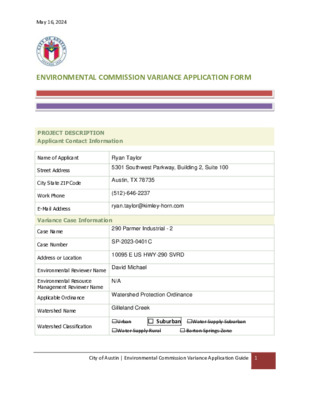
2. in a REGULAR meeting on ENVIRONMENTAL COMMISSION REGULAR CALLED MEETING MINUTES WEDNESDAY, June 5, 2024 The ENVIRONMENTAL COMMISSION convened Wednesday, June 5, 2024, at 6310 Wilhelmina Delco Drive in Austin, Texas. Chair Bedford called the Environmental Commission Meeting to order at 6:01 p.m. Commissioners in Attendance: Perry Bedford, Jennifer Bristol, Richard Brimer, Peter Einhorn, Haris Qureshi, and David Sullivan Commissioners in Attendance Remotely: Colin Nickells and Mariana Krueger Commissioners Absent: Hanna Cofer and Melinda Schiera PUBLIC COMMUNICATION: GENERAL Speakers Santiago Kathy Mitchell APPROVAL OF MINUTES 1. Approve the minutes of the Environmental Commission Regular Meeting on May 15, 2024. The minutes of the Environmental Commission Regular meeting on May 15, 2024, were approved on Commissioner Einhorn’s motion, Commissioner Qureshi’s second on a 7-0 vote. Commissioner Bristol abstained. Commissioners Cofer and Schiera were absent. DISCUSSION AND ACTION ITEMS Discussion and recommendation of Austin Water Capital Improvement Projects located in the Drinking Water Protection Zone for approval to include in the 5-year Capital spending plan as required by Financial Policy #8 – Frida Guo, Financial Manager II, Austin Water The Environmental Commission took a ten-minute recess at 6:16 P.M. Chair Bedford called the meeting to order at 6:26 P.M 1 3. 4. 5. PUBLIC HEARINGS A motion to recommend the approval of the request for inclusion of the CIP projects in Austin Water Utility’s 5-year capital spending budget passes on Commissioner Bristol’s motion, Commissioner Bedford’s second on an 8-0 vote. Commissioners Cofer and Schiera were absent. Presentation, discussion, and recommendation on bird-friendly design and building solutions from Travis Audubon – Heidi Trudell, requested by Commissioner Bristol Speakers Craig Nazor Maura Powers A recommendation regarding bird-friendly design and building solutions approved on Commissioner Bristol’s motion, Commissioner Bedford’s second on an 7-0 vote. Commissioner Nickells abstained. Commissioners Cofer and Schiera were absent. Name: 290 Parmer Industrial – 2, SP-2023-0401C Applicant: Ryan Taylor, Kimley-Horn and Associates, Inc. Location: 10095 E US 290 Hwy Service Road EB Austin, Texas Council District: District 1 Staff: David Michael, Environmental Review Specialist Senior, Development Services Department Applicant request: Variance request is to A) vary from LDC 25-8-341 to allow cut up to 15 feet and B) vary from LDC 25-8-342 to allow fill up to 16 feet. Staff recommendation: Staff recommends approval of the variances with conditions Speakers Ryan Taylor, Civil Engineer, Kimley-Horn A motion to close the public hearing was approved on Commissioner Einhorn’s motion, Commissioner Sullivan’s …
2024 Updates to the Water Conservation and Drought Contingency Plans Environmental Commission – July 3, 2024 Kevin Kluge, Water Conservation Division Manager Agenda Water Supply Conservation & Drought Planning Water Conservation Plan (WCP) Drought Contingency Plan (DCP) Next Steps 2 Austin’s Water Supply Colorado River • Combination of State-granted water rights & long-term contract with LCRA • Up to 325,000 acre- feet per year (afy) LCRA reservation & use fees pre-paid in 1999 • Additional use payments trigger when average for 2 consecutive years exceeds 201,000 afy Centralized Reclaimed System 3 Water Supply Storage Levels 4 Conservation & Drought Planning Texas requires a Water Conservation Plan (WCP) and Drought Contingency Plan (DCP) to be updated every 5 years • Submit to Texas Commission on Environmental Quality (TCEQ) • Texas Water Development Board (TWDB) requires an updated WCP for financing WCP – reduce overall water consumption and improve water use efficiency DCP – water supply drought triggers and response activities 5 Conservation & Drought Planning Water Conservation Plan (WCP) Activities in non-drought and drought conditions Describes • Conservation (rebates, education, enforcement) • Water loss • Reuse Drought Contingency Plan (DCP) Focused on drought conditions Describes drought • Stages (1-3, emergency) • Triggers (demand and supply) • Actions (historically, restrictions) Must be consistent with the LCRA 5- and 10-year goals for Total GPCD, Res. GPCD, and Water Loss DCP Requires Code changes How does this work regionally with our water supply partner? LCRAs Drought Contingency Plan (DCP) Austin DCP must align with LCRAs DCP LCRA recently updated its DCP on March 26, 2024 LCRAs significant updates include: • Adjusting drought trigger levels (From 4 stages to 5 stages) • Adding LCRAs inflow trigger for Drought Stage 2 • Adding specific drought condition water use restrictions 7 Water Conservation Plan Residential Customer Programs Household Material Distribution Residential Irrigation Audits Go Repair! and Plumbing Program Austin Energy All-Star Conservation Kits 8 Water Conservation Plan Residential Incentive Programs 9 Water Conservation Plan Commercial Incentive Programs Bucks for Business • Performance-based: $1 per 1,000 gallons saved over 10 years • Examples: high-efficient fixtures, cooling systems, reusing high quality rinse water • Program resurgence: In Fiscal Year 2024, 18 applications, saving 16.4 million gallons, plus up to 10 more by end of the fiscal …
Landscape Transformation Activities Environmental Commission | July 3, 2024 Kevin Kluge, Water Conser vation Division Manager Why New Water Conservation Measures? Lakes are 50% full Highland Lakes inflow • 2022 - record low • 2023 – 4th lowest El Niño will shift to La Niña Drought Stage 2 restrictions Per-person use has declined but plateaued 2 Landscape Transformation Strategy From traditional landscaping to plants with reduced water needs New single-family residential Potential limits on turf and irrigation Savings goal of 2,490 AF (811 MG) by 2040 3 Public Engagement & Input Public and stakeholder meetings • February, May, June, & November 2022 • August 2023 Smaller stakeholder group meetings Speak Up Austin! page • 2 surveys (256 and 303 responses) • Majority of local responses favored regulating landscape transformation 4 Internal City Stakeholders Watershed Protection Department (WPD) Development Services Department (DSD) Austin Energy (AE) – Green Building Office of Sustainability Equity Office Planning and Housing Department Wildlife Austin (PARD) Austin Fire Department – (Wildland-Urban Interface) 5 Stakeholder Meetings Home Builders Association of Greater Austin (HBA) • Concern about project delays Central Texas Professional Irrigation Association - • Supported increased enforcement • Supported high-efficiency irrigation system components Association of Professional Landscape Architects (CTPIA) (ASLA) Texas Nursery and Landscape Assoc. 6 (TNLA – Region 8) Additional Meetings Other utilities in Texas • New Braunfels • City of Frisco • Model homes with 50% turf reduction • Post-installation inspections (within 1-2 days) • Irrigation check-up • Georgetown • Residential landscape ordinance 7 Steps to Transform Landscapes Build with savings Set customers up for success Encourage alternative water 8 Build with Savings Enhanced Soil Inspections • A minimum of 6 inches of topsoil • Topsoil mix composed of 20% compost • Estimated Water Savings: 10% reduction 9 Required residential plant list • Apply commercial plant requirements to residential • Grow Green Plant Guide as a model Build with Savings Limit irrigation area • Up to 50% of landscape area; front yard or back • Estimated Water Savings: 35% annually per home 10 Set Customers Up for Success Est. Water Savings Potential Cost 22% savings $543 plus labor 10% savings Austin Water inspection 5% savings Austin Water staff time Require pressure reduction devices (new irrigation systems) Require …
Community Investment Budget Fiscal Year 2025 Introductions Who is Equity Action? ● Equity Action is a non-profit (c4) focused on protecting and expanding Austin’s transformative justice efforts. What is the Community Investment Budget? ● In collaboration with dozens of community organizations, Equity Action facilitated a FY2025 Community Investment Budget prevent violence and overdoses, stabilize people and families living on the margins, address crises with appropriate first responders, create opportunity and ensure that the long-awaited Climate Equity Plan and Sustainable Food Plans are implemented starting FY25. History of CIB and other Community-Led Budget Initiatives Austin has a long history of community-based budgeting. ● For many years Communities of Color United organized and advocated for an annual People’s Budget. These community-driven spending priorities centered public health and equity. ● The first Community Investment Budget was FY22-23 and reflected input from the largest coalition ever coordinated to address unmet community needs. After voters rejected a ballot proposal to tie up $120M in additional police, we pressed the city to think about public safety in a new way -- well-maintained parks, housing, youth activities, living wages, an independent forensic lab, public health initiatives to keep people safe from the pandemic and more! ● This year we’re back because mental health first response, substance-related deaths, rehousing and housing stabilization, safe and well maintained parks, and workforce opportunity requires ongoing investment! Community Investment Budget Priorities Fiscal Year 2025 ● Crime survivor support, violence prevention ● Park maintenance, library materials ● Overdose prevention/NARCAN ● Mental health crisis response ● Sheltering/housing the unhoused ● Preventing eviction and stabilizing vulnerable families ● Re-entry assistance with jobs, housing for formerly incarcerated ● Resilience hubs in areas most vulnerable to extreme weather ● Workforce development & opportunity ● New sustainable food plan ● Implement climate equity plan and address water availability/cost Why is the CIB important? While Austin is considered one of the best cities in the country to live in for many people, we still have a long way to go to ensure that it is the best for everyone - regardless of age, race, gender, sexual orientation, immigration status, language and income. The CIB this year details spending priorities for 5.7% of the roughly $1.4 billion General Revenue budget. These funding recommendations address well established community needs, gaps in existing programs and services, and suggest ways to improve the safety and quality of life for Austinites across the city. …
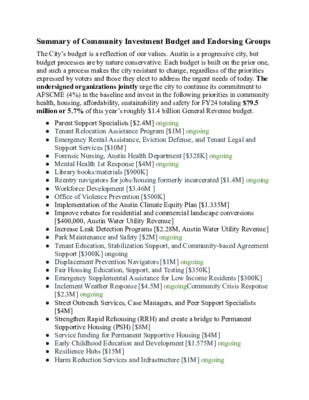
Summary of Community Investment Budget and Endorsing Groups The City’s budget is a reflection of our values. Austin is a progressive city, but budget processes are by nature conservative. Each budget is built on the prior one, and such a process makes the city resistant to change, regardless of the priorities expressed by voters and those they elect to address the urgent needs of today. The undersigned organizations jointly urge the city to continue its commitment to AFSCME (4%) in the baseline and invest in the following priorities in community health, housing, affordability, sustainability and safety for FY24 totaling $79.5 million or 5.7% of this year’s roughly $1.4 billion General Revenue budget. ● Parent Support Specialists [$2.4M] ongoing ● Tenant Relocation Assistance Program [$1M] ongoing ● Emergency Rental Assistance, Eviction Defense, and Tenant Legal and Support Services [$10M] ● Forensic Nursing, Austin Health Department [$328K] ongoing ● Mental Health 1st Response [$4M] ongoing ● Library books/materials [$900K] ● Reentry navigators for jobs/housing formerly incarcerated [$1.4M] ongoing ● Workforce Development [$3.46M ] ● Office of Violence Prevention [$500K] ● Implementation of the Austin Climate Equity Plan [$1.335M] ● Improve rebates for residential and commercial landscape conversions [$400,000, Austin Water Utility Revenue] ● Increase Leak Detection Programs [$2.28M, Austin Water Utility Revenue] ● Park Maintenance and Safety [$2M] ongoing ● Tenant Education, Stabilization Support, and Community-based Agreement Support [$300K] ongoing ● Displacement Prevention Navigators [$1M] ongoing ● Fair Housing Education, Support, and Testing [$350K] ● Emergency Supplemental Assistance for Low Income Residents [$300K] ● Inclement Weather Response [$4.5M] ongoing Community Crisis Response [$2.3M] ongoing [$4M] ● Street Outreach Services, Case Managers, and Peer Support Specialists ● Strengthen Rapid Rehousing (RRH) and create a bridge to Permanent Supportive Housing (PSH) [$8M] ● Service funding for Permanent Supportive Housing [$4M] ● Early Childhood Education and Development [$1.575M] ongoing ● Resilience Hubs [$15M] ● Harm Reduction Services and Infrastructure [$1M] ongoing ● Immigration Legal Services for Low Income Families [$250K] ● Equity Office [$800K] ongoing ● Family Stabilization Grant [$3M] ongoing ● Logistical Support For Austinites Seeking Abortion Care [$250K] ongoing ● Food Sovereignty and Food Systems-Related Funding [$850K] ● East Austin Performing Arts Funding [$850K] ● Austin Community-Owned Food Retail Initiative [$500K] ● Give the Resilience Office a budget [$1M] ongoing TOTAL REQUEST FOR NEW FUNDS: $79.5M (General Fund) $2,680,000 (AWU) Endorsing Organizations Alliance for Safety and Justice American Civil Liberties Union of Tx …
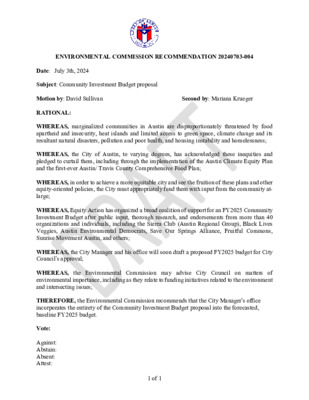
ENVIRONMENTAL COMMISSION RECOMMENDATION 20240703-004 Second by: Mariana Krueger Date: July 3th, 2024 Subject: Community Investment Budget proposal Motion by: David Sullivan RATIONAL: WHEREAS, marginalized communities in Austin are disproportionately threatened by food apartheid and insecurity, heat islands and limited access to green space, climate change and its resultant natural disasters, pollution and poor health, and housing instability and homelessness; WHEREAS, the City of Austin, to varying degrees, has acknowledged these inequities and pledged to curtail them, including through the implementation of the Austin Climate Equity Plan and the first-ever Austin/ Travis County Comprehensive Food Plan; WHEREAS, in order to achieve a more equitable city and see the fruition of these plans and other equity-oriented policies, the City must appropriately fund them with input from the community at- large; WHEREAS, Equity Action has organized a broad coalition of support for an FY2025 Community Investment Budget after public input, thorough research, and endorsements from more than 40 organizations and individuals, including the Sierra Club (Austin Regional Group), Black Lives Veggies, Austin Environmental Democrats, Save Our Springs Alliance, Fruitful Commons, Sunrise Movement Austin, and others; WHEREAS, the City Manager and his office will soon draft a proposed FY2025 budget for City Council’s approval; WHEREAS, the Environmental Commission may advise City Council on matters of environmental importance, including as they relate to funding initiatives related to the environment and intersecting issues; THEREFORE, the Environmental Commission recommends that the City Manager’s office incorporates the entirety of the Community Investment Budget proposal into the forecasted, baseline FY2025 budget. Vote: Against: Abstain: Absent: Attest: 1 of 1
URBAN FORESTRY COMMITTEE RECOMMENDATION 20240627-004 Seconded by: Richard Brimer Date: June 27, 2024 Subject: City of Austin Tree Canopy Ordinance Motion by: Melinda Schiera WHEREAS, the Urban Forestry Committee recognizes Council approved, on August 8, 2019, a Resolution declaring a climate emergency in the City, and WHEREAS, the Council approved, on September 30, 2021, the Austin Climate Equity Plan setting a goal of 50% Tree Canopy by 2050, and WHEREAS, Council re-affirmed its target of net-zero community-wide emissions by 2040 on February 15, 2024, and WHEREAS, current data shows 41% canopy cover city-wide based on satellite imagery captured in the summer of 2022, and WHEREAS, the payment rate to the Urban Forest Replenishment Fund (UFRF) was last set in 2010 and has not been updated since then, and WHEREAS, the tree canopy over East Austin is less than West Austin, and there is a specific need to increase tree canopy on private land in East Austin, and WHEREAS, an expansive Tree Canopy mitigates the heat island effect, removes carbon from the air, improves community health by removing pollutants from the air, and improves biodiversity, and WHEREAS, feedback from Urban Landscape Architects to the Environmental Commission is that trees planted from site plan requirements are not surviving, THEREFORE, the Urban Forestry Committee recommends the Environmental Commission advise Council adopt the following actions to more aggressively expand, protect, and enhance the City’s Tree Canopy: 1. Set a goal of 50% city-wide canopy cover by 2040 instead of 2050 with a particular emphasis on racial equity and and reducing heat island effects in East Austin (that is, land East of I-35 within the city limits). 1 of 3 2. Capture satellite imagery to calculate the city-wide canopy cover biennially instead of every four years and use this data to inform methods for achieving 50% canopy cover by 2040. 3. Require the City Arborist and the Development Services Department to document the number and scope of unpermitted removal of protected and heritage trees removed each year by address and actions taken. A report of these activities shall be presented to the Environmental Commission, Urban Forestry Committee, and Council annually. 4. Add fruit and nut-bearing trees to the list of preferred trees that are appropriate for the Central Texas climate. Bennually update the list of preferred trees to adjust for changing climate. 5. Define a new category of protected trees, based on the breadth of …
ENVIRONMENTAL COMMISSION RECOMMENDATION 20240703-004 Second by: Mariana Krueger Date: July 3rd, 2024 Subject: Community Investment Budget proposal Motion by: David Sullivan RATIONALE: WHEREAS, marginalized communities in Austin are disproportionately threatened by food apartheid and insecurity, heat islands and limited access to green space, climate change and its resultant natural disasters, pollution, and poor health, and housing instability and homelessness; WHEREAS, the City of Austin, to varying degrees, has acknowledged these inequities and pledged to curtail them, including through the implementation of the Austin Climate Equity Plan and the first-ever Austin/ Travis County Comprehensive Food Plan; WHEREAS, in order to achieve a more equitable city and see the fruition of these plans and other equity-oriented policies, the City must appropriately fund them with input from the community- at-large; WHEREAS, Equity Action has organized a broad coalition of support for an FY2025 Community Investment Budget after public input, thorough research, and endorsements from dozens of organizations and individuals, including the Sierra Club (Austin Regional Group), Black Lives Veggies, Save Our Springs Alliance, Fruitful Commons, Rewild ATX, and others; WHEREAS, the City Manager and his office will soon draft a proposed FY2025 budget for City Council’s approval; WHEREAS, the Environmental Commission may advise City Council on matters of environmental importance, including as they relate to funding initiatives related to the environment and intersecting issues; THEREFORE, the Environmental Commission recommends that the City Manager’s office incorporate the entirety of the Community Investment Budget proposal into the forecasted, baseline FY2025 budget. Vote: 8-0 For: Haris Qureshi, Hanna Cofer, Perry Bedford, Melinda Schiera, David Sullivan, Richard Brimer, Mariana Krueger, Peter Einhorn Against: None Abstain: None Absent: Jennifer Bristol, Colin Nickels Attest: 1 of 2 Perry Bedford, Commission Chair 2 of 2
ENVIRONMENTAL COMMISSION REGULAR CALLED MEETING MINUTES WEDNESDAY, July 3, 2024 The ENVIRONMENTAL COMMISSION convened Wednesday, July 3, 2024, at 6310 Wilhelmina Delco Drive in Austin, Texas. Chair Bedford called the Environmental Commission Meeting to order at 6:01 p.m. Commissioners in Attendance: Perry Bedford, Jennifer Bristol, Richard Brimer, Hanna Cofer, Haris Qureshi, Melinda Schiera and David Sullivan Commissioners in Attendance Remotely: Peter Einhorn, Mariana Krueger Commissioners Absent: Colin Nickells PUBLIC COMMUNICATION: GENERAL Speakers Patricia Bobeck, Butler Landfill Kimerly Duda, Exposition School in a REGULAR meeting on APPROVAL OF MINUTES Approve the minutes of the Environmental Commission Regular Meeting on June 5, 2024. The minutes of the Environmental Commission Regular meeting on June 5, 2024, were approved on Commissioner Sullivan’s motion, Commissioner Brimer’s second on a 7-0 vote. Commissioners Cofer and Schiera abstained. Commissioner Nickells was absent. STAFF BRIEFINGS Staff briefing on Austin's Drought Contingency Plan and Water Conservation Plan – Kevin Kluge, Water Conservation Division Manager, Austin Water Speakers: Anna Bryan-Borjas, Austin Water Kevin Kluge, Austin Water Ramesh Swaminathan, Watershed Protection Item conducted as posted. No action taken. 1. 2. 1 3. 4. 5. 6. Staff briefing on updates to single family residential landscape transformation activities – Kevin Kluge, Water Conservation Division Manager, Austin Water Speaker: Kevin Kluge, Austin Water Item conducted as posted. No action taken. DISCUSSION AND ACTION ITEMS Presentation, discussion and recommendation on the Community Investment Budget – Kathy Mitchell, Equity Action. Sponsored by Commissioners Sullivan and Krueger Speakers: Bobby Levenski, Save Our Springs A motion to recommend the Community Investment Budget was approved on Commissioner Sullivan’s motion, Commissioner Krueger’s second, on an 8–0 vote. Commissioner Nickells was absent. Commissioner Bristol was off the dais. COMMITTEE UPDATES Discussion on the draft recommendation from the Urban Forestry Committee on supporting Austin’s tree canopy – Richard Brimer Speakers: Bobby Levenski, Save Our Springs Item conducted as posted. No action taken. Update from the Bird-Friendly Design working group on their first meeting on July 1st – Jennifer Bristol Commissioners Sullivan and Krueger provided an update. No action taken. FUTURE AGENDA ITEMS None ADJOURNMENT Chair Bedford adjourned the meeting at 8:35 P.M. The minutes were approved at the July 17, 2024 meeting on Commissioner Sullivan’s motion, Commissioner Bedford’s second on a 7-0 vote. Commissioners Einhorn and Nickells were absent. Commissioner Qureshi was off the dais. 2
Urban Forestry Committee Meeting June 27th, 2024 at 11:30 AM Permitting And Development Center, Events Center, Room 1401 6310 Wilhelmina Delco Drive Austin, Texas 78752 Some members of the Urban Forestry Committee will be participating by videoconference. Public comment will be allowed in-person or remotely via telephone. Speakers may only register to speak on an item once either in-person or remotely and will be allowed up to three minutes to provide their comments. Registration no later than noon the day before the meeting is required for remote participation by telephone. To register to speak remotely, call or email Elizabeth Funk, Watershed Protection Department, at (512) 568-2244, Elizabeth.Funk@austintexas.gov, no later than noon, the day before the meeting. The following information is required: speaker name, item number(s) they wish to speak on, whether they are for/against/neutral, email address and telephone number (must be the same number that will be used to call into the meeting). CURRENT COMMISSIONERS: Richard Brimer (Committee Chair) Mariana Krueger Colin Nickells Melinda Schiera CALL TO ORDER PUBLIC COMMUNICATION: GENERAL AGENDA The first 5 speakers signed up prior to the meeting being called to order will each be allowed a three-minute allotment to address their concerns regarding items not posted on the agenda. APPROVAL OF MINUTES STAFF BRIEFINGS Services Department 1. Approve the minutes of the Urban Forestry Committee Meeting of March 28, 2024 2. City Arborist Quarterly Report FY24 – Naomi Rotramel, City Arborist, Development 3. Staff briefing on climate adaptation and Austin’s urban forest – Emily King, Urban Forestry, Development Services Department DISCUSSION AND ACTION ITEMS Brimer, Urban Forestry Committee Chair Richard Brimer, Urban Forestry Committee Chair FUTURE AGENDA ITEMS ADJOURNMENT 4. Discussion and recommendation on strategies to improve Austin’s tree canopy – Richard 5. Discussion and recommendation on the 2023-2024 Urban Forestry Annual Report – The City of Austin is committed to compliance with the American with Disabilities Act. Reasonable modifications and equal access to communications will be provided upon request. Meeting locations are planned with wheelchair access. If requiring Sign Language Interpreters or alternative formats, please give notice at least 2 days (48 hours) before the meeting date. Please call Elizabeth 512-568-2244, Elizabeth.Funk@austintexas.gov; for additional information; TTY users route through Relay Texas at 711. Protection Department, Funk, Watershed at
Vulnerability Assessment of Austin’s Urban Forest and Natural Areas J u n e 2 0 24 Vulnerability Assessment What is it Why it matters Dive deeper What is it An assessment that evaluates the vulnerability of urban trees and natural and developed landscapes within the City of Austin to a range of future climates. Vulnerability is… …the susceptibility of a system to the adverse effects of climate change. Vulnerability is a function of potential climate change impacts and the adaptive capacity of the system. Use this space for an engaging chart or images Vulnerability Assessment Highlights: Climate ● Increased temperatures ● Precipitation (droughts and floods) ● Shift to aridification Vulnerability Assessment Highlights: Trees Almost 90% of species are moderately – highly vulnerable 76% of low and moderately vulnerable species are native to our area Why it matters Climate change is here; 6 of the hottest 10 years in Austin were between 2000-2019. Austin has over 33 million trees; our trees will be directly and indirectly impacted by climate change. Extreme heat is a threat to our community. Trees shade and cool. Significant Benefits Dive deeper • Summary of the report here • Full report here • Austin's Climate Equity Plan Emily King Urban Forester Emily.King@AustinTexas.gov facebook.com/NatureCityATX instagram.com/NatureCityATX
Annual Internal Review This report covers the time period of 7/1/2023 to 6/30/2024 Urban Forestry Committeee The Committee mission statement is: May study, investigate, advise, report, and recommend actions, programs, or plans the Committee determines necessary or advisable for the care, preservation, pruning, planting, replanting, removal, or disposition of trees and shrubs and other landscaping in public parks, along streets, and in other public areas. Develop recommendations for urban forest plans for the planting, maintenance, and replacement of trees in parks, along streets, and in other public area, and submit them to the Environmental Commission for review and appropriate action. 1. Describe the board’s actions supporting their mission during the previous calendar year. Address all elements of the board’s mission statement as provided in the relevant sections of the City Code. • Review current tree removal and public complaint processes. • Review and recommend Austin’s tree canopy status and goals for 2050. • Define the term “ghost trees” and how they impact tree canopy management. • Review Heritage Tree administrative varaiance process. • Plan for upcoming year’s activities and goals. • Receive update on tree preservation numbers. • Update Committee on tree preservation incentives in the HOME code amendments. 2. Determine if the board’s actions throughout the year comply with the mission statement. The Committee’s actions throughout the year did comply with the mission of the Urban Forestry Committee. 3. List the board’s goals and objectives for the new calendar year. • Continue to work with City Staff on implementation to meet the City’s goal of 50% canopy cover by the year 2050 and focus on increasing canopy equity. • Move the 50% canopy cover date forward to 2040. Annual Review and Work Plan 2024 Page 2 • Coordinate with Parks and Recreation Department and Parks Board in efforts to improve canopy cover along trails. • Work more closely with non-profits (e.g., Treefolks) to increase the number of trees provided to schools, public parks, and individuals in efforts to reduce the heat island effect in urban areas. • Develop plans with City Staff to encourage developers to increase the use of butterfly gardens, micro-forests to improve biodiversity. Improve documentation of unpermitted tree removals. • • Calculate City of Austin canopy cover biennially. • Require Urban Forestry to double the existing canopy coverage in East Austin (east of Interstate I-35) by 2040. • Adjust the tree mitigation fund to account for …
URBAN FORESTRY COMMITTEE RECOMMENDATION 2024XXXX-00X Date: Subject: City of Austin Tree Canopy Ordinance Motion by: Melinda Schiera Seconded by: WHEREAS, the Urban Forestry Committee recognizes Council approved, on August 8, 2019, a Resolution declaring a climate emergency in the City, and WHEREAS, the Council approved, on September 30, 2021, the Austin Climate Equity Plan setting a goal of 50% Tree Canopy by 2050, and WHEREAS, Council re-affirmed its target of net-zeros community-wide emissions by 2040 on February 15, 2024, and WHEREAS, current data shows 41% canopy cover city wide based on satellite imagery captured in the summer of 2022, and WHEREAS, the tree canopy over East Austin is less than West Austin, and there is a specific need to increase tree canopy on private land in East Austin, and WHEREAS, an expansive Tree Canopy mitigates the heat island effect, removes carbon from the air, improves community health be removing pollutants from the air, and improves biodiversity, and WHEREAS, feedback from Urban Landscape Architects to the Environmental Commission is that trees planted from site plan requirements are not surviving, THEREFORE, the Urban Forestry Committee recommends the Environmental Commission advise Council adopt the following actions to more aggressively expand, protect, and enhance the City’s Tree Canopy: 1. Set a goal of 50% city-wide canopy cover by 2040 instead of 2050. 2. Capture satellite imagery to calculate the city-wide canopy cover biennially instead of every four-years. 3. Require the City Arborist and the Development Services Department to document the number and scope of unpermitted removal of protected and heritage trees removed each year by address and actions taken. A report of these activities shall be presented to the Environmental Commission, Urban Forestry Committee, and Council annually. 1 of 3 4. Add fruit and nut bearing trees to the list of preferred trees that are appropriate for the Central Texas climate. Bennually update the list of preferred trees to adjust for changing climate. 5. Define a new category of protected trees, based on the breadth of the canopy in addition to the diameter as measured four and one-half feet above natural grade. 6. Improve incentive plans for developers to encourage retention of existing trees using non- financial incentives, development considerations, density, increased FAR, etc. 7. Require the Urban Forestry Department develop a plan to double the existing canopy coverage in East Austin (east of Interstate I-35) by 2040. This plan shall be presented to …
1. 2. 3. 4. URBAN FORESTRY COMMITTEE MEETING REGULAR CALLED MEETING MINUTES WEDNESDAY, March 28, 2024 The Urban Forestry Committee convened in a REGULAR meeting on Thursday, March 28, 2024, at 6310 Wilhelmina Delco Drive in Austin, Texas. Chair Brimer called the Urban Forestry Committee Meeting to order at 10:02 a.m. Commissioners in Attendance: Richard Brimer Commissioners in Attendance Remotely: Mariana Krueger, Melinda Schiera Commissioners Absent: Colin Nickells PUBLIC COMMUNICATION: GENERAL None APPROVAL OF MINUTES Approve the minutes of the Urban Forestry Committee Meeting of October 12, 2023 The minutes from the regular meeting on October 12th, 2023 were approved on Commissioner Schiera’s motion, Commissioner Krueger’s second on a 3–0 vote. Commissioner Nickells was absent. STAFF BRIEFINGS Staff briefing heritage tree administrative variance procedures – Jim Dymkowski, Division Manager, Community Tree Preservation, Development Services Department Item conducted as posted. No action taken. Staff briefing on overall tree preservation numbers – Jim Dymkowski, Urban Forestry, Development Services Department Item conducted as posted. No action taken. Staff update on drafted tree preservation incentives in HOME code amendments – Jim Dymkowski, Urban Forestry, Development Services Department Emily King, Urban Forestry, Development Services Department Speakers: Bobby Levenski, Save our Springs Alliance (speaking on items 4 and 5) Item conducted as posted. No action taken. DISCUSSION ITEMS 5. Discuss ghost trees and how they are addressed in the current heritage tree ordinance– Richard Brimer Speakers: Bobby Levenski, Save our Springs Alliance Item conducted as posted. No action was taken. 6. Discuss Committee goals for the upcoming year – Mariana Krueger Speakers: Commissioner Krueger, on increasing food forests and native planting corridors Commissioner Schiera, on the growth of tree canopy and increasing tree review after planting Commissioner Brimer, on actionable items to protect tree canopy and incentives on compliance with existing regulations Item conducted as posted. No action taken. FUTURE AGENDA ITEMS Commissioner Schiera requested to meet to determine high-level priorities and action items for the committee. Commissioner Schiera requested making a recommendation to Council on increasing the inspections of trees after plantings Commissioner Krueger requested an agenda item to create package of recommendations to support food forests and community gardens at the Environmental Commission. Chair Brimer adjourned the meeting at 12 p.m. without objection.
City Arborist Program Tree Report Environmental Commission Urban Forestry Subcommittee Meeting June 27, 2024 Naomi Rotramel, City Arborist City Arborist Program Tree Report: Preservation City Arborist Program Tree Report: Inches Replanted for Mitigation City Arborist Program Tree Report: Dead, Diseased, Imminent Hazard Removals (Site Plan and stand-alone Tree Permit only)
City Arborist Program Tree Report Environmental Commission Urban Forestry Subcommittee Meeting June 27th, 2024 Naomi Rotramel, City Arborist 1 City Arborist Program Tree Report: Preservation City Arborist Program Tree Report: Inches Replanted for Mitigation City Arborist Program Tree Report: Dead, Diseased, Imminent Hazard Removals (Site Plan and stand-alone Tree Permit only) 5
Regular Meeting of the Environmental Commission June 5, 2024 at 6:00 PM Permitting And Development Center, Events Center, Room 1405 6310 Wilhelmina Delco Drive Austin, Texas 78752 Some members of the Environmental Commission will be participating by videoconference. The meeting may be viewed online at: http://www.austintexas.gov/page/watch-atxn-live Public comment will be allowed in-person or remotely via telephone. Speakers may only register to speak on an item once either in-person or remotely and will be allowed up to three minutes to provide their comments. Registration no later than noon the day before the meeting is required for remote participation by telephone. To register to speak remotely, call or email Kaela Champlin, Watershed Protection Department, at (737) 230-3786, Kaela.Champlin@austintexas.gov no later than noon, the day before the meeting. The following information is required: speaker name, item number(s) they wish to speak on, whether they are for/against/neutral, email address and telephone number (must be the same number that will be used to call into the meeting). Colin Nickells Jennifer Bristol, Secretary David Sullivan Richard Brimer Perry Bedford, Chair CURRENT COMMISSIONERS: Haris Qureshi Peter Einhorn Mariana Krueger Melinda Schiera Hanna Cofer, Vice Chair AGENDA CALL TO ORDER PUBLIC COMMUNICATION: GENERAL The first 10 speakers signed up prior to the meeting being called to order will each be allowed a three-minute allotment to address their concerns regarding items not posted on the agenda. 1 APPROVAL OF MINUTES DISCUSSION AND ACTION ITEMS Approve the minutes of the Environmental Commission Regular Meeting on May 15, 2024. Discussion and recommendation of Austin Water Capital Improvement Projects located in the Drinking Water Protection Zone for approval to include in the 5-year Capital spending plan as required by Financial Policy #8 – Frida Guo, Financial Manager II, Austin Water Presentation, discussion, and recommendation on bird-friendly design and building solutions from Travis Audubon – Heidi Trudell, requested by Commissioner Bristol PUBLIC HEARINGS Name: 290 Parmer Industrial – 2, SP-2023-0401C Applicant: Ryan Taylor, Kimley-Horn and Associates, Inc. Location: 10095 E US 290 Hwy Service Road EB Austin, Texas Council District: District 1 Staff: David Michael, Environmental Review Specialist Senior, Development Services Department Applicant request: Variance request is to A) vary from LDC 25-8-341 to allow cut up to 15 feet and B) vary from LDC 25-8-342 to allow fill up to 16 feet. Staff recommendation: Staff recommends approval of the variances with conditions Name: Stassney Park, SPC-2023-0110C Applicant: Nick Brown / Kimley-Horn Location: …
in a REGULAR meeting on ENVIRONMENTAL COMMISSION REGULAR CALLED MEETING MINUTES WEDNESDAY, May 15, 2024 The ENVIRONMENTAL COMMISSION convened Wednesday, May 15, 2024, at 6310 Wilhelmina Delco Drive in Austin, Texas. Vice Chair Bedford called the Environmental Commission Meeting to order at 6:00 p.m. Commissioners in Attendance: Perry Bedford, Richard Brimer, Hanna Cofer, Peter Einhorn, Mariana Krueger, Haris Qureshi, and David Sullivan Commissioners in Attendance Remotely: Colin Nickells, Melinda Schiera, and David Sullivan Commissioners Absent: Jennifer Bristol PUBLIC COMMUNICATION: GENERAL None APPROVAL OF MINUTES 1. Approve the minutes of the Environmental Commission Regular Meeting on May 5, 2024. The minutes of the Environmental Commission Regular meeting on May 5, 2024, were approved on Commissioner Brimer’s motion, Commissioner Krueger’s second on a 9-0 vote. Commissioner Bristol was absent. STAFF BRIEFINGS 2. Update on the 2023 State of the Environment Report and 2023 Watershed Protection Annual Report – Liz Johnston, Interim Environmental Officer, and Anupa Gharpurey, Assistant Director, Watershed Protection Department Speakers: Liz Johnston Anupa Gharpurey Jorge Morales Kaela Champlin Ramesh Swaminathan 1 4. PUBLIC HEARINGS 3. Chair Bedford called for a recess at 6:27. Chair Bedford reconvened the meeting at 6:37. Item conducted as posted. No action was taken. Name: 3 Men Movers, SP-2023-0294C Applicant: Hollis Scheffler – Westwood Professional Services Location: 9989 E US 290 Hwy Service Road EB, Austin, TX 78744 Council District: District 1 Staff: Ryan Soutter, Environmental Review Specialist Senior, Development Services Department Applicant request: Request to vary from a) LDC 25-8-301 to allow driveway construction on slopes greater than 15%; b) LDC 25-8-302 to allow building and parking construction on slopes over 15%; c) LDC 25-8-341 to allow cut up to 12 feet; and d) LDC 25-8-342 to allow fill up to 15 feet. Staff recommendation: Staff recommends approval of the variances with conditions Speakers: Ryan Soutter Justin Lange Liz Johnston Mike McDougal A motion to close the public hearing passed on Commissioner Einhorn’s motion, Commissioner Brimer’s second on a 9–0 vote. Commissioner Bristol was absent. A motion to approve the requested variances with conditions passed on Commissioner Bedford’s motion, Commissioner Qureshi’s second on an 8–0 vote. Commissioner Brimer abstained. Commissioner Bristol was absent. Name: Sunfield PUD Amendment #1; Case No. C814-2014-0083.01 Applicant: Katherine P. Loayza, Jackson Walker L.L.P. Location: 1901 Turnersville Road Council District: District 5 Staff: Leslie Lilly, Environmental Conservation Program Manager, Watershed Protection Department Applicant request: To amend a Planned Unit Development (PUD) …
Memorandum To: Boards and Commissions From: Shay Ralls Roalson, Director, Austin Water Date: March 30, 2024 Subject: Board and Commission and Citizen Review of new Growth-related Capital Improvement Projects in Drinking Water Protection Zone The Austin City Council approved an amendment to Austin Water’s (AW) Financial Policy No. 8 to provide for enhanced Board and Commission and citizen reviews of AW’s new growth-related capital improvement projects (CIP) located in the Drinking Water Protection Zone (DWPZ). The previous ordinance (No. 20130117-017) took effect on January 28, 2013 and on August 11, 2021 ordinance (No. 20210811-001) amended the DWPZ financial policy. AW is presenting the new growth-related projects to Boards and Commissions as set forth in the ordinance. The revised Financial Policy No. 8 reads as follows: Capital improvement projects for new water and wastewater treatment plants, capital expansions, and growth-related projects that are located in the Drinking Water Protection Zone (DWPZ) will be identified and submitted, as part of the annual budget process, to the following Boards and Commissions: Water and Wastewater Commission, Resource Management Commission, and the Environmental Board. These Boards and Commissions will review growth-related DWPZ capital projects spending plans, obtain Board and Commission and citizen input, review consistency with Imagine Austin Comprehensive Plan, review effect on growth within the DWPZ, and make recommendations on project approval for inclusion in Austin Water's five-year capital spending plan. This summer, AW representatives will be distributing a brief report to the Commissions on the CIP projects located in the DWPZ related to the financial policy. Attachments: CIP Subprojects Summary CIP Subprojects Supplemental Information and Map The City of Austin is committed to compliance with the Americans with Disabilities Act. Reasonable modifications and equal access to communications will be provided upon request. Austin Water Infrastructure Management Financial Policy No. 8 Drinking Water Protection Zone Projects Summary FY25-29 CIP Plan Development Each year, as part of the City of Austin Budget approval process, Austin Water submits a plan for the capital improvements program (CIP) spending for the upcoming five-year period. Austin Water’s FY25-29 CIP Plan includes projects located across the Austin metropolitan area, including the Drinking Water Protection Zone (DWPZ). In compliance with Austin Water’s Financial Policy No. 8, the capital improvement projects for new water and wastewater treatment plants, capital expansions, and growth related projects that are located in the DWPZ are presented below for consideration by City of Austin Boards and Commissions. …
June 5, 2024 Environmental Commission The Travis Audubon Society requested this report on bird safe buildings for presentation to the City of Austin and general dissemination within the Central Texas community. It was submitted to the South Central Waterfront Advisory Board on March 18, 2024, the Design Commission on April 22, 2024, and was prepared by Heidi Trudell, a bird collision prevention researcher and consultant, who in March 2024 was hired as a technical advisor by Guardian Glass. Passing directly over Austin, North America’s Central Flyway serves as the primary migration corridor1 during spring and fall for hundreds of species of birds. Due to this geographic funneling, Texas is home to three of the top ten most deadly cities for birds2 (Houston, Dallas, San Antonio), making it especially critical to proactively preserve biodiversity. Travis County alone has documented 4273 species of birds, which is more than fourteen states4 have recorded. With bird populations in steep decline,5 and an estimated 621 million to 2 billion6 birds dying at windows in the US annually, it is critical now more than ever that municipal leaders, especially in ecologically significant areas like Austin, step forward to reverse the trend. Initial steps have already been taken; Austin’s dedication to bird conservation has already been established by committing to meet the standards of a Bird City.7 This includes a pledge to reduce nonessential lighting during migration8 that comes as part of a statewide initiative9 to address the detrimental impact that artificial light at night has on migrating birds. As Austinites are well aware, however, it’s not just birds that need dark skies to thrive; even outside of bird migration, bats are especially sensitive to lighting.10 1allaboutbirds.org/news/heres-how-to-use-the-new-migration-forecast-tools-from-birdcast/# 2news.cornell.edu/stories/2019/04/chicago-tops-list-most-dangerous-cities-migrating-birds 3ebird.org/region/US-TX-453?yr=all 4ebird.org/region/US/regions 53billionbirds.org 6meridian.allenpress.com/wjo/article-abstract/125/2/406/129654/Evaluating-the-Effectiveness-of-Select-Visual/ 7austintexas.gov/news/austin-now-designated-bird-city-working-protect-habitats-and-promote-bird-friendly-practices 8traviscountytx.gov/news/2021/2113-lights-out-for-migrating-birds 9tx.audubon.org/urbanconservation/lights-out-texas 10batcon.org/new-paper-suggests-light-pollution-limits-bat-habitat/ The next step is to address the built environment directly. Glass is a dynamic material; it can reflect habitat or be entirely transparent. As a result, birds are unable to see glass11 unless it is modified. Poorly designed buildings dramatically increase the risk of collision. One way to significantly improve the odds of survival for birds living in or migrating through Central Texas is to ensure that buildings meet bird safe standards.12 Every building that is made bird safe - as new construction or a retrofit - will save dozens to hundreds of birds13 per building, per year. Best practices in bird safe building standards align with Austin’s values14 of being …
May 16, 2024 ENVIRONMENTAL COMMISSION VARIANCE APPLICATION FORM 5301 Southwest Parkway, Building 2, Suite 100 PROJECT DESCRIPTION Applicant Contact Information Name of Applicant Ryan Taylor Street Address City State ZIP Code Work Phone E-Mail Address Case Name Case Number Variance Case Information Austin, TX 78735 (512)-646-2237 ryan.taylor@kimley-horn.com 290 Parmer Industrial - 2 SP-2023-0401C Address or Location 10095 E US HWY-290 SVRD Environmental Reviewer Name David Michael Environmental Resource Management Reviewer Name N/A Applicable Ordinance Watershed Name Watershed Classification Watershed Protection Ordinance Gilleland Creek ☐Urban ☐ Suburban ☐Water Supply Suburban ☐Water Supply Rural ☐ Barton Springs Zone City of Austin | Environmental Commission Variance Application Guide 1 May 16, 2024 Edwards Aquifer Recharge Zone ☐ Barton Springs Segment ☐ Northern Edwards Segment ☐ Not in Edwards Aquifer Zones Edwards Aquifer Contributing Zone ☐ Yes ☐ No Distance to Nearest Classified Waterway 373’ Water and Wastewater service to be provided by City of Austin The variance request is as follows: Request 25-8-341 - to allow cut exceeding eight (8) feet on Lot 3 of this development. This lot proposes 62,889 square feet of cut over 8 feet with a maximum depth of 15 feet. Impervious cover Existing Existing Proposed Proposed Overall Lot 3 Overall Lot 3 square footage: ____0____ _0____ 1,525,471 682,585 acreage: percentage: ____0____ __0____ 35.02 15.67 ____0____ __0____ 54.7 72.3 Provide general description of the property (slope range, elevation range, summary of vegetation / trees, summary of the geology, CWQZ, WQTZ, CEFs, floodplain, heritage trees, any other notable or outstanding characteristics of the property) The overall 290 Parmer Industrial development is a 64.04 Acre industrial warehouse development located at 10095 E US 290 SVRD EB, Austin, Texas 78653. The 290 Parmer Industrial – 2 site is Lot 3 (21.67 acres) of this development. The existing site is currently undeveloped. Elevation on the site varies from 583 at the Southwest corner down to 511 at the Northeast corner. The existing site has small trees and vegetation, particularly in the Critical Water Quality Zone; but does not include any heritage trees. Approximately 7.80 Acres of the property is in a Critical Water Quality zone and 3.47 Acres of the property is in the 100-year floodplain. City of Austin | Environmental Commission Variance Application Guide 2 May 16, 2024 Clearly indicate in what way the proposed project does not comply with current Code (include maps and exhibits) FINDINGS OF FACT The proposed site …
290 PARMER INDUSTRIAL - 2 10095 E US 290 HWY SP-2023-0401C David Michael Environmental Review Specialist Senior Development Services Department PROPERTY DATA • Gilleland Creek Watershed • Suburban Watershed Classification, Desired Development Zone • Austin Full Purpose • Council District 1 • Not located over Edwards Aquifer Recharge Zone LOCATION Site Location Austin ETJ Austin City Limits Edwards Aquifer Recharge Zone Edwards Aquifer Contributing Zone LOCATION LOCATION View from south looking west View from south looking north LOCATION 2 ft elevation contour lines Critical Water Quality Zones VARIANCE REQUESTS 1. Request to vary LDC 25-8-341 to allow cut up to 15 feet. 2. Request to vary LDC 25-8-342 to allow fill up to 16 feet. GRADING VARIANCE FINDINGS IN SUMMARY • Variances for grading have been granted for similar projects. • Grading is a design decision, but the project provides greater environmental protection with increased landscaping. • The project does not create a significant probability of harmful environmental consequences. • The variance will result in water quality that is at least equal to the water quality achievable without the variance. STAFF DETERMINATION AND CONDITIONS The required landscape plan will be supplemented with the establishment of managed native wildflower meadows on the graded slopes, an increase in the amount of tree canopy and other vegetative cover, and larger tree sizes planted. • +14,000 sq. ft. wildflower seeding & management area • 50 additional shade trees • +250 additional shade tree inches (larger sizes) • +150 additional small tree inches (larger sizes) APPLICANT PRESENTATION