
REGULAR MEETING OF THE ENVIRONMENTAL COMMISSION WEDNESDAY, APRIL 15, 2026, AT 6:00 P.M. PERMITTING AND DEVELOPMENT CENTER, ROOM 1405 6310 WILHELMINA DELCO DRIVE AUSTIN, TEXAS Some members of the Environmental Commission may be participating by videoconference. The meeting may be viewed online at: http://www.austintexas.gov/page/watch-atxn-live Public comment will be allowed in-person or remotely via telephone. Speakers may only register to speak on an item once either in-person or remotely and will be allowed up to three minutes to provide their comments. Registration no later than noon the day before the meeting is required for remote participation by telephone. To register to speak remotely, contact Nicole Corona, 512-974-3146, Nicole.Corona@austintexas.gov. CURRENT COMMISSIONERS: Mariana Krueger, Chair Jennifer Bristol, Vice Chair Haris Qureshi, Secretary Richard Brimer Isabella Changsut Annie Fierro AGENDA CALL TO ORDER PUBLIC COMMUNICATION: GENERAL Justin Fleury Martin Luecke Mar Moretta-Urdiales Allison Morrison David Sullivan The first ten speakers signed up prior to the meeting being called to order will each be allowed a three-minute allotment to address their concerns regarding items not posted on the agenda. APPROVAL OF MINUTES 1. Approve the minutes of the Environmental Commission Regular Meeting on April 1, 2026. PUBLIC HEARINGS 2. Presentation, discussion, and recommendation to amend City Code Title 25 (Land Development) and amend Ordinance No. 20221115-048 to modify development review processes, methods to demonstrate water quality compliance, street design, and utility infrastructure design for the design and construction of certain transit system projects and related transit system infrastructure. Presented by Donna Galati, Capital Program Consultant, Austin Project Connect, donna.galati@austintexas.gov, 512-974-2733. DISCUSSION AND ACTION ITEMS 3. Approve a recommendation to Council regarding the Final Draft of the Rain to River Strategic Plan. Presented by Jorge Morales, Director, Austin Watershed Protection. WORKING GROUP UPDATES 4. Update from the Bird-Friendly Design Working Group regarding the meeting on April 10, 2026. FUTURE AGENDA ITEMS ADJOURNMENT The City of Austin is committed to compliance with the Americans with Disabilities Act. Reasonable modifications and equal access to communications will be provided upon request. For assistance, please contact the Liaison or TTY users’ route through 711. A person may request language access accommodations no later than 48 hours before the scheduled meeting. Please call or email Nicole Corona at Austin Watershed Protection, at 512-974-3146, Nicole.Corona@austintexas.gov to request service or for additional information. For more information on the Environmental Commission, please contact Nicole Corona at 512- 974-3146, Nicole.Corona@austintexas.gov.

ENVIRONMENTAL COMMISSION MINUTES REGULAR MEETING WEDNESDAY, APRIL 1, 2026 The Environmental Commission convened in a regular meeting on Wednesday, April 1, 2026, at the Permitting and Development Center, Room 1405, located at 6310 Wilhelmina Delco Drive in Austin, Texas. Vice Chair Krueger called the Environmental Commission Meeting to order at 6:00 p.m. Commissioners in Attendance: Mariana Krueger, Vice Chair Haris Qureshi, Secretary Richard Brimer Isabella Changsut Annie Fierro Justin Fleury Martin Luecke Mar Moretta-Urdiales Allison Morrison David Sullivan Commissioners in Attendance Remotely: Jennifer Bristol, Chair PUBLIC COMMUNICATION: GENERAL Corbin Graham, Landfill leachate leakage in Walnut Creek watershed Roy Waley, Elon Musk’s data centers APPROVAL OF MINUTES 1. Approve the minutes of the Environmental Commission Regular Meeting on March 4, 2026. The minutes from the Environmental Commission Regular Meeting on March 4, 2026, were approved on Commissioner Sullivan’s motion, Commissioner Brimer’s second, on a 10-0 vote. Chair Bristol was off the dais. 1 PUBLIC HEARINGS 2. Name: 1404 East Riverside PUD, C814-2025-0111 Applicant: Amanda Swor, Drenner Group Location: 1404 East Riverside Drive Council District: 3 Staff: Sean Watson, Environmental Program Coordinator, Austin Watershed Protection, 512- 963-2167, Sean.Watson@austintexas.gov Applicant Request: The applicant proposes a new Planned Unit Development (PUD) Staff Recommendation: Recommended with conditions The meeting was recessed at 6:38 p.m. until 6:47 p.m. without objection. The public hearing was conducted, and a motion to close the public hearing was approved on Commissioner Sullivan’s motion, Commissioner Brimer’s second, on an 11-0 vote. The motion to recommend the project 1404 East Riverside PUD, C814-2025-0111, located at 1404 East Riverside Drive, to Council with conditions and the following amendments was approved on Secretary Qureshi’s motion, Commissioner Brimer’s second on an 11-0 vote. The following amendment was made by Commissioner Fleury and seconded by Chair Bristol. The amendment was to revise the condition “Of the existing parking on site, reserve at least ten parking spaces, including ADA-compliant parking, on the ground level garage floor for public parking and park access” to read: “Of the existing parking on site, reconsider reserving some parking spaces, including ADA- compliant parking, on the ground level garage floor for public parking and park access.” The amendment was approved on a 10-1 vote. Commissioner Brimer voted nay. The following amendment was made by Chair Bristol. The amendment was to remove the condition of maximum allowable height of 120 feet. The amendment was approved on an 11-0 vote without objection. 3. Name: …

ITEM FOR ENVIRONMENTAL COMMISSION AGENDA COMMISSION MEETING DATE: April 15, 2026 NAME & NUMBER OF PROJECT: C20-2026-003 Transit System Projects Ordinance Amendment Sponsor Department: Austin Project Connect City Staff: Donna Galati, Capital Program Consultant, Austin Project Connect, donna.galati@austintexas.gov, 512-974-2733 Description: Amend the 2022 Transit System Projects Ordinance to add additional streamlining elements with a focus on project-specific technical regulation. Background: On October 29, 2021, Council approved Ordinance No. 20211029-003 directing staff to review City Code, criteria manuals, and permitting procedures to identify impediments to the design, construction, implementation, and operation of Project Connect to add streamlining elements with a focus on project-specific technical regulation. The foundational ordinance for Transit System Projects, Ordinance. No. 20221115-048, was approved by Council on November 15, 2022. The Transit System Projects foundational ordinance created a central location for transit- specific regulations, expanded permitting options, clarified uses, and provided a programmatic approach to construction noise mitigation. Summary of Proposed Code Amendment: 1. Modifies site plan requirements to accommodate permitting tools for the light rail permitting process. 2. Recission of obsolete utility ordinance from 2000. 3. Establishes back-of-curb streetscape standards for light rail. 4. Establishes a water quality compliance program for light rail. 5. Establishes administrative review of heritage trees for Transit System Projects. 6. Incorporates administrative rule modifications that proactively address constrained right of way conditions where compliance will be challenging and ensures consistency in expiration of site plan components. Proposed Text Amendment(s): See attached draft ordinance. Staff Recommendation: Recommended Staff supports the proposed amendments to Ordinance No. 20221115-048. The amendments will further support Resolution No. 20211029-003, which directed staff to review City Code, criteria manuals, and permitting procedures to identify impediments to the design, construction, implementation, and operation of Project Connect to add streamlining elements with a focus on project-specific technical regulation. Board and Commission Action: April 15, 2026 – To be considered by the Codes and Ordinances Joint Committee. April 15, 2026 – To be considered by the Environmental Commission. April 28, 2026 – Tentatively scheduled for consideration by the Planning Commission. May 21, 2026 – Tentatively scheduled for City Council action.

WORKING DRAFT FOR AMENDMENT TO PROJECT CONNECT ORDINANCE SUBJECT TO ADDITIONAL LANGUAGE CHANGES PART 1. On November 15, 2022, City Council adopted Ordinance No. 20221115-048 (the “Original Ordinance”), approving the Transit System Project Regulations to facilitate the construction of Project Connect (“Project”), the City’s high-capacity transit system expansion. PART 2. The attached exhibits are incorporated into this ordinance in their entirety as though set fully in the text of this ordinance. The exhibits are as follows: Exhibit A and A-1: Transit System Project Map Exhibit C: Preliminary Water Quality Treatment Map PART 3. This ordinance and the attached exhibits amend the Original Ordinance as amended for the Transit System Project Regulations, modifying conditions and replacing any likewise named or identified exhibits in the Original Ordinance as amended. Development of and uses for the Transit System Project shall conform to the limitations and conditions set forth in this ordinance and in the attached exhibits. If this ordinance and the attached exhibits conflict, this ordinance controls. Except as otherwise specifically provided by this ordinance, all other rules, regulations and ordinances of the City of Austin (“City”) apply to a Transit System Project. PART 4. This ordinance repeals Ordinance No. 000309-114. PART 5. Code Modifications. The following code modifications apply to a Transit System Project. (A) General Requirements and Procedures (1) City Code Section 25-1-21(108) (Definitions, Site) is modified to provide that a site can be a noncontiguous area and may cross a public street or right-of-way. (2) The Director of Austin Development Services may allow development to be reviewed and approved in multiple layers within one overall site plan. (B) Transportation (1) City Code Section 25-6-171 (Standards for Design and Construction) is modified to allow Project Connect Design Criteria to supersede any conflicting requirements in Chapter 25-6 (Transportation), subject to final approval by the City Traffic Engineer or Director of Austin Transportation and Public Works. (2) Notwithstanding any provision in Title 25 (Land Development) excluding Chapter 25- 2 (Zoning), the planting of street trees in the right-of-way shall follow the criteria of this subsection. WORKING DRAFT FOR AMENDMENT TO PROJECT CONNECT ORDINANCE SUBJECT TO ADDITIONAL LANGUAGE CHANGES (a) Street trees planted in the right-of-way can have a horizontal clearance from the outer edge of the root barrier to the outer edge of an existing storm drain that is running parallel to the light rail alignment of: (i) five feet; or (ii) three …
2 3 4 Final Environmental Impact Statement/ Record of Decision (FEIS/ROD) The Final Environmental Impact Statement includes: • Responses to each individual public comment received on the Draft Environmental Impact Statement • Design updates in response to community feedback • Analysis of environmental effects and commitments to address potential project impacts • Mitigation Monitoring Plan documenting measures that reduce or avoid potential adverse impacts, noting implementation and monitoring practices The Record of Decision: • Enables us to proceed into the next phase of project work The FEIS/ROD will conclude our NEPA compliance and affirm the preferred project 5 LRT Contractor Preconstruction Overview Pre-Construction Activities 2026 Preconstruction (1A): Design Progression & Construction Planning 2027 2028 … 2/18/2026 Board Authorization Preconstruction (1B): Final Design & Permitting Board Authorization to finish final design Construction Packages Board Authorization for Construction Packages Preconstruction (1A): Design Progression & Construction Planning • Advance design and initiate permitting • Field work and utility coordination Preconstruction (1B): Final Design & Permitting • Advance design and refine construction cost estimates to execute construction packages (may be staggered) • Constructability reviews, innovation, and integrated cost estimating • Advance Right-of-Way acquisition activities • Obtain Third Party approvals and permits • Planning for construction: phasing, sequencing, and schedule • Engage community in design and construction planning • Prepare for FTA requirements 7 Transit System Projects Ordinance Amendment Austin Project Connect | April 15, 2026 Transit System Projects Ordinance Response to: Resolution No. 20211029-003 which directed staff to: • Review City Code, criteria manuals, and permitting procedures to identify impediments to the design, construction, implementation, and operation of Project Connect • Develop new regulations and procedures to address those impediments Foundational ordinance approved by Council on Nov. 15, 2022 Established home for Transit System Project regulations Modified permitting tools to accommodate Austin Light Rail Anticipated additional impediments would be identified as project progressed Amendments address these issues and support the project as it enters final design 9 Components of this Ordinance 1. Site Plan Modification 2. Removal of Outdated Utility Policy 3. Austin Light Rail Streetscape Standards 4. Austin Light Rail Water Quality Compliance Program 5. Administrative Review of Heritage Trees 6. Administrative Rule Modifications 10 1. Site Plan Modifications To facilitate the permitting process for Austin Light Rail, site plans will be allowed to have non-contiguous limits of construction (LOC). Refresher: Site Plan Layers Tool …
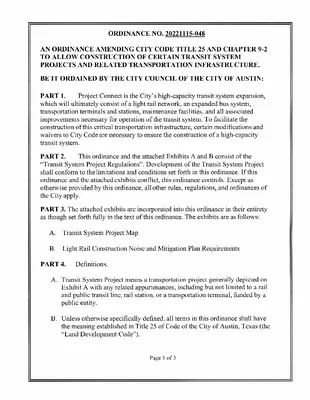
ORDINANCE NO. 20221115-048 AN ORDINANCE AMENDING CITY CODE TITLE 25 AND CHAPTER 9-2 TO ALLOW CONSTRUCTION OF CERTAIN TRANSIT SYSTEM PROJECTS AND RELATED TRANSPORTATION INFRASTRUCTURE. BE IT ORDAINED BY THE CITY COUNCIL OF THE CITY OF AUSTIN: Project Connect is the City's high-capacity transit system expansion, PART 1. which will ultimately consist of a light rail network, an expanded bus system, transportation terminals and stations, maintenance facilities, and all associated improvements necessary for operation of the transit system. To facilitate the construction ofthis critical transportation infrastructure, certain modifications and waivers to City Code are necessary to ensure the construction of a high-capacity transit system. This ordinance and the attached Exhibits A and B consist of the PART 2. "Transit System Project Regulations". Development ofthe Transit System Project shall conform to the limitations and conditions set forth in this ordinance. If this ordinance and the attached exhibits conflict, this ordinance controls. Except as otherwise provided by this ordinance, all other rules, regulations, and ordinances of the City apply. PART 3. The attached exhibits are incorporated into this ordinance in their entirety as though set forth fully in the text of this ordinance. The exhibits are as follows: A. Transit System Project Map B. Light Rail Construction Noise and Mitigation Plan Requirements PART 4. Definitions. A. Transit System Project means a transportation project generally depicted on Exhibit A with any related appurtenances, including but not limited to a rail and public transit line, rail station, or a transportation terminal, funded by a public entity. B. Unless otherwise specifically defined, all terms in this ordinance shall have the meaning established in Title 25 of Code of the City of Austin, Texas (the .,Land Development Code"). Page 1 0f 3 A Transit System Project for light rail lines or any associated PART 5. infrastructure necessary to construct the light rail lines must comply with a noise and mitigation plan approved by the City that meets the requirements listed in Exhibit B. To the extent there is a conflict with Chapter 9-2 (Noise and Amplified Soundj, the approved noise and mitigation Plan will control. PART 6. Transit System Uses A. The use of a site for a traction powered substation is a Local Utility Service use as described in City Code Section 25-2-6(28). B. The use of a site for the provision of maintenance, repair, vehicular or equipment servicing, material storage, or similar activities for …
A STRATEGIC PLAN TO PROTECT AUSTIN’S CREEKS AND COMMUNITIES City of Austin | Austin Watershed Protection FINAL DRAFT 2026 A Strategic Plan to Protect Austin’s Creeks & Communities LAND ACKNOWLEDGMENT As we introduce the Rain to River Strategic Plan, we ground our work in the recognition that every watershed has a story – one that began long before Austin was a city. By sharing this land acknowledgment, we hope to honor the Indigenous peoples who have cared for these lands and waters for generations while acknowledging the harms that persist today. We acknowledge, with respect, that the land we are on is the traditional and ancestral homelands of the Tonkawa, the Apache, the Ysleta del Sur Pueblo, the Lipan Apache Tribe, the Texas Band of Yaqui Indians, the Coahuitlecan and all other tribes not explicitly stated. Additionally, we would like to acknowledge and pay respects to the Alabama-Coushatta Tribe of Texas, the Kickapoo Tribe of Texas, Carrizo & Comecrudo, Tigua Pueblo, Caddo, Comanche, Kiowa, Wichita, Chickasaw, Waco nations, and all the American Indian and Indigenous Peoples and communities who have been or have become a part of these lands and territories in Texas, here on Turtle Island. Not all indigenous peoples listed claim Texas as ancestral lands, as many were forcibly relocated to Texas from their ancestral homelands. Though our work is just beginning, the vision and values in this strategic plan call us to care for our watersheds with humility, gratitude, and a deep sense of responsibility for generations to come. This shared purpose is reflected in the plan’s commitments and strategies, which prioritize equity, resilience, and collaborative stewardship. In adopting this new plan, we affirm our responsibility to learn from the land, repair relationships, and build trust as we work toward a future where watershed protection and cultural respect go hand in hand. 1 The clear, flowing water of Barton Creek at Sculpture Falls Scientist evaluating a wetland along Gilleland Creek Crew repairing a tributary of Tannehill Branch Creek Youth educator exploring a cave in the Edwards Aquifer Engineer assessing erosion on a tributary of Walnut Creek WELCOME LETTER I’m pleased to introduce Rain to River, the updated strategic plan for Austin Watershed Protection. This plan represents more than a set of strategies – it reflects a shift in how we approach our work, our partnerships, and our long-term responsibilities to the people and environment of Austin. Our …

FROM RAIN TO RIVER: WORKING WITH WATER’S PROMISE AND PERIL WHY WE’RE UPDATING THE PLAN At Austin Watershed Protection, our work begins with a drop of rain and follows its journey across the land, into our streets and neighborhoods, and through the creeks that shape Austin’s people, places, and ecosystems. Water brings life, offering spaces to swim, fish, and connect with nature, nourishing our neighborhoods and local wildlife. Rain can also bring devastation, flooding streets and homes, endangering lives, and creating stress, uncertainty, and lasting harm. Every storm carries this duality (promise and peril, vitality and risk) and our work is grounded in navigating both sides of that reality. For decades, decisions about how to protect and manage Austin’s creeks, floodplains, and stormwater infrastructure were guided primarily by technical assessments, environmental monitoring, engineering models, and permitting requirements. While essential, these tools often overlooked the equally vital human systems that define watershed health: the social, historical, and cultural contexts of the communities that live alongside these waters and the realities they face every day. The Rain to River Strategic Plan marks a deliberate shift. We cannot do this work with technical expertise alone; we need the wisdom of those who experience flooding, erosion, and water pollution firsthand. By treating lived experience and community knowledge as data, we combine technical expertise with the insights of residents and community leaders to create strategies that are both practical and responsive to community needs. The Rain to River Strategic Plan charts a forward-looking path for the next decade. It responds to Austin’s changing climate, rapid growth, and the pressing need for equity, setting goals and strategies to ensure our watersheds—and the people who rely on them—are protected, resilient, and healthy. When we last updated our strategic plan in 2016, Austin faced many of the same challenges we see today. In the years since, those challenges have grown in scale, urgency, and complexity. Since 2016, our city has experienced severe floods, extreme heat, winter storms, and prolonged drought. These events had devastating impacts, with some Austinites losing their homes and others losing their lives. Population growth has accelerated development, increasing the pressure on our natural systems and aging infrastructure. At the same time, our community’s understanding of environmental justice and climate vulnerability has evolved, bringing a sharper focus on who benefits from public investment and who bears the greatest risks. Our previous plan helped us make …

OUR VALUES | STEWARDS These represent the core values that we, as Watershed Protection staff, aspire to as stewards of Austin’s watersheds. They were formally adopted by leadership in 2025 after extensive conversations with staff across the department about what matters most in how we do our work. As stewards, we care for our watersheds and safeguard our infrastructure to support the communities that rely on them. We recognize the environment’s fundamental connection to protecting health and safety. We address urgent needs while planning for a sustainable and resilient future. We use public funds responsibly and transparently to implement solutions. We are committed to equity, prioritizing efforts to achieve fair outcomes for all. Through shared stewardship, we collaborate with city and community partners, leveraging our collective wisdom and strengths. Staff at the Central Texas Juneteenth Parade SERVICE Show up TEAMWORK Paddle together EQUITY Lifts all boats WISDOM Reflect and listen ACCOUNTABILITY Anchor trust RESILIENCE Ride the waves DEDICATION Dive in SUSTAINABILITY Shape tomorrow Service is at the core of our work, ensuring we provide high quality support and effective solutions to the community. • We hold ourselves to the highest standards of customer service by listening, engaging, and responding in a timely manner. • We provide accurate and consistent service to our internal customers to ensure our staff works safely and effectively while serving the community. We promote teamwork and collaboration, knowing we can rely on each other and that we are stronger when we work together. • We invest time and effort in cultivating effective teams, characterized by mutual support and respect for each other as whole people. • We value collaboration beyond our department, understanding that working across agencies and with community members is essential to achieving our missions. We are committed to equity by acknowledging that different people and environments need different resources to thrive. • We foster a workplace where everyone is valued, empowered, and has the chance to succeed and grow. • We prioritize our work towards achieving equal outcomes for all. We strive for excellence in our work by leveraging the wisdom of our staff, community, and watersheds. • We learn from the knowledge and experiences of our community, ensuring their voices shape our work and guide our decisions. • We foster a culture of creativity, continuous learning, and data- informed decision making. We hold ourselves accountable to each other, our community, and the …

COMMUNITY PRIORITIES Connecting with our community ambassadors The community priorities were developed through several years of listening, surveying, and working directly with Austin residents, especially those historically left out of city planning. Input was gathered through a multi-year community engagement process. Across these efforts, residents consistently raised concerns about flooding, water quality, equity, access to natural spaces, and the need for clearer communication and proactive action from the City. These findings were synthesized into draft themes and priorities. The Community Activation Group (CAG) then refined and validated these priorities to ensure they reflected community needs and values. While these priorities highlight areas where the community sees the greatest opportunities for improvement, they do not encompass the full scope of our work. Our core services and functions remain the foundation of what we do, and we will continue delivering them reliably. The recommendations identified here are intended to build on that foundation, addressing gaps and strengthening the programs that matter most to residents. Some of the community recommendations outlined in this section may go beyond what our department can directly lead. To address these priorities, we will need to rely on strong partnerships and connections with other city departments, community organizations, and residents. Through collaboration on initiatives such as parks, trails, and housing, we can expand our impact and work together to make meaningful progress. The community priorities and our department values share a common focus on equity, resilience, sustainability, and collaboration. Acting as stewards, we draw on the wisdom of the community to guide decisions, prepare for challenges, and shape solutions. By grounding our work in these values, we aim to deliver results that are measurable and enduring. 47 Community Priorities: 1. EQUITY & INCLUSION 2. FLOOD MITIGATION & EMERGENCY PREPAREDNESS 3. CLIMATE RESILIENCE & SUSTAINABILITY 4. NATURAL RESOURCE PROTECTION & RESTORATION 5. ACCESSIBILITY & PUBLIC ENGAGEMENT 6. TRUST & COLLABORATION 7. SUSTAINABLE DEVELOPMENT & GROWTH 8. SUPPORT FOR UNHOUSED & VULNERABLE POPULATIONS 9. EDUCATION & YOUTH ENGAGEMENT 10. INNOVATION & LEADERSHIP Students showing their #creeklove at Barton Springs University Rain to River: A Strategic Plan to Protect Austin’s Creeks & Communities | FINAL DRAFT 1. EQUITY & INCLUSION Ensure historically underserved communities have equitable access to resources and decision-making processes. S S E N D E R A P E R P Y C N E G R E M E I I & N O T A G …
Rain to River: Austin Watershed Protection Strategic Plan Review and Adoption Environmental Commission Austin Watershed Protection | April 15, 2026 What is Rain to River? Austin Watershed Protection’s Strategic Plan to Protect Austin’s Creeks and Communities Guiding Blueprint for Department Communication Resource – Establishes our mission, – Helps explain our vision, and values – Sets strategies and direction for the next 10 years work and priorities to staff, policymakers, and the community Note: Rain to River will update and replace the current Watershed Protection Strategic Plan 2 Guiding Principles for the Plan • • • • • • Center the needs of vulnerable populations Engage the community through clear and open communication Align our aspirations with community priorities Strengthen partnerships for greater impact Empower our leaders to advocate for our mission Create a dynamic and inclusive framework 3 Plan Highlights • Our mission remains unchanged to reduce the impacts of flooding, erosion, and water pollution • Reflects how we will strengthen and adapt our work to center community and build resilience • Expands our focus to include community voices, lived experience, and shared stewardship as essential components of our infrastructure • Holistic and proactive approach that balances immediate needs with our long-term vision • Equity not as a one-time initiative, but as an ongoing practice rooted in accountability and trust 4 Our Challenges • Climate change is driving more extreme weather, including more intense storms and prolonged drought • Historic inequities have left some neighborhoods more exposed to flooding and degraded waterways • Urbanization and development add pressure to our natural environment and infrastructure • Housing costs are driving displacement of residents and an increase in people experiencing homelessness 5 Community Engagement • Robust and inclusive process that spanned multiple years • We identified stakeholder groups that have been historically underrepresented in our past planning efforts and worked to engage with them more directly • We partnered with local organizations, community ambassadors, and advocacy groups to reach residents in every district • Engagement took many forms—surveys, interviews, focus groups, neighborhood meetings, and community events 6 Community Activation Group The Community Activation Group (CAG) helped shape the content of the plan and ensured that the diverse voices of our community are integral to the Rain to River planning process and Austin Watershed Protection’s work. • Diverse community leaders with expertise in the environment, community health, and disaster preparedness and recovery • …