Community Development Commission Regular Meeting of the Community Development Commission - This regular meeting of the CDC will follow a hybrid format - remote and in-person. Please see agenda for details.
COMMUNITY DEVELOPMENT COMMISSION (CDC) MEETING April 14, 2026 – 6:30 PM AUSTIN CITY HALL, BOARDS AND COMMISSIONS - ROOM 1101 301 W 2ND STREET, 78701 AUSTIN, TEXAS Some members of the CDC may be participating by videoconference. The meeting may be viewed online at: http://www.austintexas.gov/page/watch-atxn-live Public comment will be allowed in-person or remotely via telephone. Speakers may only register to speak on an item once either in-person or remotely and will be allowed up to three minutes to provide their comments. Registration no later than noon the day before the meeting is required for remote participation by telephone. To register to speak remotely, contact Miguel Lopez, (512) 975-1575, Miguel.lopez@austintexas.gov. CURRENT COMMISSIONERS: Noe Elias, Chair, Montopolis Nyeka Arnold, North Austin Tisha-Vonique Hood, Public Sector Raul E. Longoria, South Austin Cassandra Medrano, South Austin Tiffany Moore, Public Sector Ebonie Oliver, Colony Park Jenny E. Achilles, Vice Chair, Private Sector Taniquewa S. Brewster, Rosewood-Zaragosa Cynthia Jaso, Dove Springs Sonia Martinez, East Austin Valerie Menard, St. John’s Jo Anne Ortiz, Public Sector Lyric E. Wardlow, Public Sector AGENDA CALL TO ORDER PUBLIC COMMUNICATION: GENERAL The first 10 speakers signed up prior to the meeting being called to order will each be allowed a three- minute allotment to address their concerns regarding items not posted on the agenda. APPROVAL OF MINUTES 1. Approve the minutes of the CDC Regular meeting on March 10, 2026. STAFF BRIEFINGS 2. Staff briefing regarding Community Services Block Grant (CSBG) activities and outcomes. Presentation by Angel Zambrano, Program Manager III, Austin Public Health. DISCUSSION ITEMS 3. Presentation on the Public Hearing on Needs Assessment for Annual Action Plan. Presentation by Veronica Samo, Public Information and Marketing Program Manager, and Julie Smith, Community Engagement Specialist, Austin Housing. DISCUSSION AND ACTION ITEMS 4. 5. 6. 7. Discussion and possible action on the Neighborhood Services Unit’s mission statement. Presentation by Angel Zambrano, Program Manager III, Austin Public Health. Discussion and possible action concerning the Acquisition of Montopolis/Fairway property by the city of Austin for the future construction of deeply affordable housing. Presentation by Susana Almanza, Executive Director, People Organized in Defense of Earth and its Resources (PODER). Discussion and possible action concerning CDC recommendations for City of Austin Rental Assistance program. Discussion led by Chair Noe Elias and Vice Chair Nyeka Arnold. Discussion and possible action concerning the creation of an Infrastructure Working Group. This working group will focus on access to, and …

Community Services Block Grant 2026 Contract Programmatic/Financial Report April 14, 2026 The Community Services Block Grant funds the delivery of services to low-income Texas residents in all 254 counties. These funds support a variety of direct services in addition to helping maintain the core administrative elements of community action agencies. For the City of Austin, the grant provides funding for the delivery of basic needs, case management, preventive health and employment support services through the City’s seven (7) Neighborhood Centers. Mission: The Neighborhood Services Unit improves the lives and health of people experiencing poverty by providing public health and social services and connecting residents of Austin and Travis County to community resources. ◼ Basic Needs (food, clothing, information and referral, notary services, transportation, car safety education and car seats, tax preparation, fans, Thanksgiving food baskets and other seasonal activities); ◼ Preventive Health (screenings for blood pressure, blood sugar including a1C, and cholesterol; pregnancy testing; health promotion presentations, coordination and participation in health fairs, immunizations, coordination of wellness activities, linkages to medical home providers and diabetes case management); ◼ Case Management (individual/family support counseling, advocacy, self-sufficiency case management, crisis intervention, linkages with employers, educational opportunities and training, and working with individuals on quality-of-life issues); ◼ Employment Support (intake, assessment and goal setting, job readiness training, job placement assistance, and job retention services) Expenditures Categories 2026 Contract Budget Cumulative Expenditures as of 2/28/26 % of Total Personnel Fringe Benefits Other Total $131,194.64 $78,326.71 $382,620 $209,521.35 55% 1 Transition Out of Poverty Goal Goal Achieved TOP Individuals who transitioned out of poverty 41 11 Success Rate% 27% Austin Public Health Report on PY26 Community Action Plan MISSION: To prevent disease, promote health, and protect the well-being of our community. TOP 5 NEEDS: Housing; Basic Needs; Employment; Health; Income Report Date: February FNPI Outcome Description Target #Enrolled #Achieved Success Rate % 4 4E 5 5B 5D SRV 4C 4I 5A 5JJ 7A 7B 7D 7N Housing Households who avoided eviction Health and Social/Behavioral Development Individuals who demonstrated improved physical health and well being Individuals who improved skills related to the adult role of parents/caregivers Service Description Rent Payments Utility Payments Immunizations (Flu) Food Distribution Case Management Eligibility Determinations Transportation Emergency Clothing 3A.1 Total number of volunteer hours donated to the Agency Programmatic/Administrative Updates 700 53 53 8% #Enrolled #Achieved Success Rate % 20 50 10 7 70% Number Served 53 A Year Ago 16 …

• The Montopolis-Fairway Mixed Use Zoning & FLUM Case is a clear example of Environmental Racism. Montopolis is a predominantly low- income community with a majority of people of color. • Montopolis families are being squeezed out by luxury & unaffordable apartments. Thes new Apartments do not serve families. The majority of over 3,744 apartment units are 1- or 2- bedroom units. The Montopolis-Fairway Mix Use Case is currently zoned SF-3-GR- NP. The Montopolis-Fairway Mix Use case is a developers speculation case and here is the evidence: • On February 21, 2024 it was presentd as CS-MU-V-NP. • On May 17th, 2024, it was then presented as CS-DB90-NP • On September 19, 2025 is was presented as GR-V-NP • On January 22, 2026 is presented as GR-V-DB90-NP • We know where fundamental change is most urgently needed. Montopolis already has the highest concentration of multifamily, commercial and industrial zoning of any planning area in the city. Our green spaces, like our single-family zoning, are precious and limited. Help us to protect our families and our community by opposing clearly incompatible and unwelcome development. Montopolis has Currently has Over 3,744 apartment units. More units will be built in the near future. Montopolis Single family homes are being destroyed. We need to preserve our single family housing

COMMUNITY DEVELOPMENT COMMISSION DRAFT MEETING MINUTES MARCH 10th, 2026 The COMMUNITY DEVELOPMENT COMMISSION convened in a REGULAR MEETING on MARCH 10th, 2026, at CITY HALL, BOARDS AND COMMISSION ROOM, in Austin, Texas. Some members of the commission participated by video conference. Board Members/Commissioners in Attendance: Jose Noe Elias (Chair) Cynthia Jaso Jenny Achilles Lyric Wardlow Tiffany Moore Raul Longoria Board Members/Commissioners in Attendance Remotely: Cassandra Medrano Ebonie Oliver JoAnne Ortiz Sonia Martinez Nyeka Arnold Taniquewa Brewster Valerie Menard Tisha-Vonique Hood Board Members/Commissioners Absent: Staff Members in Attendance: Angel Zambrano Lorena Lopez Chavarin (Remotely) Miguel Lopez Nefertitti Jackmon CALL TO ORDER Chair Elias called the meeting to order at 6:31 PM, with 8 members present. Commissioner Longoria, Arnold and Medrano joined the dais at 6:37 PM, bringing the total to 11 members present. Commissioners Menard, Tisha, and Brewster joined the dais at 6:42 PM, bringing the total 14 Commissioners present. PUBLIC COMMUNICATION: GENERAL The first 10 speakers signed up prior to the meeting being called to order will each be allowed a three- minute allotment to address their concerns regarding items not posted on the agenda. Susana Almanza from PODER spoke regarding the Equity Overlay. Zenobia Joseph spoke regarding bus shelters and infrastructure on Mopac. APPROVAL OF MINUTES 1. Approve the minutes of the CDC Regular meeting on February 10th, 2026. On Commissioner Longoria's motion, Commissioner Lyric seconded, and February 10th, 2026, the minutes were approved on a 12-0-1 vote. STAFF BRIEFINGS 2. Staff briefing regarding Community Services Block Grant (CSBG) activities and outcomes. Presentation by Angel Zambrano, Program Manager III, Austin Public Health. Angel Zambrano presented on the Community Services Block Grant. 3. Staff briefing regarding Austin Housing activities and outcomes will be included in Item 5 “Update on the Austin Housing Community Initiated Solutions (CIS) and Anti-Displacement Community Acquisition Program (ADCAP) programs”. Presentation by Nefertitti Jackmon, Community Displacement Prevention Officer, Austin Housing. Nefertitti Jackmon presented. DISCUSSION ITEMS 4. Update on the CDC Annual Retreat. Discussion led by Miguel Lopez, Planner I, Austin Housing. The City of Austin is committed to compliance with the American with Disabilities Act. Reasonable modifications and equal access to communications will be provided upon request. Meeting locations are planned with wheelchair access. If requiring Sign Language Interpreters or alternative formats, please give notice by calling 512-974-1606 at least 2 days prior to the meeting date. TTY users route through Relay Texas at 711. For more …

My Community Needs The Annual Action Plan decides how to distribute approximately $14 million in grant funding from the U.S. Department of Housing and Urban Development (HUD). The programs from this grant fund affordable housing, job creation, and public service needs for low- and moderate-income families, persons with disabilities, and seniors. Tuesday, April 14th at Community Development Commission nd Austin City Hall (301 W. 2 Street) Thursday, April 23rd at Austin City Council Austin City Hall (301 W. 2 Street) nd Learn more at SpeakUpAustin.org/MyCommunityNeeds Share your community needs by attending a Public Hearing and/or filling out the Needs Assessment Survey that informs the Action Plan. (512) 974-3100 | Housing@AustinTexas.govAustinTexas.gov/Housing | SpeakUpAustin.org/HousingHub El Plan de Acción Anual decide cómo distribuir aproximadamente $14 millones en subvenciones de Servicios de Vivienda de Austin y Desarrollo Urbano de los Estados Unidos (HUD). Los programas de esta subvención financian viviendas asequibles, la creación de empleo y las necesidades de servicios públicos para familias de ingresos bajos y moderados, personas con discapacidad y personas mayores. Mis necesidades comunitarias Martes 14 de abril en la Comisión de Desarrollo Comunitario Ayuntamiento de Austin (301 W. 2nd Street) Jueves 23 de abril en el Ayuntamiento de Austin Ayuntamiento de Austin (301 W. 2nd Street) Obtenga más información en SpeakUpAustin.org/MyCommunityNeeds_esp Comparta las necesidades de su comunidad asistiendo a una Audiencia Pública y/o completando la Encuesta de Evaluación de Necesidades que informa el Plan de Acción. (512) 974-3100 | Housing@AustinTexas.govAustinTexas.gov/Housing | SpeakUpAustin.org/HousingHub
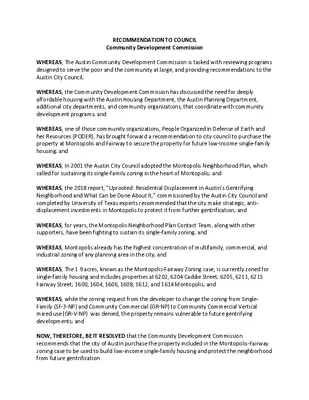

RECOMMENDATION TO COUNCIL Community Development Commission WHEREAS, The Austin Community Development Commission is tasked with reviewing programs designed to serve the poor and the community at large, and providing recommendations to the Austin City Council; WHEREAS, the Community Development Commission has discussed the need for deeply affordable housing with the Austin Housing Department, the Austin Planning Department, additional city departments, and community organizations, that coordinate with community development programs; and WHEREAS, one of those community organizations, People Organized in Defense of Earth and her Resources (PODER), has brought forward a recommendation to city council to purchase the property at Montopolis and Fairway to secure the property for future low-income single-family housing; and WHEREAS, In 2001 the Austin City Council adopted the Montopolis Neighborhood Plan, which called for sustaining its single-family zoning in the heart of Montopolis; and WHEREAS, the 2018 report, “Uprooted: Residential Displacement in Austin’s Gentrifying Neighborhood and What Can be Done About It,” commissioned by the Austin City Council and completed by University of Texas experts recommended that the city make strategic, anti- displacement investments in Montopolis to protect it from further gentrification; and WHEREAS, for years, the Montopolis Neighborhood Plan Contact Team, along with other supporters, have been fighting to sustain its single-family zoning; and WHEREAS, Montopolis already has the highest concentration of multifamily, commercial, and industrial zoning of any planning area in the city; and WHEREAS, The 1.9 acres, known as the Montopolis-Fairway Zoning case, is currently zoned for single-family housing and includes properties at 6202, 6204 Caddie Street; 6205, 6211, 6215 Fairway Street; 1600, 1604, 1606, 1608, 1612, and 1614 Montopolis; and WHEREAS, while the zoning request from the developer to change the zoning from Single- Family (SF-3-NP) and Community Commercial (GR-NP) to Community Commercial Vertical mixed use (GR-V-NP) was denied, the property remains vulnerable to future gentrifying developments; and NOW, THEREFORE, BE IT RESOLVED that the Community Development Commission recommends that the city of Austin purchase the property included in the Montopolis-Fairway zoning case to be used to build low-income single-family housing and protect the neighborhood from future gentrification.


COMMUNITY DEVELOPMENT COMMISSION RECOMMENDATION Support for allocating $10 million for rental assistance Date: April XX, 2026 Subject: Rental Assistance Recommendations Motioned By: Commissioner Seconded By: Commissioner Recommendation Description of Recommendation to Council ● Allocate $10 million in funding to restart the rental assistance program and to provide emergency rental assistance. Rationale As Austin celebrates the recent decrease in rents driven by an increase in housing supply, the reality is that our community is also experiencing record numbers of evictions and a growing number of neighbors facing homelessness. The increase in housing supply has contributed to declining rents at the higher end of the market, but it has not meaningfully improved affordability for those struggling on the lower end of the income spectrum, especially because the increased density has led to the demolition of naturally occurring affordable housing. Austin must continue to address housing supply, but we must also ensure that our policies support those most at risk of displacement. Protecting our most vulnerable residents is essential to maintaining the inclusive and resilient community we strive to be. As lower-wage workers—those who keep our city functioning every day—struggle to remain in Austin, the Housing Department has made the decision to end its rental assistance program. This program has been a critical lifeline. According to Dr. Murillo of El Buen Samaritano, it was already reaching only about 20% of those in need—families on the brink of eviction. Ending the program now, when the need is clearly far greater than the resources available, will only exacerbate housing instability across our community. For many families, rental assistance is the difference between stability and eviction, between remaining housed and falling into homelessness. Commendation Whereas, data shows that higher income, luxury developments dominate the housing built in Austin over the past several years, and Whereas, although Austin is leading the nation in affordable unit development, we are only building housing at 60% MFI and above, and Whereas, Austin is falling behind in the development of housing that is affordable for our lowest-income neighbors, particularly those living at or below 30% of the Area Median Income (AMI), and Whereas, nearly half of all renters struggling to pay rent and Austin is seeing more than 14,000 evictions in the last 12 months, and Whereas, the Austin Community Development Commission has heard countless stories from residents highlighting the urgent need for rental assistance and the importance of expanding, not …
COMMUNITY DEVELOPMENT COMMISSION MEETING MINUTES APRIL 14th, 2026 The COMMUNITY DEVELOPMENT COMMISSION convened in a REGULAR MEETING on APRIL 14th, 2026, at CITY HALL, BOARDS AND COMMISSION ROOM, in Austin, Texas. Some members of the commission participated by video conference. Board Members/Commissioners in Attendance: Jose Noe Elias (Chair) Cynthia Jaso Jenny Achilles Lyric Wardlow Tiffany Moore Raul Longoria Board Members/Commissioners in Attendance Remotely: Nyeka Arnold (Vice Chair) Cassandra Medrano Ebonie Oliver JoAnne Ortiz Sonia Martinez Taniquewa Brewster Valerie Menard Board Members/Commissioners Absent: Tisha-Vonique Hood Staff Members in Attendance: Angel Zambrano Lorena Lopez Chavarin (Remotely) Miguel Lopez Nefertitti Jackmon CALL TO ORDER Chair Elias called the meeting to order at 6:41 PM PUBLIC COMMUNICATION: GENERAL The first 10 speakers signed up prior to the meeting being called to order will each be allowed a three minute allotment to address their concerns regarding items not posted on the agenda. Susana Almanza provided public comment. APPROVAL OF MINUTES 1. Approve the minutes of the CDC Regular meeting on March 10th, 2026. Postponement for the next meeting. STAFF BRIEFINGS 2. Staff briefing regarding Community Services Block Grant (CSBG) activities and outcomes. Presentation by Angel Zambrano, Program Manager III, Austin Public Health. The presentation was made by Angel Zambrano, Program Manager III, Austin Public Health. DISCUSSION ITEMS 3. Presentation on the Public Hearing on Needs Assessment for Annual Action Plan. Presentation by Veronica Samo, Public Information and Marketing Program Manager, and Julie Smith, Community Engagement Specialist, Austin Housing. The presentation was made by Miguel Lopez, Planner I, Austin Housing. DISCUSSION AND ACTION ITEMS Discussion and possible action on the Neighborhood Services Unit’s mission statement. 4. Presentation by Angel Zambrano, Program Manager III, Austin Public Health. The City of Austin is committed to compliance with the American with Disabilities Act. Reasonable modifications and equal access to communications will be provided upon request. Meeting locations are planned with wheelchair access. If requiring Sign Language Interpreters or alternative formats, please give notice by calling 512-974-1606 at least 2 days prior to the meeting date. TTY users route through Relay Texas at 711. For more information on the Community Development Commission, please contact Edward Blake at 512-974-3108. CDC Commissioners may contact CTM for email/technology assistance: 512-974-4357. The following amendment was made by Vice Chair Arnold and seconded by Commissioner Jaso. The amendment was to revise the section to state: “The Neighborhood Services Unit aims to improve the lives and …