Item 6: Age-Friendly Action Plan Priority Areas — original pdf
Backup
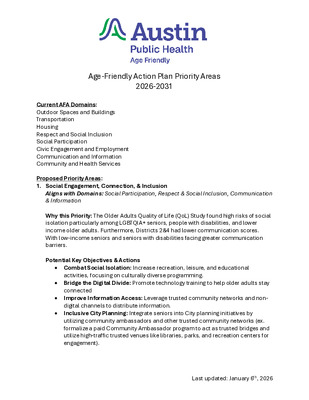
Age-Friendly Action Plan Priority Areas 2026-2031 Current AFA Domains: Outdoor Spaces and Buildings Transportation Housing Respect and Social Inclusion Social Participation Civic Engagement and Employment Communication and Information Community and Health Services Proposed Priority Areas: 1. Social Engagement, Connection, & Inclusion Aligns with Domains: Social Participation, Respect & Social Inclusion, Communication & Information Why this Priority: The Older Adults Quality of Life (QoL) Study found high risks of social isolation particularly among LGBTQIA+ seniors, people with disabilities, and lower income older adults. Furthermore, Districts 2&4 had lower communication scores. With low-income seniors and seniors with disabilities facing greater communication barriers. Potential Key Objectives & Actions • Combat Social Isolation: Increase recreation, leisure, and educational activities, focusing on culturally diverse programming. • Bridge the Digital Divide: Promote technology training to help older adults stay • • connected Improve Information Access: Leverage trusted community networks and non- digital channels to distribute information. Inclusive City Planning: Integrate seniors into City planning initiatives by utilizing community ambassadors and other trusted community networks (ex. formalize a paid Community Ambassador program to act as trusted bridges and utilize high-tra(cid:431)ic trusted venues like libraries, parks, and recreation centers for engagement). Last updated: January 6th, 2026 Previous Related Goals & Strategies AFA Action Plan 2021-2025 • Increase recreation, leisure, and educational activities targeting older adults, including multigenerational programs • Expand city-wide interagency collaborations to identify and optimize • • opportunities for senior engagement Increase in amenities at parks and public spaces Integrate age-inclusive policies as criteria for decision making and promote age- friendly customer service best practices • Ensure services and programs targeted to seniors respect racial, ethnic, and cultural diversity and are welcoming and inclusive • Identify opportunities for seniors to participate in multi-group service day events • Make City of Austin’s Commission on Aging meetings accessible for older adults • Provide multi-cultural information and resources, recognizing the diversity of Austin’s senior population. • Promote technologies and technology training that help older adults stay connected to their community, friends, and family. 2. Health, Mobility, and Accessibility Aligns with Domains: Community & Health Services, Transportation, and Outdoors Spaces & Buildings Why this Priority: The QoL study highlights gaps in food security for District 3 and seniors with disabilities. Concerns about healthcare access arose for those seniors ages 50-64 who do not yet qualify for Medicare. Potential Key Objectives & Actions • Enhance Food Access: increase access to healthy foods and support SNAP • outreach Improve Healthcare Navigation: Build awareness of low/no-cost health services for those not covered by Medicare. • Support Caregivers: Expand outreach for caregiver support programs. • Emergency Preparedness: Ensure emergency responders and preparedness sta(cid:431) are trained in age friendly practices and provide specific preparedness strategies for seniors. Improve Pedestrian Safety: Maintain sidewalks, ensure pedestrian-friendly crossing signals, and improve lighting at transit stops. • • Enhance Accessibility of Public Spaces: Ensure public spaces and buildings are accessible to those with limited mobility. Last updated: January 6th, 2026 Previous Related Goals & Strategies AFA Action Plan 2021-2025 • Build awareness of public, private, and non-profit low or no cost health care services available to seniors, and identify health services not covered by Medicare • Expand the reach of health outreach programs and mobile health care services • Expand community outreach and public awareness around caregiver support and in-home support programs, including respite care, palliative care and other home-based support programs. • Support a robust awareness and education campaign focused on SNAP outreach and the benefit of investing in better food choices for better health outcomes. • Provide broad access to healthy culturally appropriate foods, local farmers markets, co-ops, grocery stores, community gardens, and corner stores in neighborhoods. • Provide information, education and training to ensure the safety, wellness and readiness of seniors in emergency situations. • Ensure emergency responders are trained in age-friendly best practices to be prepared to respond to the needs of older adults during emergency events. • Provide emergency response and preparedness strategies on the City of Austin Website specific to the needs of the senior population • Strengthen elder abuse detection by providing education to law enforcement and other first responders. • Create partnerships to provide educational materials related to identifying and reporting senior financial exploitation targeting banking and financial institutions. • Ensure safe, a(cid:431)ordable, and accessible modes of transportation for older adults • Maintain and add new sidewalks so they are safe and accessible for seniors • Improve seating, shelters, and lighting at transit stops to encourage use of public transportation • Ensure pedestrian friendly crossing signals and clear signage are in place • Provide older adults with tools and information needed to make informed travel • choices Improve coordinated e(cid:431)orts and communication across existing senior transportation agencies • Expand access to outdoor spaces and public buildings Last updated: January 6th, 2026 3. Housing & Economic Security Aligns with Domains: Housing, Civic Engagement & Employment Why this Priority: The QoL study identified that 41% of seniors rate a(cid:431)ordability as “fair” or “poor” and nearly 30% of housed seniors worry about losing their housing. Additionally, 19% of seniors want to work but cannot find employment, especially seniors with lower income. Potential Key Objectives & Actions • Support Aging in Place: Expand, invest, and promote home repair and modification programs (specifically prioritize most requested home modifications: grab bars/handrails, ramps, walk-in showers/tubs, accessible cabinetry). Increase Housing A(cid:431)ordability: encourage innovative a(cid:431)ordable housing models and expand funding for senior housing. • • Ensure Utility Security: Improve access and promotion of energy e(cid:431)iciency/weatherization programs and utility assistance (ex. address the high rate of utility insecurity by improving information dissemination about utility assistance services (like CAP) specifically through trusted local organizations and in multiple languages). • Strengthen Economic Security: Connect Seniors with employment resources, job fairs, and resume coaching, specifically linking Senior Community Service Employment Program (SCSEP) and Workforce Solutions with community. • Prevent Financial Exploitation: Create partnerships to provide educational materials on identifying financial exploitation. Previous Related Goals & Strategies AFA Action Plan 2021-2025 • Encourage the development of new and innovative models of a(cid:431)ordable housing for seniors • Expand funding for a(cid:431)ordable senior housing • • Expand assistance for a(cid:431)ordable home repair, maintenance, and modification Increase access to rent and utility assistance programs for seniors for senior homeowners. Improve access to energy e(cid:431)iciency and weatherization programs • • Provide more interim housing for unhoused seniors Last updated: January 6th, 2026 • Enhance accessibility and visibility of existing employment resources for older adults • Promote job fairs and job-sharing employment opportunities, as well as events that provide education, resume building, interview coaching, and job training for older adults. • Distribute information on key topics such as age discrimination in the workplace and working while receiving Social Security benefits. • Publicize volunteer opportunities as well as opportunities for civic engagement Last updated: January 6th, 2026