
REGULAR MEETING OF THE COMMISSION ON AGING WEDNESDAY, FEBRUARY 11, 2026 AT 12:00 P.M. AUSTIN CITY HALL, BOARDS & COMMISSIONS ROOM 301 W 2ND ST AUSTIN, TEXAS 78701 Some members of the Commission on Aging may be participating by videoconference. Public comment will be allowed in-person or remotely via telephone. Speakers may only register to speak on an item once either in-person or remotely and will be allowed up to three minutes to provide their comments. Registration no later than noon the day before the meeting is required for remote participation by telephone. To register to speak remotely, call or email Ryan Sperling, 512-974-3568, Ryan.Sperling@austintexas.gov. CURRENT COMMISSIONERS: Richard Bondi, Chair Teresa Ferguson, Vice Chair Austin Adams Suzanne Anderson Martin Kareithi Faith Lane Fred Lugo Gloria Lugo Judi L Nudelman Jennifer Scott Luan Tran Preston Tyree Henry Van de Putte Selina Yee Xiaoyi Zeng AGENDA CALL TO ORDER PUBLIC COMMUNICATION: GENERAL The first ten speakers signed up prior to the meeting being called to order will each be allowed a three-minute allotment to address their concerns regarding items not posted on the agenda. APPROVAL OF MINUTES 1. Approve the minutes of the Commission on Aging regular meeting of January 14, 2026. DISCUSSION ITEMS 2. Presentation regarding programming for seniors at the Waterloo Greenway. Presentation by Kelly Pierce, Executive Assistant and Board Liaison, Waterloo Greenway Conservancy. 3. Presentation regarding addiction and mental health. Presentation by Dr. Roshni Koli, Medical Director, Meadows Mental Health Institute. 4. Discussion on advancing primary care for advancing populations, focusing on preventive education. 5. Discussion regarding the path forward for the quality of life study. 6. Discussion regarding the services and programming of adult day centers. Presentation by Commissioner Suzanne Anderson. DISCUSSION AND ACTION ITEMS 7. Approve a recommendation regarding a moratorium on human services funding reductions pending an inclusive, equity-based program review. 8. Approve a recommendation regarding PARD accessibility and cultural inclusion across demographics. 9. Approve a recommendation to improve transit safety and equity for historically underserved older adults. 10. Approve a recommendation improving job and volunteer access for older adults across demographics. 11. Approve the formation of a working group to review Community Service Award criteria, review applications, and present top two suggested candidates each for volunteer and professional awards. 12. Amend the annual schedule to add a November date. WORKING GROUP UPDATES 13. Update from the Quality of Life Study Working Group regarding key dates …

COMMISSION ON AGING REGLUAR MEETING MINUTES WEDNESDAY, JANUARY 14, 2026 The Commission on Aging convened in a Regular meeting on Wednesday, January 14, 2026, at 301 W 2nd Street in Austin, Texas. Chair Bondi called the Commission on Aging Meeting to order at 12:15 p.m. Commissioners in Attendance: Richard Bondi, Chair Suzanne Anderson Fred Lugo Judi L Nudelman Jennifer Scott Commissioners in Attendance Remotely: Teresa Ferguson, Vice Chair Martin Kareithi Faith Lane Gloria Lugo Luan Tran Preston Tyree Henry Van de Putte Selina Yee PUBLIC COMMUNICATION: GENERAL None present. APPROVAL OF MINUTES 1. Approve the minutes of the Commission on Aging Regular Meeting on December 10, 2025. The minutes of the Commission on Aging regular meeting on December 10, 2025 were approved on Commissioner Scott’s motion, Commissioner Anderson’s second on a 12-0 vote. Commissioner Adams was absent. Commissioner Van de Putte was off the dais. 1 STAFF BRIEFINGS 2. Staff briefing regarding the Age Friendly Austin Partner Summit on January 28th, progress of community engagement for the development of the Age Friendly Austin Action Plan 2026- 2030, progress on Resolution 20250605-084, and other Age-Friendly Austin activities. Briefing by Halana Kaleel, Public Health Community Engagement Specialist, and Nicole Alexander, Public Health Program Coordinator, Austin Public Health. The presentation was made by Halana Kaleel, Public Health Community Engagement Specialist, and Nicole Alexander, Public Health Program Coordinator, Austin Public Health. DISCUSSION ITEMS 3. 4. Discussion regarding responses on a community input survey regarding budget priorities created and presented by Chair Bondi. The presentation was made by Chair Bondi. Discussion regarding scheduling future presentations to the Commission on Aging. Discussed. DISCUSSION AND ACTION ITEMS 5. 6. Discussion and possible approval of the formation of a Working Group to collaborate with stakeholders and provide a recommendation on emergency preparedness. Discussed. Discussion and possible approval of a recommendation to support the Age-Friendly Action Plan Priority Areas for 2026-2031. Withdrawn without objection. WORKING GROUP UPDATES 7. 8. Update from the Budget Working Group regarding proposed recommendation topics. Update was given by Chair Bondi. Update from the Quality of Life Survey Working Group regarding the status of updates to the final report, review by City staff, and next steps. Update was given by Chair Bondi. FUTURE AGENDA ITEMS Presentation on addiction and mental health – Judi Nudelman Presentation on advancing population health – Dr. Luan Tran, Jennifer Nudelman and Jennifer Scott Presentation on the continuum of care for …

COMMISSION RECOMMENDATION Commission on Aging Recommendation Number: 20260211-010: Improving Job and Volunteer Access for Older Adults Across Demographics – Budget Neutral WHEREAS, the City of Austin has stated that the Imagine Austin Comprehensive Plan—adopted by City Council in 2012—guides City decision-making when setting goals and policies1; and WHEREAS, the Imagine Austin vision states that Austin is “a beacon of sustainability, social equity and economic opportunity… where community needs and values are recognized… and where the necessities of life are affordable and accessible to all”2; and WHEREAS, the City of Austin Office of the City Auditor reports that cities prioritize being inclusive for people as they age because “older people are a valuable resource for their families and communities”3; and WHEREAS, the City Auditor found that the City “does not have clear outreach about programs and services for older adults.”4 and that as a result “older adults may not be able to find what they need.”5 indicating improvement opportunities through clearer, more consistent outreach and navigation of existing services; and WHEREAS, the City Auditor found that the City provides services to older adults across multiple departments, and that the Age-Friendly Program Coordinator works across departments and “with over 30 community organizations”6 supporting older adults—demonstrating an existing coordination and partner infrastructure the City can leverage; and WHEREAS, the Quality of Life Study “gathered an ambitious and statistically generalizable representation of historically marginalized voices, identified for purposeful sampling by the collaborative study planning process and partners, including: Asian American and Asian immigrant older adults, Black or African American older adults, LGBTQIA+ older adults, Latino or Hispanic older adults, Older adults 1 https://services.austintexas.gov/edims/document.cfm?id=430726 2 https://www.austintexas.gov/sites/default/files/files/Imagine_Austin/IA_InfographicConnections.pdf 3 City_Services_for_Older_Adults_October_2022.pdf 4 Ibid. 5 Ibid. 6 Ibid. Page 1 of 3 with disabilities, Older adults living at or below 60% of Austin's Median Family Income, Older adults living in all ten City Council districts, and Older adults living alone”7; and WHEREAS, the Austin Older Adult Quality of Life Study found that “19% of older adults report wanting to work but are unable to find a job”8, further that this “group, is disproportionately represented among lower-income residents, highlighting the intersection of economic need and barriers to employment,” 9and identified barriers including ageism, functional limitations, and transportation challenges10; and WHEREAS, the Austin Older Adult Quality of Life Study found that 17% of older adults experienced discrimination in places they visit regularly and 13% do not feel safe in their neighborhoods11, …
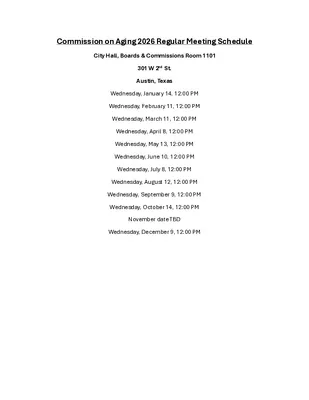
Commission on Aging 2026 Regular Meeting Schedule City Hall, Boards & Commissions Room 1101 301 W 2nd St. Austin, Texas Wednesday, January 14, 12:00 PM Wednesday, February 11, 12:00 PM Wednesday, March 11, 12:00 PM Wednesday, April 8, 12:00 PM Wednesday, May 13, 12:00 PM Wednesday, June 10, 12:00 PM Wednesday, July 8, 12:00 PM Wednesday, August 12, 12:00 PM Wednesday, September 9, 12:00 PM Wednesday, October 14, 12:00 PM November date TBD Wednesday, December 9, 12:00 PM
Commission on Aging February 9, 2026 Chief Executive Officer Dr. Colette Pierce Burnette Stephanie Bergara, Senior Manager of Community Engagement and Programming A Little About Me Our Mission Waterloo Greenway Conservancy creates and maintains an extraordinary urban park system and a restored Waller Creek, in partnership with the City of Austin, for the benefit of all. The Conservancy renews the natural environment, promotes play, health and wellness, economic vitality and mobility, and engages the community through outreach, education, cultural events, and the arts. Our Vision Waterloo Greenway is an iconic and flourishing public park, comprised of walking and biking trails, playscapes, open green spaces, and a healthy creek, enlivened by Austin’s diverse and vibrant community. Founded on the bedrock of great design, the park connects people with nature and one another. It is an enduring, beloved and vital green artery that serves as a model for sustainable urban life Commitment to Equity Waterloo Greenway, as a vibrant urban park, embraces the transformative power of public spaces to build communities and ecosystems, amplify culture, and enhance health and well-being. As the stewards behind Waterloo Greenway, we boldly commit to building equity through thoughtful design, innovative programming, and uplifting community initiatives, honoring the space’s history and forging an inclusive park for Austin’s diverse communities now and in the future. Core Values • Visionary Civic Leadership • Integrity • Social Equity • Design Excellence • Collaboration & Partnership • Responsible & Sustainable Stewardship Public-Private Partnership Waterloo Greenway Founders Melba Whatley, Melanie Barnes, and Tom Meredith CONGRESS AVE Texas Capi tol S T 4 T H S T 5 T H S T 6 T H S T 7 T H S T 8 T H S T 9 T H S T 1 0 T H S T 1 1 T H S T 1 2 T H SAN JACINTO BLVD C E S A R C H A V E Z S T Austin Conv ention Center TRINITY ST NECHES ST Red Riv er Cult ural District Symphony Square The Refuge Emma S. Barrient os Mexican American Cultural Center The Confluence RAINEY ST Palm School RED RIVER ST SABINE ST Palm Park IH- 35 Phase I Phase II Symphony Square Completed 2018 Waterloo Park Completed 2021 The Confluence Opening Summer 2026 Palm Park Design Development Phase III 4th-12th St Schematic Design The Refuge Concept Design The Uni versi ty of Texas at …
Mental Health and Aging Roshni Koli, MD Chief Medical Officer Meadows Institute The Meadows Institute works at the intersection of policy and programs. We create mental health solutions and support implementation, and we shape and help enact policy. | 2 Shape mental health policy STATE AND NATIONAL POLICY Extract lessons learned and proof points The work of the Meadows Institute Enact mental health policy SOLUTIONS Develop, implement, scale, and finance evidence- based solutions in local, state, and national systems OUR VALUES Collaboration and partnership Data-driven and evidence-based Innovation Nonpartisanship Stewardship Background | 3 • In 2023, 17% of Americans were aged 65 or older,1 and by 2040, that proportion is projected to rise to over 22%.2 • Over 90% of older adults reported having at least one chronic medical condition, and nearly 80% reported having two or more.3 • 16% of older adults also have a mental health condition or a substance use disorder.4 • Fewer than half of older adults with a mental health condition, and approximately 10% of those with a substance use disorder, receive treatment.4 • Mental health symptoms in older adults frequently overlap with physical illnesses or age-related changes.”5 Suicide Mortality Among Adults (18+) and Older Adults (65+) | 4 In 2024, there were 10,496 deaths from suicide by adults 65 years old or older. *Deaths occurring in 2024 are considered provisional and are subject to change as final mortality data are finalized and certified. Substance Use Disorder in Older Adults | 5 • In 2023, approximately 7% of older adults (65+) had a substance use disorder.4 • Alcohol misuse is the most common SUD in older adults.4 • SUD is often difficult to recognize and may be mistaken for dementia, anxiety, or depression.6 • Only 18% of Substance Use Treatment Programs are designed for older adults.6 • Physiological changes in older adults alter the way in which substances are metabolized, often increasing the risk of medication interactions, falls, injuries, and cognitive decline.7 Dementia | 6 • Texas is at the epicenter of the crisis. Currently, over 500,000 Texans suffer from some form of Dementia.8 We have the third highest number of Alzheimer’s cases in the country and the second-highest number of Alzheimer’s-related deaths. • One of several identified barriers in health care for Texans with Alzheimer's Disease and Related Dementias is insufficient coordination of dementia care between specialists and PCPs.8 • Depression and dementia are …
Helping older adults and family caregivers THRIVE! Opening a Day Activity and Health Services (DAHS) Program in Texas Overview of Licensing & Start- Up Requirements What is the Texas Administrative Code? The Texas Administrative Code (TAC) is the official compilation of all state agency rules and regulations in Texas, created in 1977. These rules, which have the force of law, are organized into 17 titles covering various subject areas. DAHS facility rules are found in the Texas Administrative Code (TAC). It governs everything from architectural requirements to how to run the facility, staffing, space requirements, etc... AGE of Central Texas - What is AGE? DAHS Program Overview & Pre-Planning DAHS provides daytime health and social services to adults with chronic conditions or who are socially isolated • Choose business structure (LLC, nonprofit, etc.) • Secure compliant location & zoning approval • Develop policies & procedures per TAC Chapter 559 AGE of Central Texas – Pre-Planning Texas Licensing Requirements • Apply through HHSC TULIP system • State architects must approve plans and you pay for the Photo Here review. • Submit background checks & ownership disclosures • Pay licensing fee (3-year license) • Pass Life Safety Code & health inspections • Initial survey conducted before full operation Must serve 3 non-related individuals Photo Here Operational & Staffing Standards • Nurse oversight required – LVN okay but needs 4 hours weekly of RN oversight • Staff training & background checks – checks are done monthly through the HHSC. The state requires an 8 to 1 ratio of members to staff, but we do 6 to one • Infection control & emergency preparedness plans • Required services: meals, nursing, activities, personal care AGE of Central Texas – Operations Post-Licensure & Medicaid Enrollment • Maintain compliance with HHSC surveys • Enroll as Medicaid provider (if applicable) – Reimburses $36 a day. o You must participate in CACFP which will give a small monthly reimbursement for meals, but also has stringent compliance protocol o You must also offer transportation if you are a Medicaid provider o Medicaid has its own annual reporting • Ongoing quality assurance & reporting • License renewal every 3 years or more frequently depending on findings AGE of Central Texas – Post-Licensure Offering vibrant daytime care for older adults with diverse needs in Austin and Round Rock. Our State licensed adult day health centers provide specialized care for those with dementia …
COMMISSION RECOMMENDATION Commission on Aging Recommendation Number: 20260211-007: Moratorium on Human Services Funding Reductions Pending an Inclusive, Equity-based Program Review WHEREAS, the City has publicly described Imagine Austin—first adopted by Council in 2012—as a 30- year plan that maps out a vision of Austin as “a beacon of sustainability, social equity, and economic opportunity; where diversity and creativity are celebrated; where community needs and values are recognized; where leadership comes from its citizens; and where the necessities of life are affordable and accessible to all”1; and WHEREAS, the Planning Department’s current Imagine Austin update briefing materials describe Imagine Austin as the City’s comprehensive plan and “a guide for long-term growth, development, and land use decisions,”2 and note the plan was initially adopted in 2012 as a 30-year plan; and WHEREAS, the City’s Imagine Austin Comprehensive Plan Update memorandum states that Imagine Austin “guides City decision-making when setting goals and policies.”3 reinforcing its relevance to City budget and service decisions; and WHEREAS, the Citywide Strategic Plan identifies “Strategic Anchors” that guide City decision-making, including Equity and Sustainability & Resiliency, and defines equity as ensuring “every member of the community has a fair opportunity to live a long, healthy, and meaningful life”4; and WHEREAS, the same Citywide Strategic Plan defines sustainability as balancing three goal areas—“(1) prosperity and jobs, (2) conservation and the environment, and (3) community health, equity, and cultural vitality”,5 directly linking sustainability to community health and equity outcomes supported by human services; and WHEREAS, the Citywide Strategic Plan includes Proactive Prevention as a Strategic Anchor and states that prevention includes “addressing social determinants of health outcomes, rather than only treating 1 City Embarks on Community-Wide Effort to Update Imagine Austin | AustinTexas.gov 2 https://services.austintexas.gov/edims/document.cfm?id=424906&utm 3 Ibid. 4 FY25_Proposed_Bgt_Citywide_Strategic_Plan.pdf, pp. 2–3 5 FY25_Proposed_Bgt_Citywide_Strategic_Plan.pdf, p. 3 Page 1 of 3 the disease”,6 underscoring the importance of services that prevent crises and reduce long-term costs; and WHEREAS, the City’s age-friendly work is an established City priority, including implementation functions housed within Austin Public Health and updates to the Age-Friendly Austin Action Plan (as described in the City Auditor’s report on City Services for Older Adults)7; and WHEREAS, Austin Public Health has adopted goals to “prevent disease, promote health, and protect the well-being of all,” including promoting healthy behaviors across life stages and preventing and controlling chronic disease and risk factors, goals that are advanced by effective community-based human services (Austin Public Health …
COMMISSION RECOMMENDATION Commission on Aging Recommendation Number: 20260211-008: PARD Accessibility and Cultural Inclusion Across Demographics - Budget Neutral WHEREAS, the Austin Older Adult Quality of Life Study states that it gathered a "statistically generalizable representation of historically marginalized voices, identified for purposeful sampling.”1 including Asian American and Asian immigrant older adults; Black or African American older adults; LGBTQIA+ older adults; older adults with disabilities; and older adults living at or below 60% of Austin’s Median Family Income; and WHEREAS, the study further found that "LGBTQIA+ populations report the highest isolation scores across all demographic categories.”2 demonstrating disparities affecting access to recreation and participation; and WHEREAS, the study reports that “lower-income groups earning $10,000–$49,999 show consistently elevated isolation,”3 highlighting the importance of accessible and culturally relevant programming; and WHEREAS, focus group findings reported that older adults experience "access barriers (e.g. language, disability, technology) that prevent relationship-building and community participation,”4 demonstrating the importance of accessibility and inclusion; and WHEREAS, the Imagine Austin Comprehensive Plan establishes the City’s vision of Austin as "a beacon of sustainability, social equity and economic opportunity.”5 providing policy support for equitable access; and WHEREAS, the City Council adopted the Parks and Recreation Department Long Range Plan as an amendment to Imagine Austin, establishing the official blueprint guiding parks and recreation planning6; and 1 Austin Older Adult Quality of Life Study, November 2025, p.5 2 Austin Older Adult Quality of Life Study, November 2025, p.123 3 Ibid. 4 Austin Older Adult Quality of Life Study, November 2025, p.43 5 Imagine Austin Comprehensive Plan, June 15, 2012, p. 198 6 Our Parks, Our Future Long Range Plan | AustinTexas.gov Page 1 of 2 WHEREAS, Age-Friendly Austin planning materials identify social participation and accessible public spaces as essential components supporting healthy aging and equitable inclusion7. NOW, THEREFORE, BE IT RESOLVED THAT THE COMMISSION ON AGING RECOMMENDS: 1. Budget-Neutral Accessibility Improvements. The Parks and Recreation Department incorporate accessibility improvements into existing programs through operational adjustments that reduce barriers affecting lower-income older adults, LGBTQIA+ older adults, older adults with disabilities, and culturally diverse populations without requiring additional appropriations. 2. Budget-Neutral Cultural Inclusion Improvements. PARD strengthen cultural inclusion through partnerships, inclusive practices, and outreach within existing operational structures. 3. Alignment With Adopted City Plans. These actions shall align with Imagine Austin, the PARD Long Range Plan, and the Age-Friendly Austin framework. 4. Budget-Neutral Implementation. Implementation shall occur within existing operational resources and shall not …
COMMISSION RECOMMENDATION Commission on Aging Recommendation Number: 20260211-009: Improve Transit Safety and Equity for Historically Underserved Older Adults – Budget Neutral WHEREAS, the Austin Older Adult Quality of Life Study intentionally centered historically marginalized and priority populations, including Asian American and Asian immigrant older adults; Black or African American older adults; Latino or Hispanic older adults; Native American/Indigenous and Native Alaskan older adults; Middle Eastern and North African older adults; LGBTQIA+ older adults (including gay, lesbian, bisexual, and Two-Spirit individuals); men, women, non-binary individuals, and trans men; older adults with disabilities; older adults living at or below 60% of Austin’s Median Family Income (MFI); older adults residing in all ten City Council districts; caregivers; linguistically diverse older adults; and socially isolated older adults, in order to ensure inclusive and equitable policy development1; and WHEREAS, the study found elevated social isolation risk among LGBTQIA+ older adults, Native American/Indigenous older adults, Asian American older adults, men, trans men, older adults with disabilities, and lower-income older adults earning between $10,000 and $49,999 annually, demonstrating that accessibility and cultural inclusion are essential determinants of participation in recreation and social programming2; and WHEREAS, focus group findings further indicate that Asian American, Black or African American, Latino or Hispanic, Native American/Indigenous, LGBTQIA+, low-income, linguistically diverse, disabled, caregiving, and socially isolated older adults frequently experience barriers to participation due to accessibility limitations, transportation barriers, cultural mismatch, language barriers, and lack of perceived belonging, reinforcing the need for inclusive and accessible public recreation programs3; and WHEREAS, the Imagine Austin Comprehensive Plan, adopted by Austin City Council on June 14, 2012, establishes a vision of Austin as a city committed to “sustainability, social equity and economic opportunity4; where diversity and creativity are celebrated; where community needs and values are recognized; and where the necessities of life are affordable and accessible to all,”5 and affirms that all residents should have access to public facilities, parks, and recreation opportunities essential to health, quality of life, and community participation; and 1 Austin Older Adult Quality of Life Study, November 2025, p.5 2 Austin Older Adult Quality of Life Study, November 2025, p.118 3 Ibid. 4 Imagining Austin: Our Vision of a Complete Community, p.4 5 Imagine Austin Comprehensive Plan, June 15, 2012, pp. 15, 95, 198 Page 1 of 3 WHEREAS, the Imagine Austin Comprehensive Plan further establishes that Austin will become a city of “complete communities,”6 where residents of all ages, …
COMMISSION RECOMMENDATION Commission on Aging Recommendation Number: 20260211-007: Moratorium on Human Services Funding Reductions Pending an Inclusive, Equity-based Program Review WHEREAS, the City has publicly described Imagine Austin—first adopted by Council in 2012—as a 30- year plan that maps out a vision of Austin as “a beacon of sustainability, social equity, and economic opportunity; where diversity and creativity are celebrated; where community needs and values are recognized; where leadership comes from its citizens; and where the necessities of life are affordable and accessible to all”1; and WHEREAS, the Planning Department’s current Imagine Austin update briefing materials describe Imagine Austin as the City’s comprehensive plan and “a guide for long-term growth, development, and land use decisions,”2 and note the plan was initially adopted in 2012 as a 30-year plan; and WHEREAS, the City’s Imagine Austin Comprehensive Plan Update memorandum states that Imagine Austin “guides City decision-making when setting goals and policies.”3 reinforcing its relevance to City budget and service decisions; and WHEREAS, the Citywide Strategic Plan identifies “Strategic Anchors” that guide City decision- making, including Equity and Sustainability & Resiliency, and defines equity as ensuring “every member of the community has a fair opportunity to live a long, healthy, and meaningful life”4; and WHEREAS, the same Citywide Strategic Plan defines sustainability as balancing three goal areas—“(1) prosperity and jobs, (2) conservation and the environment, and (3) community health, equity, and cultural vitality”,5 directly linking sustainability to community health and equity outcomes supported by human services; and WHEREAS, the Citywide Strategic Plan includes Proactive Prevention as a Strategic Anchor and states that prevention includes “addressing social determinants of health outcomes, rather than only treating 1 City Embarks on Community-Wide Effort to Update Imagine Austin | AustinTexas.gov 2 https://services.austintexas.gov/edims/document.cfm?id=424906&utm 3 Ibid. 4 FY25_Proposed_Bgt_Citywide_Strategic_Plan.pdf, pp. 2–3 5 FY25_Proposed_Bgt_Citywide_Strategic_Plan.pdf, p. 3 Page 1 of 4 the disease”,6 underscoring the importance of services that prevent crises and reduce long-term costs; and WHEREAS, the City’s age-friendly work is an established City priority, including implementation functions housed within Austin Public Health and updates to the Age-Friendly Austin Action Plan (as described in the City Auditor’s report on City Services for Older Adults)7; and WHEREAS, Austin Public Health has adopted goals to “prevent disease, promote health, and protect the well-being of all,” including promoting healthy behaviors across life stages and preventing and controlling chronic disease and risk factors, goals that are advanced by effective community-based human services (Austin Public …
COMMISSION RECOMMENDATION Commission on Aging Recommendation Number: 20260211-008: PARD Accessibility and Cultural Inclusion Across Demographics - Budget Neutral WHEREAS, the Austin Older Adult Quality of Life Study states that it gathered a "statistically generalizable representation of historically marginalized voices, identified for purposeful sampling.”1 including Asian American and Asian immigrant older adults; Black or African American older adults; LGBTQIA+ older adults; older adults with disabilities; and older adults living at or below 60% of Austin’s Median Family Income; and WHEREAS, the study further found that "LGBTQIA+ populations report the highest isolation scores across all demographic categories.”2 demonstrating disparities affecting access to recreation and participation; and WHEREAS, the study reports that “lower-income groups earning $10,000–$49,999 show consistently elevated isolation,”3 highlighting the importance of accessible and culturally relevant programming; and WHEREAS, focus group findings reported that older adults experience "access barriers (e.g. language, disability, technology) that prevent relationship-building and community participation,”4 demonstrating the importance of accessibility and inclusion; and WHEREAS, the Imagine Austin Comprehensive Plan establishes the City’s vision of Austin as "a beacon of sustainability, social equity and economic opportunity.”5 providing policy support for equitable access; and WHEREAS, the City Council adopted the Parks and Recreation Department Long Range Plan as an amendment to Imagine Austin, establishing the official blueprint guiding parks and recreation planning6; and 1 Austin Older Adult Quality of Life Study, November 2025, p.5 2 Austin Older Adult Quality of Life Study, November 2025, p.123 3 Ibid. 4 Austin Older Adult Quality of Life Study, November 2025, p.43 5 Imagine Austin Comprehensive Plan, June 15, 2012, p. 198 6 Our Parks, Our Future Long Range Plan | AustinTexas.gov 7 Age-Friendly Austin Action Plan Amendment, September 2025 Page 1 of 2 WHEREAS, Age-Friendly Austin planning materials identify social participation and accessible public spaces as essential components supporting healthy aging and equitable inclusion7. NOW, THEREFORE, BE IT RESOLVED THAT THE COMMISSION ON AGING RECOMMENDS: 1. Budget-Neutral Accessibility Improvements. The Parks and Recreation Department incorporate accessibility improvements into existing programs through operational adjustments that reduce barriers affecting lower-income older adults, LGBTQIA+ older adults, older adults with disabilities, and culturally diverse populations without requiring additional appropriations. 2. Budget-Neutral Cultural Inclusion Improvements. PARD strengthen cultural inclusion through partnerships, inclusive practices, and outreach within existing operational structures. 3. Alignment With Adopted City Plans. These actions shall align with Imagine Austin, the PARD Long Range Plan, and the Age-Friendly Austin framework. 4. Budget-Neutral Implementation. Implementation shall …
COMMISSION RECOMMENDATION Commission on Aging Recommendation Number: 20260211-010: Improving Job and Volunteer Access for Older Adults Across Demographics – Budget Neutral WHEREAS, the City of Austin has stated that the Imagine Austin Comprehensive Plan—adopted by City Council in 2012—guides City decision-making when setting goals and policies1; and WHEREAS, the Imagine Austin vision states that Austin is “a beacon of sustainability, social equity and economic opportunity… where community needs and values are recognized… and where the necessities of life are affordable and accessible to all”2; and WHEREAS, the City of Austin Office of the City Auditor reports that cities prioritize being inclusive for people as they age because “older people are a valuable resource for their families and communities”3; and WHEREAS, the City Auditor found that the City “does not have clear outreach about programs and services for older adults.”4 and that as a result “older adults may not be able to find what they need.”5 indicating improvement opportunities through clearer, more consistent outreach and navigation of existing services; and WHEREAS, the City Auditor found that the City provides services to older adults across multiple departments, and that the Age-Friendly Program Coordinator works across departments and “with over 30 community organizations”6 supporting older adults—demonstrating an existing coordination and partner infrastructure the City can leverage; and WHEREAS, the Quality of Life Study “gathered an ambitious and statistically generalizable representation of historically marginalized voices, identified for purposeful sampling by the collaborative study planning process and partners, including: Asian American and Asian immigrant older adults, Black or African American older adults, LGBTQIA+ older adults, Latino or Hispanic older adults, Older adults 1 https://services.austintexas.gov/edims/document.cfm?id=430726 2 https://www.austintexas.gov/sites/default/files/files/Imagine_Austin/IA_InfographicConnections.pdf 3 City_Services_for_Older_Adults_October_2022.pdf 4 Ibid. 5 Ibid. 6 Ibid. Page 1 of 4 with disabilities, Older adults living at or below 60% of Austin's Median Family Income, Older adults living in all ten City Council districts, and Older adults living alone”7; and WHEREAS, the Austin Older Adult Quality of Life Study found that “19% of older adults report wanting to work but are unable to find a job”8, further that this “group, is disproportionately represented among lower-income residents, highlighting the intersection of economic need and barriers to employment,” 9and identified barriers including ageism, functional limitations, and transportation challenges10; and WHEREAS, the Austin Older Adult Quality of Life Study found that 17% of older adults experienced discrimination in places they visit regularly and 13% do not feel safe in their neighborhoods11, …