SPECIAL CALLED MEETING OF THE COMMISSION ON AGING AGE FRIENDLY ADVISORY COMMITTEE MONDAY, OCTOBER 5, 2026, AT 11:00 A.M. CITY OF AUSTIN PERMITTING AND DEVELOPMENT CENTER, 1401/1402 6310 WILHELMINA DELCO DR AUSTIN, TEXAS Some members of the Age Friendly Advisory Committee may be participating by videoconference. Public comment will be allowed in-person or remotely via telephone. Speakers may only register to speak on an item once either in-person or remotely and will be allowed up to three minutes to provide their comments. Registration no later than noon the day before the meeting is required for remote participation by telephone. To register to speak remotely, contact Nicole Alexander, Nicole.Alexander@austintexas.gov. CURRENT COMMISSIONERS: Richard Bondi, Chair Suzanne Anderson Teresa Ferguson Henry Van de Putte Selena Yee AGENDA CALL TO ORDER PUBLIC COMMUNICATION: GENERAL The first 10 speakers signed up prior to the meeting being called to order will each be allowed a three-minute allotment to address their concerns regarding items not posted on the agenda. STAFF BRIEFINGS 1. Staff briefing regarding the 2026-2030 Age-Friendly Austin (AFA) Action Plan current status and plan implementation timeline. Presentation by Nicole Alexander, Age Friendly Program Coordinator, and Halana Kaleel, Public Health Community Engagement Specialist, Austin Public Health DISCUSSION ITEMS 2. Discussion and review of the final draft of the Age Friendly Austin Action Plan for 2026-2030. DISCUSSION AND ACTION ITEMS 3. Discussion and possible action on the Commission on Aging’s action plans for the AFAP 2026- 2030. 4. Discussion and possible action on edits on the Commission on Aging Build, Bridge, and Champion Framework for the Age-Friendly Austin Action Plan (2026–2030). 5. Discussion and possible action on amending the 2026 meeting schedule for the Age Friendly Advisory Committee. 6. Discussion and possible action on adopting the 2027 meeting schedule for the Age Friendly Advisory Committee. FUTURE AGENDA ITEMS ADJOURNMENT The City of Austin is committed to compliance with the Americans with Disabilities Act. Reasonable modifications and equal access to communications will be provided upon request. For assistance, please contact the Liaison or TTY users’ route through 711. A person may request language access accommodations no later than 48 hours before the scheduled meeting. Please email Nicole Alexander at Austin Public Health Department, at Nicole.Alexander@austintexas.gov, to request service or for additional information. For more information on the Age Friendly Advisory Committee, please email Nicole Alexander at Nicole.Alexander@austintexas.gov.

REGULAR MEETING OF THE COMMISSION ON AGING WEDNESDAY, SEPTEMBER 9, 2026, 12:00 P.M. AUSTIN CITY HALL, BOARDS & COMMISSIONS ROOM 301 W 2ND ST AUSTIN, TEXAS 78701 Some members of the Commission on Aging may be participating by videoconference. Public comment will be allowed in-person or remotely via telephone. Speakers may only register to speak on an item once either in-person or remotely and will be allowed up to three minutes to provide their comments. Registration no later than noon the day before the meeting is required for remote participation by telephone. To register to speak remotely, call or email Ryan Sperling, 512-974-3568, Ryan.Sperling@austintexas.gov. CURRENT COMMISSIONERS: Richard Bondi, Chair Teresa Ferguson, Vice Chair Suzanne Anderson Martin Kareithi Faith Lane Fred Lugo Angie Ozarowski Jennifer Scott Luan Tran AGENDA CALL TO ORDER PUBLIC COMMUNICATION: GENERAL Preston Tyree Henry Van de Putte Selina Yee Xiaoyi Zeng The first ten speakers signed up prior to the meeting being called to order will each be allowed a three-minute allotment to address their concerns regarding items not posted on the agenda. APPROVAL OF MINUTES 1. Approve the minutes of the regular meeting of the Commission of Aging on August 12, 2026. DISCUSSION ITEMS 2. Discussion on the wrapping up of proclamations recommended at the June meeting. 3. Review of revised bluelines for Age Friendly Action Plan (AFAP) Focus Areas One and Two. 4. Discussion regarding AFAP Focus Area Three 5. Discussion regarding potential updates to the previously approved Commission on 2026- 2030 internal framework. 6. Update on Joint Inclusion Committee discussions at the August 26 meeting. DISCUSSION AND ACTION ITEMS 7. Approve a recommendation to Council for a proclamation on National Adult Day Services Week – September 20-26. 8. Approve a recommendation to Council for a proclamation on Health Literacy Month – October. 9. Approve a recommendation to Council for a proclamation on Veterans Day – November 11. 10. Approve a recommendation to Council for a proclamation on Home Care Aide Day – November 18. 11. Approve a recommendation to Council for a proclamation on National Care at Home Month – November. 12. Approve a recommendation to Council for a proclamation on National Family Caregivers Month – November. 13. Approve the formation of a working group to propose budget recommendations for the FY2027-28 Budget Cycle. 14. Approve updates to working group membership. WORKING GROUP UPDATES 15. Update from the Quality of Life Study Analysis Working …

COMMISSION ON AGING MINUTES REGULAR MEETING WEDNESDAY, AUGUST 12, 2026 The Commission on Aging convened in a regular meeting on Wednesday, August 12, 2026, at Austin City Hall, Boards and Commissions Room 1101, 301 W 2nd Street in Austin, Texas. Chair Bondi called the Commission on Aging Meeting to order at p.m. Commissioners in Attendance: Richard Bondi (Chair) Preston Tyree Fred Lugo Luan Tran Xiaoyi Zeng Commissioners in Attendance Remotely: Teresa Ferguson (Vice Chair) Suzanne Anderson Martin Kareithi Henry Van de Putte Jennifer Scott Call to order 12:24 P.M. PUBLIC COMMUNICATION: GENERAL Carlos Soto – Community Advancement Network Work Events APPROVAL OF MINUTES 1. Approve the minutes of the Commission on Aging regular meeting of July 8, 2026. The July 8, 2026 minutes were approved on Commissioner Lugo’s motion, Vice Chair Ferguson’s second on a 10-0 vote. Commissioners Lane, Ozarowski, and Yee were absent. DISCUSSION ITEMS 1. Discussion regarding Chair Bondi’s orientation sessions for new commission members. Update by Chair Bondi. 2. Update on the status of the proclamation recommendations approved at the June 10, 2026 meeting. Update by Chair Bondi. Item 2 was taken up after Item 4 without objection. 1 3. Discussion regarding the proposed City of Austin FY2026-27 budget and the status of commission recommendations. Update by Chair Bondi. 4. Discussion on the closed out 2021-2025 Age Friendly Austin Progress Report. Update by Chair Bondi. DISCUSSION AND ACTION ITEMS 5. Review and document changes to the draft version of the Age Friendly Action Plan (AFAP) 2026-2030 Focus Area 1, discuss impacts on commission work, and approve the commission’s Focus Area One Work Plan. The Commission’s Focus Area One Work Plan was approved on Commissioner Scott’s motion, Commissioner Tyree’s second on a 10-0 vote. Commissioners Lane, Ozarowski, and Yee were absent. 6. Review and document changes to the draft version of AFAP 2026-2030 Focus Area 2, discuss impacts on commission work, and approve the Commission’s Focus Area Two Work Plan. The Commission’s Focus Area Two Work Plan was approved on Commissioner Van de Putte’s motion, Commissioner Anderson’s second on a 10-0 vote. Commissioners Lane, Ozarowski, and Yee were absent. 7. Discussion regarding commission priorities for AFAP 2026-2030 Focus Area 3 and possible action to approve a list of priorities. Postponed to September without objection. 8. Discussion and possible action to approve an internal framework that guides the Commission’s priorities for the next five years, to build, bridge, and …
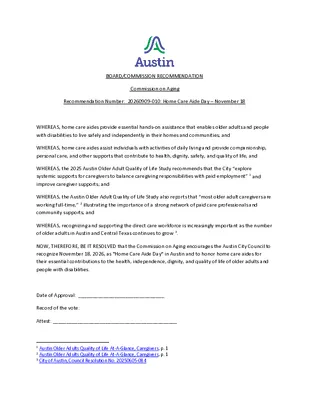
BOARD/COMMISSION RECOMMENDATION Commission on Aging Recommendation Number: 20260909-010: Home Care Aide Day – November 18 WHEREAS, home care aides provide essential hands-on assistance that enables older adults and people with disabilities to live safely and independently in their homes and communities; and WHEREAS, home care aides assist individuals with activities of daily living and provide companionship, personal care, and other supports that contribute to health, dignity, safety, and quality of life; and WHEREAS, the 2025 Austin Older Adult Quality of Life Study recommends that the City “explore systemic supports for caregivers to balance caregiving responsibilities with paid employment” 1 and improve caregiver supports; and WHEREAS, the Austin Older Adult Quality of Life Study also reports that “most older adult caregivers are working full-time,” 2 illustrating the importance of a strong network of paid care professionals and community supports; and WHEREAS, recognizing and supporting the direct care workforce is increasingly important as the number of older adults in Austin and Central Texas continues to grow 3. NOW, THEREFORE, BE IT RESOLVED that the Commission on Aging encourages the Austin City Council to recognize November 18, 2026, as "Home Care Aide Day" in Austin and to honor home care aides for their essential contributions to the health, independence, dignity, and quality of life of older adults and people with disabilities. Date of Approval: _______________________________ Record of the vote: Attest: _____________________________________________ 1 Austin Older Adults Quality of Life At-A-Glance, Caregivers, p. 1 2 Austin Older Adults Quality of Life At-A-Glance, Caregivers, p. 1 3 City of Austin, Council Resolution No. 20250605-084
BOARD/COMMISSION RECOMMENDATION Commission on Aging Recommendation Number: 20260909-011: National Care at Home Month – November WHEREAS, care delivered in the home enables older adults, people with disabilities (PWD), and individuals living with serious or acute illness to receive needed services while remaining in familiar surroundings and connected to their families and communities; and WHEREAS, care at home includes a continuum of services such as home health care, personal care, hospice and palliative care, and home- and community-based services1; and WHEREAS, the 2025 Austin Older Adult Quality of Life Study reports that “men, PWD, and caregivers all show significantly poorer Aging in Place Scores,” underscoring the importance of supports that help people remain safely in their homes and communities2; and WHEREAS, the Study reports that older adults prioritize “pest control, the installation of grab bars and handrails, ramps, and walk-in tubs or showers” to enhance the existing housing stock3; and WHEREAS, nurses, therapists, home care aides, social workers, direct care professionals, family caregivers, volunteers, and others providing care in the home play an essential role in supporting health, dignity, independence, and quality of life. NOW, THEREFORE, BE IT RESOLVED that the Commission on Aging encourages the Austin City Council to proclaim November 2026 as "National Care at Home Month" in Austin and to recognize the professionals, family caregivers, volunteers, and organizations that provide essential care and support to Austinites in their homes. Date of Approval: _______________________________ Record of the vote: Attest: _____________________________________________ 1 National Alliance for Care at Home, National Care at Home Month 2 Austin Older Adult Quality of Life Study 2025, Housing and Home and Community-Based Services (HCBS), p. 12. 3 Ibid.
BOARD/COMMISSION RECOMMENDATION Commission on Aging Recommendation Number: 20260909-012: National Family Caregivers Month – November WHEREAS, family caregivers provide essential unpaid support to older adults, people with disabilities, children, and individuals living with chronic illness, helping people remain connected to their homes, families, and communities; and WHEREAS, caregiving may include assistance with meals, transportation, medications, personal care, household activities, healthcare coordination, financial responsibilities, and emotional support; and WHEREAS, the 2025 Austin Older Adult Quality of Life Study reports that “approximately 19% reported being a paid or unpaid caregiver for an adult aged 50 or older”1 and that “the remaining 88% of caregivers were 50 years or older”2; and WHEREAS, the 2025 Austin Older Adult Quality of Life Study recommends that the City “explore systemic supports for caregivers to balance caregiving responsibilities with paid employment”3 and “explore effective methods of outreach surrounding availability of and enrollment in respite care programming and other caregiver supports”4; and WHEREAS, the Austin Families with Young Children study found that “79% of caregivers reported some level of difficulty paying for childcare,”5 demonstrating that caregiving challenges extend across the lifespan. NOW, THEREFORE, BE IT RESOLVED that the Commission on Aging encourages the Austin City Council to proclaim November 2026 as "National Family Caregivers Month" in Austin and to recognize family caregivers for their essential contributions while encouraging greater awareness of respite, education, workplace supports, and community resources available to caregivers. Date of Approval: _______________________________ Record of the vote: 1 Austin Older Adult Quality of Life Study 2025, Findings: Caregivers, p. 86. 2 Ibid. 3 Austin Older Adults Quality of Life: Caregivers At-A-Glance, p. 1. 4 Ibid. 5 Bright Beginnings: Experiences of Families with Young Children in Austin, TX, Summary Report of Findings (2025), Childcare findings, p. 30. Attest: _____________________________________________
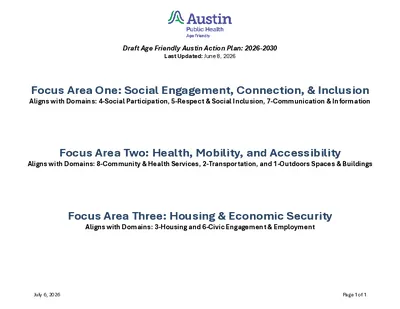
Draft Age Friendly Austin Action Plan: 2026-2030 Last Updated: July 9, 2026 August 24, 2026 Focus Area One: Social Engagement, Connection, & Inclusion Aligns with Domains: 4-Social Participation, 5-Respect & Social Inclusion, 7-Communication & Information Framework for the 2026-2030 Action Plan Understanding the Indicators The 2026-2030 Action Plan establishes measurable benchmarks for the first time by incorporating baseline scores. These indicators are derived directly from the Austin Older Adult Quality of Life Study conducted in 2025. By using community survey data to quantify how older adults currently rate their experiences, spanning from transportation satisfaction to health and food insecurity, these baselines provide a starting point. Establishing these scores allows the City of Austin and its partners to measure the effectiveness of their strategies and track year-over-year progress more accurately. Alignment with the Previous Plan's Domains When this plan notes that a section aligns with domains, it bridges our current goals to the AARP and World Health Organization’s Eight Domains of Livability. These eight domains served as the structural foundation for the city's previous age- friendly plans. To create a more targeted, efficient, and intersectional approach for 2026-2030, the City has consolidated those original eight domains into three comprehensive focus areas. Social Engagement, Connection, & Inclusion Aligns with Domains: Social Participation, Respect & Social Inclusion, Communication & Information This focus area addresses the critical need for older adults to feel valued, informed, and connected to their community. The consolidation of these domains was driven by recent quality of life findings revealing high risks of social isolation, particularly among LGBTQIA+ seniors, lower-income older adults, and individuals with disabilities. Furthermore, it targets communication hurdles, as recent data highlights that a lack of affordable internet and language barriers severely limit how homebound and multilingual seniors access essential city resources. By grouping these areas, the plan aims to build a more inclusive environment that proactively bridges the digital divide, tackles discrimination, and fosters meaningful community participation. Excerpted from: July 9, 2026 Final Draft Age Friendly Austin Action Plan: 2026-2030 Page 1 of 13 August 24, 2026 Draft Age Friendly Austin Action Plan: 2026-2030 Last Updated: July 9, 2026 August 24, 2026 Focus Area One: Social Engagement, Connection, & Inclusion Aligns with Domains: 4-Social Participation, 5-Respect & Social Inclusion, 7-Communication & Information Goal 1: Improve access to technology and community information Objective 1: Empower seniors through access to internet, digital devices, and training to use them …

Draft Age Friendly Austin Action Plan: 2026-2030 Last Updated: July 9, 2026 August 24, 2026 Focus Area Three: Housing & Economic Security Aligns with Domains: 3-Housing and 6-Civic Engagement & Employment Housing & Economic Security Aligns with Domains: Housing, Civic Engagement & Employment This focus area recognizes that safe, affordable housing and economic stability are the foundation of aging in place. It consolidates housing and employment to tackle the intense financial pressures older adults face in a rapidly changing, increasingly expensive landscape. With nearly 30% of housed seniors worrying about losing their homes, and utility insecurity disproportionately affecting seniors with disabilities and communities of color, basic economic survival is a pressing challenge. By also addressing the 19% of older adults who desire to work but cannot find employment, this section comprehensively targets the financial and residential stability required for Austin's seniors to thrive. Goal 1: Increase housing security and access to home modification and repair programs to support seniors aging in place. Objective 1: Increase annual participation in city-funded home repair and modification programs for older adults. Strategy 1: Develop multi-lingual outreach campaigns to bridge the gap between service awareness and access. Partners: Austin Housing, APH, ACE, ASC Deadline: 2027 Metrics: Translated materials created Outreach campaign launched. Strategy 2: Prioritize housing interventions that specifically address the top home repair and modification needs identified by Excerpted from: July 9, 2026 Final Draft Age Friendly Austin Action Plan: 2026-2030 Page 1 of 11 August 1124, 2026 Draft Age Friendly Austin Action Plan: 2026-2030 Last Updated: July 9, 2026 August 24, 2026 Focus Area Three: Housing & Economic Security Aligns with Domains: 3-Housing and 6-Civic Engagement & Employment seniors: pest control, grab bars/handrails, ramps, and accessible showers. Partners: Austin Housing, Meals on Wheels, Rebuilding Together. Deadline: 2028 Metrics: Annual # of targeted home modifications completed. Strategy 3: Conduct a geographic gap analysis of city-funded home repair programs to identify underserved neighborhoods and populations. Partners: Austin Housing, APH. Deadline: 2027 Metric: Gap analysis completed. Excerpted from: July 9, 2026 Final Draft Age Friendly Austin Action Plan: 2026-2030 Page 2 of 11 August 1124, 2026 Draft Age Friendly Austin Action Plan: 2026-2030 Last Updated: July 9, 2026 August 24, 2026 Focus Area Three: Housing & Economic Security Aligns with Domains: 3-Housing and 6-Civic Engagement & Employment Goal 1: Increase housing security and access to home modification and repair programs to support seniors aging in place. …

Draft Age Friendly Austin Action Plan: 2026-2030 Last Updated: July 9, 2026 August 24, 2026 Focus Area Two: Health, Mobility, and Accessibility Aligns with Domains: 8-Community & Health Services, 2-Transportation, and 1-Outdoors Spaces & Buildings Health, Mobility, and Accessibility Aligns with Domains: Community & Health Services, Transportation, and Outdoors Spaces & Buildings Physical well-being and the ability to safely navigate the city are linked, which is why health, transportation, and the built environment are combined in this section. This focus area responds to community data showing that adults ages 50 to 64 experience increased health insecurity, and that more than a quarter of participants have recently struggled to access necessary medical care. It also addresses significant concerns regarding pedestrian safety and the accessibility of recreational spaces for seniors with mobility challenges. Integrating these domains ensures a holistic approach to creating safe, accessible infrastructure that supports both the physical health and mobility of Austin's senior population. Indicators: Health Insecurity Score (Baseline: 8.85/20) Food Insecurity Score (Baseline: 3.82/6) Excerpted from: July 9, 2026 Final Draft Age Friendly Austin Action Plan: 2026-2030 Page 1 of 14 August 11 24, 2026 Draft Age Friendly Austin Action Plan: 2026-2030 Last Updated: July 9, 2026 August 24, 2026 Focus Area Two: Health, Mobility, and Accessibility Aligns with Domains: 8-Community & Health Services, 2-Transportation, and 1-Outdoors Spaces & Buildings Goal 1: Increase awareness and access to health, safety, and accessibility resources. Objective 1: Reduce use of non-urgent emergency services among seniors. Strategy 1: Support and increase capacity of the Senior Home Safety Program. Partners: Austin-Travis County Emergency Medical Services (ATCEMS), Commission on Aging, Austin Fire, Austin Police.3-1-1, APR, APL Deadline: 2029 Metric: Year-over-year % decrease in non-injury fall calls for residents 55+. Strategy 2: Develop partnerships to recruit and train volunteers to conduct initial basic home assessments. Partners: University of St. Augustine for Health Sciences, ATCEMS, Austin-Travis County Medical Reserve Corps(MRC). Deadline: 2029 Metrics: # of partnerships developed. # of assessments completed by volunteers annually. Strategy 3: Implement senior specific pop-up resource clinics. Partners: ATCEMS, APH (Mobile Van Program and Community Health Worker Hub), APR, APL Deadline: 2029 Metrics: # of seniors served annually by pop-up resource clinics # of pop-up clinics held annually. Excerpted from: July 9, 2026 Final Draft Age Friendly Austin Action Plan: 2026-2030 Page 2 of 14 August 11 24, 2026 Draft Age Friendly Austin Action Plan: 2026-2030 Last Updated: July 9, 2026 …

Commission on Aging 2026-2030 Priority Framework The Commission on Aging adopts this Build and Bridge Framework to help refine and prioritize its work within its responsibilities under City Code. The Framework borrows the three focus areas of the Age-Friendly Austin Action Plan (AFAP) 2026–2030 as a useful way of organizing and narrowing that work. The Commission's responsibilities are established by City Code and include serving as an advisory body to the Austin City Council concerning the quality of life of older adults in the Austin area and helping ensure that older adults are productive, independent, and healthy. The AFAP does not alter or limit those responsibilities. The Commission's Age Friendly Advisory Committee provides oversight of the AFAP consistent with the responsibilities established for the Committee in the Commission's bylaws: monitoring progress, championing older adult involvement in plan development and implementation, reviewing and recommending revisions, and helping ensure community alignment through collaboration with City departments and the older adult community. City Council's adoption of Resolution No. 20250605-084 strengthened the City's commitment to older adults, including directing City departments to incorporate an age-friendly perspective and the AFAP into how they fulfill their missions. This creates additional opportunities for the Commission to engage City departments on issues within the Commission's responsibilities. Build and Bridge Using the three AFAP focus areas, the Commission will identify areas within its City Code responsibilities where focused attention can have a meaningful impact. For each selected area, the Commission may identify one or both of the following roles: Build – Develop or contribute to Commission activities addressing an identified area of focus. Bridge – Convene stakeholders, facilitate collaboration, share information, or strengthen connections addressing an identified area of focus. Build and Bridge describe ways the Commission may approach its work. They do not assign responsibility to the Commission for implementing the AFAP. The Commission's Build and Bridge selections are not intended to encompass every issue affecting older adults or the full scope of its responsibilities. They identify areas where the Commission believes sustained attention can have the greatest impact. Using the Build and Bridge Selections The Build and Bridge selections adopted within each of the three focus areas shall help prioritize and inform: Compiled by: Richard Bondi Page 1 of 2 09/08/2026 Commission on Aging 2026-2030 Priority Framework • Commission meeting agendas and work sessions; • Invited presentations and guest speakers; • Recommendations to the Austin City Council; …

BOARD/COMMISSION RECOMMENDATION Commission on Aging Recommendation Number: 20260909-007: National Adult Day Services Week – September 20–26 WHEREAS, adult day services provide “health, therapeutic, and social services for older adults and individuals with disabilities, helping them maintain independence while supporting caregivers” 1 and other supports for older adults and adults with disabilities while helping individuals remain connected to their families and communities; and WHEREAS, National Adult Day Services Week traces its history to 1983, when Congress enacted House Joint Resolution 132, designating the week beginning September 25 as “National Adult Day Care Center Week,” 2 and President Ronald Reagan issued Proclamation 5107 recognizing that adult day care centers enable individuals to receive needed care without institutionalization and “offer needed respite to families” 3 caring for relatives at home; and WHEREAS, adult day services can provide essential respite and support to family caregivers, helping them balance caregiving responsibilities, employment, personal health, and other obligations; and WHEREAS, the 2025 Austin Older Adult Quality of Life Study found that “88% of older adult caregivers are themselves age 50 or older” and recommends that programs and initiatives “address caregivers’ dual identities - as both caregivers and older adults” 4; and WHEREAS, the Study further recommends that the community “explore effective methods of outreach surrounding availability of and enrollment in respite care programming and other caregiver supports” 5; and WHEREAS, adult day services are an important component of home- and community-based services that can support independence, social connection, caregiver well-being, and the ability of older adults and adults with disabilities to remain in their communities. NOW, THEREFORE, BE IT RESOLVED that the Commission on Aging encourages the Austin City Council to recognize September 20–26, 2026, as “National Adult Day Services Week” in Austin and to recognize the contributions of adult day service providers, direct care professionals, family caregivers, and community organizations that support older adults and adults with disabilities. 1 AGE of Central Texas, Adult Day Health Care 2 Proclamation 5107 -- National Adult Day Care Center Week, 1983 3 Ibid. 4 Austin Older Adults Quality of Life: Caregivers At-A-Glance, p. 1. 5 Ibid. Page 1 of 2 Date of Approval: _______________________________ Record of the vote: Attest: _____________________________________________ Page 2 of 2

BOARD/COMMISSION RECOMMENDATION Commission on Aging Recommendation Number: 20260909-008: Health Literacy Month – October WHEREAS, health literacy includes the ability to find, understand, and use information and services to make health-related decisions, and clear and accessible health information is essential to navigating health care and maintaining individual and community health; and WHEREAS, the U. S. Department of Health and Human Services, Office of Disease Prevention and Health Promotion has identified a National Action Plan to improve health literacy 1, underscoring the importance of this issue, and WHEREAS, October has been recognized as Health Literacy Month since 1999 to increase awareness of the importance of making health information easier to understand and health systems easier to navigate 2; and WHEREAS, the 2025 Austin Women and Girls Quality of Life Study recommends: “Provide language accessible materials of resources to all Austin residents by translating all materials available through the City of Austin in multiple languages and tailored to varying literacy levels” 3; and WHEREAS, the 2025 Austin Older Adult Quality of Life Study reports that “41% of older adults rate their internet as fair or poor” and identifies “digital literacy programs” among needed interventions 4; and WHEREAS, the Austin LGBTQIA+ Quality of Life Study states that “there is a great need to access high- quality, affordable, culturally responsive, comprehensive health care for LGBTQIA+ individuals” 5. NOW, THEREFORE, BE IT RESOLVED that the Commission on Aging encourages the Austin City Council to proclaim October 2026 as "Health Literacy Month" in Austin and encourages City departments, healthcare providers, community organizations, and residents to promote clear, accessible, culturally responsive, and understandable health information for people of all ages and abilities. 1 U. S. Department of Health and Human Services, Office of Disease Prevention and Health Promotion, National Action Plan to Improve Health Literacy 2 Health Literacy Solutions Center 3 Commission for Women-Final Report, November 2025, Findings: Public Services, Digital Divide in Internet Access, p. 82. 4 Austin Older Adult Quality of Life Study 2025, Findings: Public Services, Digital Divide in Internet Access, p. 117. 5 ShoutOut Austin LGBTQIA+ Quality of Life Study (2021), Key Themes, p. 7. Date of Approval: _______________________________ Record of the vote: Attest: _____________________________________________
BOARD/COMMISSION RECOMMENDATION Commission on Aging Recommendation Number: 20260909-009: Veterans Day – November 11 WHEREAS, generations of Americans have served in the United States Armed Forces, making profound contributions and sacrifices in defense of the nation; and WHEREAS, since 1919, the United States of Americans have honored veterans of our armed forces, officially recognized by the United States Congress on June 4, 1926, with these words: Whereas the 11th of November 1918 1; and WHEREAS, nearly 31,000 veterans live in Austin2, representing approximately 4% of the 18 and over population and the City of Austin has long recognized the contributions of veterans to our community, including through its annual Veterans Day observances and its employment of more than 1,600 military veterans Austin3; and WHEREAS, the U.S. Department of Veterans Affairs recognizes that later life can bring challenges for veterans, including “vision or hearing loss or a chronic medical condition,” changes in roles and relationships, “financial or housing issues,” and the need to provide or receive additional help4; and WHEREAS, ensuring that older veterans can access appropriate services and remain connected to their communities supports dignity, independence, and healthy aging; and WHEREAS, recognizing veterans also provides an opportunity to acknowledge the families and caregivers who support those who have served. NOW, THEREFORE, BE IT RESOLVED that the Commission on Aging encourages the Austin City Council to recognize November 11, 2026, as "Veterans Day" in Austin, honoring veterans of all generations for their service and sacrifice and encouraging continued efforts to ensure that veterans and their families can access the services, supports, and opportunities they need throughout their lives. 1 U. S. Dept of Veterans Affairs, History of Veterans Day 2 United States Census Bureau, Quick Facts Austin, TX - Veterans 3 Austin Human Resources, Talent Strategy Division 4 U.S. Department of Veterans Affairs, Resources for Older Veterans Date of Approval: _______________________________ Record of the vote: Attest: _____________________________________________
BOARD/COMMISSION RECOMMENDATION Commission on Aging Recommendation Number: 20260909-007: National Adult Day Services Week – September 20–26 WHEREAS, adult day services provide “health, therapeutic, and social services for older adults and individuals with disabilities, helping them maintain independence while supporting caregivers” 1 and other supports for older adults and adults with disabilities while helping individuals remain connected to their families and communities; and WHEREAS, National Adult Day Services Week traces its history to 1983, when Congress enacted House Joint Resolution 132, designating the week beginning September 25 as “National Adult Day Care Center Week,” 2 and President Ronald Reagan issued Proclamation 5107 recognizing that adult day care centers enable individuals to receive needed care without institutionalization and “offer needed respite to families” 3 caring for relatives at home; and WHEREAS, adult day services can provide essential respite and support to family caregivers, helping them balance caregiving responsibilities, employment, personal health, and other obligations; and WHEREAS, the 2025 Austin Older Adult Quality of Life Study found that “88% of older adult caregivers are themselves age 50 or older” and recommends that programs and initiatives “address caregivers’ dual identities - as both caregivers and older adults” 4; and WHEREAS, the Study further recommends that the community “explore effective methods of outreach surrounding availability of and enrollment in respite care programming and other caregiver supports” 5; and WHEREAS, adult day services are an important component of home- and community-based services that can support independence, social connection, caregiver well-being, and the ability of older adults and adults with disabilities to remain in their communities. NOW, THEREFORE, BE IT RESOLVED that the Commission on Aging encourages the Austin City Council to recognize September 20–26, 2026, as “National Adult Day Services Week” in Austin and to recognize the contributions of adult day service providers, direct care professionals, family caregivers, and community organizations that support older adults and adults with disabilities. 1 AGE of Central Texas, Adult Day Health Care 2 Proclamation 5107 -- National Adult Day Care Center Week, 1983 3 Ibid. 4 Austin Older Adults Quality of Life: Caregivers At-A-Glance, p. 1. 5 Ibid. Page 1 of 2 Date of Approval: September 9, 2026 Motioned By: Commissioner Scott Seconded By: Commissioner Anderson Vote: 10-0 For: Chair Bondi, Commissioners Anderson, Kareithi, Lane, Lugo, Ozarowski, Scott, Tyree, Yee, Zeng Against: None Abstain: None Off the dais: None Absent: Vice Chair Ferguson, Commissioners Tran and Van de Putte Attest: …
BOARD/COMMISSION RECOMMENDATION Commission on Aging Recommendation Number: 20260909-008: Health Literacy Month – October WHEREAS, health literacy includes the ability to find, understand, and use information and services to make health-related decisions, and clear and accessible health information is essential to navigating health care and maintaining individual and community health; and WHEREAS, the U. S. Department of Health and Human Services, Office of Disease Prevention and Health Promotion has identified a National Action Plan to improve health literacy 1, underscoring the importance of this issue, and WHEREAS, October has been recognized as Health Literacy Month since 1999 to increase awareness of the importance of making health information easier to understand and health systems easier to navigate 2; and WHEREAS, the 2025 Austin Women and Girls Quality of Life Study recommends: “Provide language accessible materials of resources to all Austin residents by translating all materials available through the City of Austin in multiple languages and tailored to varying literacy levels” 3; and WHEREAS, the 2025 Austin Older Adult Quality of Life Study reports that “41% of older adults rate their internet as fair or poor” and identifies “digital literacy programs” among needed interventions 4; and WHEREAS, the Austin LGBTQIA+ Quality of Life Study states that “there is a great need to access high- quality, affordable, culturally responsive, comprehensive health care for LGBTQIA+ individuals” 5. NOW, THEREFORE, BE IT RESOLVED that the Commission on Aging encourages the Austin City Council to proclaim October 2026 as "Health Literacy Month" in Austin and encourages City departments, healthcare providers, community organizations, and residents to promote clear, accessible, culturally responsive, and understandable health information for people of all ages and abilities. 1 U. S. Department of Health and Human Services, Office of Disease Prevention and Health Promotion, National Action Plan to Improve Health Literacy 2 Health Literacy Solutions Center 3 Commission for Women-Final Report, November 2025, Findings: Public Services, Digital Divide in Internet Access, p. 82. 4 Austin Older Adult Quality of Life Study 2025, Findings: Public Services, Digital Divide in Internet Access, p. 117. 5 ShoutOut Austin LGBTQIA+ Quality of Life Study (2021), Key Themes, p. 7. Date of Approval: September 9, 2026 Motioned By: Commissioner Lugo Seconded By: Commissioner Scott Vote: 10-0 For: Chair Bondi, Commissioners Anderson, Kareithi, Lane, Lugo, Ozarowski, Scott, Tyree, Yee, Zeng Against: None Abstain: None Off the dais: None Absent: Vice Chair Ferguson, Commissioners Tran and Van de Putte Attest: _____________________________________________ …
BOARD/COMMISSION RECOMMENDATION Commission on Aging Recommendation Number: 20260909-009: Veterans Day – November 11 WHEREAS, generations of Americans have served in the United States Armed Forces, making profound contributions and sacrifices in defense of the nation; and WHEREAS, since 1919, the United States of Americans have honored veterans of our armed forces, officially recognized by the United States Congress on June 4, 1926, with these words: Whereas the 11th of November 1918 1; and WHEREAS, nearly 31,000 veterans live in Austin2, representing approximately 4% of the 18 and over population and the City of Austin has long recognized the contributions of veterans to our community, including through its annual Veterans Day observances and its employment of more than 1,600 military veterans Austin3; and WHEREAS, the U.S. Department of Veterans Affairs recognizes that later life can bring challenges for veterans, including “vision or hearing loss or a chronic medical condition,” changes in roles and relationships, “financial or housing issues,” and the need to provide or receive additional help4; and WHEREAS, ensuring that older veterans can access appropriate services and remain connected to their communities supports dignity, independence, and healthy aging; and WHEREAS, recognizing veterans also provides an opportunity to acknowledge the families and caregivers who support those who have served. NOW, THEREFORE, BE IT RESOLVED that the Commission on Aging encourages the Austin City Council to recognize November 11, 2026, as "Veterans Day" in Austin, honoring veterans of all generations for their service and sacrifice and encouraging continued efforts to ensure that veterans and their families can access the services, supports, and opportunities they need throughout their lives. 1 U. S. Dept of Veterans Affairs, History of Veterans Day 2 United States Census Bureau, Quick Facts Austin, TX - Veterans 3 Austin Human Resources, Talent Strategy Division 4 U.S. Department of Veterans Affairs, Resources for Older Veterans Date of Approval: September 9, 2026 Motioned By: Commissioner Tyree Seconded By: Commissioner Anderson Vote: 10-0 For: Chair Bondi, Commissioners Anderson, Kareithi, Lane, Lugo, Ozarowski, Scott, Tyree, Yee, Zeng Against: None Abstain: None Off the dais: None Absent: Vice Chair Ferguson, Commissioners Tran and Van de Putte Attest: _____________________________________________ (Ryan Sperling, Staff Liaison)
BOARD/COMMISSION RECOMMENDATION Commission on Aging Recommendation Number: 20260909-010: Home Care Aide Day – November 18 WHEREAS, home care aides provide essential hands-on assistance that enables older adults and people with disabilities to live safely and independently in their homes and communities; and WHEREAS, home care aides assist individuals with activities of daily living and provide companionship, personal care, and other supports that contribute to health, dignity, safety, and quality of life; and WHEREAS, the 2025 Austin Older Adult Quality of Life Study recommends that the City “explore systemic supports for caregivers to balance caregiving responsibilities with paid employment” 1 and improve caregiver supports; and WHEREAS, the Austin Older Adult Quality of Life Study also reports that “most older adult caregivers are working full-time,” 2 illustrating the importance of a strong network of paid care professionals and community supports; and WHEREAS, recognizing and supporting the direct care workforce is increasingly important as the number of older adults in Austin and Central Texas continues to grow 3. NOW, THEREFORE, BE IT RESOLVED that the Commission on Aging encourages the Austin City Council to recognize November 18, 2026, as "Home Care Aide Day" in Austin and to honor home care aides for their essential contributions to the health, independence, dignity, and quality of life of older adults and people with disabilities. 1 Austin Older Adults Quality of Life At-A-Glance, Caregivers, p. 1 2 Austin Older Adults Quality of Life At-A-Glance, Caregivers, p. 1 3 City of Austin, Council Resolution No. 20250605-084 Date of Approval: September 9, 2026 Motioned By: Commissioner Anderson Seconded By: Commissioner Ozarowski Vote: 10-0 For: Chair Bondi, Commissioners Anderson, Kareithi, Lane, Lugo, Ozarowski, Scott, Tyree, Yee, Zeng Against: None Abstain: None Off the dais: None Absent: Vice Chair Ferguson, Commissioners Tran and Van de Putte Attest: _____________________________________________ (Ryan Sperling, Staff Liaison)
BOARD/COMMISSION RECOMMENDATION Commission on Aging Recommendation Number: 20260909-011: National Care at Home Month – November WHEREAS, care delivered in the home enables older adults, people with disabilities (PWD), and individuals living with serious or acute illness to receive needed services while remaining in familiar surroundings and connected to their families and communities; and WHEREAS, care at home includes a continuum of services such as home health care, personal care, hospice and palliative care, and home- and community-based services1; and WHEREAS, the 2025 Austin Older Adult Quality of Life Study reports that “men, PWD, and caregivers all show significantly poorer Aging in Place Scores,” underscoring the importance of supports that help people remain safely in their homes and communities2; and WHEREAS, the Study reports that older adults prioritize “pest control, the installation of grab bars and handrails, ramps, and walk-in tubs or showers” to enhance the existing housing stock3; and WHEREAS, nurses, therapists, home care aides, social workers, direct care professionals, family caregivers, volunteers, and others providing care in the home play an essential role in supporting health, dignity, independence, and quality of life. NOW, THEREFORE, BE IT RESOLVED that the Commission on Aging encourages the Austin City Council to proclaim November 2026 as "National Care at Home Month" in Austin and to recognize the professionals, family caregivers, volunteers, and organizations that provide essential care and support to Austinites in their homes. 1 National Alliance for Care at Home, National Care at Home Month 2 Austin Older Adult Quality of Life Study 2025, Housing and Home and Community-Based Services (HCBS), p. 12. 3 Ibid. Date of Approval: September 9, 2026 Motioned By: Commissioner Yee Seconded By: Commissioner Tyree Vote: 10-0 For: Chair Bondi, Commissioners Anderson, Kareithi, Lane, Lugo, Ozarowski, Scott, Tyree, Yee, Zeng Against: None Abstain: None Off the dais: None Absent: Vice Chair Ferguson, Commissioners Tran and Van de Putte Attest: _____________________________________________ (Ryan Sperling, Staff Liaison)
BOARD/COMMISSION RECOMMENDATION Commission on Aging Recommendation Number: 20260909-012: National Family Caregivers Month – November WHEREAS, family caregivers provide essential unpaid support to older adults, people with disabilities, children, and individuals living with chronic illness, helping people remain connected to their homes, families, and communities; and WHEREAS, caregiving may include assistance with meals, transportation, medications, personal care, household activities, healthcare coordination, financial responsibilities, and emotional support; and WHEREAS, the 2025 Austin Older Adult Quality of Life Study reports that “approximately 19% reported being a paid or unpaid caregiver for an adult aged 50 or older”1 and that “the remaining 88% of caregivers were 50 years or older”2; and WHEREAS, the 2025 Austin Older Adult Quality of Life Study recommends that the City “explore systemic supports for caregivers to balance caregiving responsibilities with paid employment”3 and “explore effective methods of outreach surrounding availability of and enrollment in respite care programming and other caregiver supports”4; and WHEREAS, the Austin Families with Young Children study found that “79% of caregivers reported some level of difficulty paying for childcare,”5 demonstrating that caregiving challenges extend across the lifespan. NOW, THEREFORE, BE IT RESOLVED that the Commission on Aging encourages the Austin City Council to proclaim November 2026 as "National Family Caregivers Month" in Austin and to recognize family caregivers for their essential contributions while encouraging greater awareness of respite, education, workplace supports, and community resources available to caregivers. 1 Austin Older Adult Quality of Life Study 2025, Findings: Caregivers, p. 86. 2 Ibid. 3 Austin Older Adults Quality of Life: Caregivers At-A-Glance, p. 1. 4 Ibid. 5 Bright Beginnings: Experiences of Families with Young Children in Austin, TX, Summary Report of Findings (2025), Childcare findings, p. 30. Date of Approval: September 9, 2026 Motioned By: Commissioner Lane Seconded By: Commissioner Zeng Vote: 10-0 For: Chair Bondi, Commissioners Anderson, Kareithi, Lane, Lugo, Ozarowski, Scott, Tyree, Yee, Zeng Against: None Abstain: None Off the dais: None Absent: Vice Chair Ferguson, Commissioners Tran and Van de Putte Attest: _____________________________________________ (Ryan Sperling, Staff Liaison)
REGULAR MEETING OF THE COMMISSION ON AGING WEDNESDAY, AUGUST 12, 2026, 12:00 P.M. AUSTIN ENERGY HEADQUARTERS, SHUDDE FAITH ASSEMBLY HALL 4815 MUELLER BLVD AUSTIN, TEXAS 78723 Some members of the Commission on Aging may be participating by videoconference. Public comment will be allowed in-person or remotely via telephone. Speakers may only register to speak on an item once either in-person or remotely and will be allowed up to three minutes to provide their comments. Registration no later than noon the day before the meeting is required for remote participation by telephone. To register to speak remotely, call or email Ryan Sperling, 512-974-3568, Ryan.Sperling@austintexas.gov. CURRENT COMMISSIONERS: Richard Bondi, Chair Teresa Ferguson, Vice Chair Suzanne Anderson Martin Kareithi Faith Lane Fred Lugo Angie Ozarowski Jennifer Scott Luan Tran AGENDA CALL TO ORDER PUBLIC COMMUNICATION: GENERAL Preston Tyree Henry Van de Putte Selina Yee Xiaoyi Zeng The first ten speakers signed up prior to the meeting being called to order will each be allowed a three-minute allotment to address their concerns regarding items not posted on the agenda. APPROVAL OF MINUTES 1. Approve the minutes of the Commission on Aging regular meeting of July 8, 2026. DISCUSSION ITEMS 1. Discussion regarding Chair Bondi’s orientation sessions for new commission members. 2. Update on the status of the proclamation recommendations approved at the June 10, 2026 meeting. 3. Discussion regarding the proposed City of Austin FY2026-27 budget and the status of commission recommendations. 4. Discussion on the closed out 2021-2025 Age Friendly Austin Progress Report. DISCUSSION AND ACTION ITEMS 5. Review and document changes to the draft version of the Age Friendly Action Plan (AFAP) 2026-2030 Focus Area 1, discuss impacts on commission work, and approve the commission’s Focus Area One Work Plan. 6. Review and document changes to the draft version of AFAP 2026-2030 Focus Area 2, discuss impacts on commission work, and approve the Commission’s Focus Area Two Work Plan. 7. Discussion regarding commission priorities for AFAP 2026-2030 Focus Area 3 and possible action to approve a list of priorities. 8. Discussion and possible action to approve an internal framework that guides the Commission’s priorities for the next five years, to build, bridge, and champion key strategies from the 2026-2030 AFAP. 9. Approve a recommendation to Council supporting the 2026-2030 AFAP. WORKING GROUP UPDATES 10. Update from the Quality of Life Study Analysis working group regarding their progress on the working group goals. …


COMMISSION ON AGING MINUTES REGULAR MEETING WEDNESDAY, JULY 8, 2026 The Commission on Aging convened in a regular meeting on Wednesday, July 8, 2026, at Austin City Hall, Boards and Commissions Room 1101, 301 W 2nd Street in Austin, Texas. Chair Bondi called the Commission on Aging Meeting to order at 12:12 p.m. Commissioners in Attendance: Richard Bondi (Chair) Suzanne Anderson Fred Lugo Judi Nudelman Agnieszka Ozarowski Xiaoyi Zeng Commissioners in Attendance Remotely: Teresa Ferguson (Vice Chair) Martin Kareithi Faith Lane Preston Tyree Henry Van de Putte Selina Yee PUBLIC COMMUNICATION: GENERAL None present. APPROVAL OF MINUTES 1. Approve the minutes of the Commission on Aging regular meeting of June 10, 2026. The minutes of the June 10, 2026 meeting were approved on Commissioner Nudelman’s motion, Vice Chair Ferguson’s second on an 11-0 vote. Commissioner Kareithi was off the dais. Commissioners Scott and Tran were absent. STAFF BRIEFINGS 2. Update on a timeline for finalizing Age Friendly Action Plan 2026-2030. Briefing by Halana Kaleel, Community Engagement Specialist, and Nicole Alexander, Age Friendly Austin Program Coordinator, Austin Public Health. 1 The briefing was made by Nicole Alexander, Age Friendly Austin Program Coordinator, Austin Public Health. DISCUSSION ITEMS 3. Update on the July staff report to the Age Friendly Advisory Committee. Update by Chair Bondi. 4. Discussion regarding the Age Friendly Action Plan Focus Area Two. Discussion was held. 5. Update regarding the status of the proclamation recommendations approved at the June 10, 2026 meeting. Update by Chair Bondi. 6. Discussion regarding the Commission on Aging’s 2026 Annual Internal Review and Report. Discussion was held. 7. Discussion on the June 24th Joint Inclusion Committee (JIC) meeting, including Levers of Economic Mobility Index, briefing on the Human Rights Impact Review, new Equity Officer Dr. Joseph Allen, Austin Police Department (APD) Collective Sex Crimes Unit and discussion of APD engagement with the JIC, and newly established Native American and Indigenous Quality of Life Commission. Discussion was held. DISCUSSION AND ACTION ITEMS 8. Discussion reviewing the commission’s working groups, and possible action to change working group membership. The Federal Budget Reduction Working Group, FY2026-26 Budget Recommendation Follow-Up Working Group, and Quality of Life Transition Working Group were dissolved without objection. Commissioner Zeng was added to the Quality of Life Study Analysis Working Group on Commissioner Anderson’s motion, Commissioner Tyree’s second on a 12-0 vote. Commissioners Scott and Tran were absent. 9. Discussion regarding commission priorities …
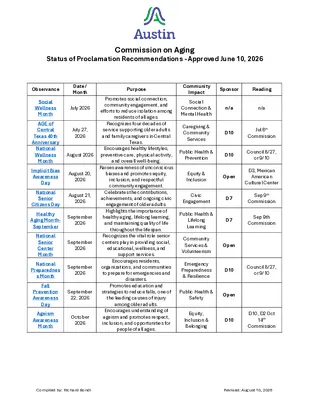
Commission on Aging Status of Proclamation Recommendations - Approved June 10, 2026 Observance Social Wellness Month AGE of Central Texas 40th Anniversary National Wellness Month Implicit Bias Awareness Day National Senior Citizens Day Healthy Aging Month- September National Senior Center Month National Preparednes s Month Fall Prevention Awareness Day Ageism Awareness Month Date / Month July 2026 July 27, 2026 August 2026 August 20, 2026 August 21, 2026 September 2026 September 2026 September 2026 September 22, 2026 October 2026 Purpose Promotes social connection, community engagement, and efforts to reduce isolation among residents of all ages. Recognizes four decades of service supporting older adults and family caregivers in Central Texas. Encourages healthy lifestyles, preventive care, physical activity, and overall well-being. Raises awareness of unconscious biases and promotes equity, inclusion, and respectful community engagement. Celebrates the contributions, achievements, and ongoing civic engagement of older adults. Highlights the importance of healthy aging, lifelong learning, and maintaining quality of life throughout the lifespan. Recognizes the vital role senior centers play in providing social, educational, wellness, and support services. Encourages residents, organizations, and communities to prepare for emergencies and disasters. Promotes education and strategies to reduce falls, one of the leading causes of injury among older adults. Encourages understanding of ageism and promotes respect, inclusion, and opportunities for people of all ages. Equity & Inclusion Open Community Impact Social Connection & Mental Health Caregiving & Community Services Public Health & Prevention Civic Engagement Public Health & Lifelong Learning Community Services & Volunteerism Emergency Preparedness & Resilience Sponsor Reading n/a n/a Jul 8th Commission Council 8/27, or 9/10 D3, Mexican American Cultural Center Sep 9th Commission Sep 9th Commission D10 D10 D7 D7 Open D10 Council 8/27, or 9/10 Public Health & Safety Open Equity, Inclusion & Belonging D10 D10, D2 Oct 14th Commission Compiled by: Richard Bondi Revised: August 10, 2026


Draft Age Friendly Austin Action Plan: 2026-2030 Last Updated: July 9, 2026 Focus Area One: Social Engagement, Connection, & Inclusion Aligns with Domains: 4-Social Participation, 5-Respect & Social Inclusion, 7-Communication & Information Goal 1: Improve access to technology and community information. Objective 1: Empower seniors through access to internet, digital devices, and training to use them confidently. Strategy 1: Develop and/or strengthen small scale tech lending libraries and expand hot spot check out program for tablets/laptops by identifying additional capacity to support programming. Partners: Austin Public Library (APL), Austin Free-Net (AFN), Austin Economic Development (AED), Commission on Aging, Travis County, AGE of Central Texas (AGE) Deadline: 2029 Metric: Identify grants to support programming Amount ($) of grant funding secured # of devices actively circulating annually Annual, device loan frequency per year. Strategy 2: Expand digital literacy programming including programming offered in Spanish and other languages frequently spoken by seniors. Partners: APL, AFN, Austin Parks and Recreation (APR), digitalLIFT, Hispanic/Latino Quality of Life Resource Advisory Commission, AGE, GAVA. Deadline: 2029 Metrics: # of non-English digital literacy classes held annually # of digital literacy classes held annually # of attendees # of attendees annually. Excerpted from: July 9, 2026 Final Draft Age Friendly Austin Action Plan: 2026-2030 Page 1 of 11 August 11, 2026 Draft Age Friendly Austin Action Plan: 2026-2030 Last Updated: July 9, 2026 Focus Area One: Social Engagement, Connection, & Inclusion Aligns with Domains: 4-Social Participation, 5-Respect & Social Inclusion, 7-Communication & Information Goal 1: Improve access to technology and community information (continued) Strategy 3: Expand broadband availability and affordability initiatives, prioritizing neighborhoods experiencing persistent connectivity gaps. Partners: AFN, Austin Technology Services (ATS), Technology Commission, Commission on Aging, Hispanic/Latino Quality of Life Resource Advisory Commission, GAVA, Austin Equity and Inclusion (AEI). Deadline: 2029 Metric: # of affordability programs created # of seniors enrolled in affordability programs. Objective 2: Optimize community information sharing and platforms to ensure seniors can intuitively navigate digital tools and understand essential resources. Strategy 1: Print materials using large fonts, clear language, and ensure access to multilingual materials. Partners: Lead: Austin Communications and Engagement (ACE), All City Departments, AEI. Deadline: ongoing Metric: % of public documents meeting Age-Friendly print standards. Strategy 2: Provide all printed and digital City communications targeting seniors in high-demand languages such as Spanish, Simplified Chinese, Vietnamese, Korean, etc. Partners: Lead: Austin Communications and Engagement, All City Departments, AEI. Deadline: ongoing Metric: % …


Draft Age Friendly Austin Action Plan: 2026-2030 Last Updated: July 9, 2026 Focus Area Two: Health, Mobility, and Accessibility Aligns with Domains: 8-Community & Health Services, 2-Transportation, and 1-Outdoors Spaces & Buildings Goal 1: Increase awareness and access to health, safety, and accessibility resources. Objective 1: Reduce use of non-urgent emergency services among seniors. Strategy 1: Support and increase capacity of the Senior Home Safety Program. Partners: Austin-Travis County Emergency Medical Services (ATCEMS), Commission on Aging, Austin Fire, Austin Police.3-1-1. Deadline: 2029 Metric: Year-over-year % decrease in non-injury fall calls for residents 55+. Strategy 2: Develop partnerships to recruit and train volunteers to conduct initial basic home assessments. Partners: University of St. Augustine for Health Sciences, ATCEMS, Austin-Travis County Medical Reserve Corps(MRC). Deadline: 2029 Metrics: # of partnerships developed. # of assessments completed by volunteers annually. Strategy 3: Implement senior specific pop-up resource clinics. Partners: ATCEMS, APH (Mobile Van Program and Community Health Worker Hub), APR. Deadline: 2029 Metrics: # of seniors served annually. # of pop-up clinics annually. Excerpted from: July 9, 2026 Final Draft Age Friendly Austin Action Plan: 2026-2030 Page 1 of 13 August 11, 2026 Draft Age Friendly Austin Action Plan: 2026-2030 Last Updated: July 9, 2026 Focus Area Two: Health, Mobility, and Accessibility Aligns with Domains: 8-Community & Health Services, 2-Transportation, and 1-Outdoors Spaces & Buildings Goal 1: Increase awareness and access to health, safety, and accessibility resources. (continued) Strategy 4: Develop health promotion and physical activity campaigns targeting older adults. Partners: APH, ATCEMS, ACE. Deadline: 2028 Metric: # of campaigns targeting older adults. Strategy 5: Distribute and promote newsletters (digital and print) that feature home safety tips, local fall prevention programming, and wellness resources to older adults and their caregivers. Partners: APH, ATCEMS, APR (Senior Activity Centers), ACE, MOWCTX, AGE, ASC, AAACAP, Family Eldercare, Capital City Village. Deadline: 2028 Metric: % increase in participation in fall prevention programming. Objective 2: Reduce the food insecurity score for seniors. Strategy 1: Advocate for increased funding for congregate meal programs at trusted locations of seniors such as senior activity centers, recreation centers, and community centers. Partners: APH, APR, MOWCTX, AAACAP. Deadline: 2029 Metrics: # of seniors served at congregate meal sites annually. Annual City budget allocation for congregate meal programs ($). Increase in frequency/# of congregate sites. Excerpted from: July 9, 2026 Final Draft Age Friendly Austin Action Plan: 2026-2030 Page 2 of 13 August 11, 2026 …
Draft Age Friendly Austin Action Plan: 2026-2030 Last Updated: July 9, 2026 Focus Area Three: Housing & Economic Security Aligns with Domains: 3-Housing and 6-Civic Engagement & Employment Goal 1: Increase housing security and access to home modification and repair programs to support seniors aging in place. Objective 1: Increase annual participation in city-funded home repair and modification programs for older adults. Strategy 1: Develop multi-lingual outreach campaigns to bridge the gap between service awareness and access. Partners: Austin Housing, APH, ACE. Deadline: 2027 Metrics: Translated materials created Outreach campaign launched. Strategy 2: Prioritize housing interventions that specifically address the top home repair and modification needs identified by seniors: pest control, grab bars/handrails, ramps, and accessible showers. Partners: Austin Housing, Meals on Wheels, Rebuilding Together. Deadline: 2028 Metrics: Annual # of targeted home modifications completed. Strategy 3: Conduct a geographic gap analysis of city-funded home repair programs to identify underserved neighborhoods and populations. Partners: Austin Housing, APH. Deadline: 2027 Metric: Gap analysis completed. Excerpted from: July 9, 2026 Final Draft Age Friendly Austin Action Plan: 2026-2030 Page 1 of 10 August 11, 2026 Draft Age Friendly Austin Action Plan: 2026-2030 Last Updated: July 9, 2026 Focus Area Three: Housing & Economic Security Aligns with Domains: 3-Housing and 6-Civic Engagement & Employment Goal 1: Increase housing security and access to home modification and repair programs to support seniors aging in place. (continued) Objective 1: Increase annual participation in city-funded home repair and modification programs for older adults. (continued) Strategy 4: Prioritize outreach to seniors with disabilities on available home modification assistance programs. Partners: Austin Housing. Deadline: Ongoing Metric: Annual # of platforms or events promoting home modification assistance programs prioritizing seniors with disabilities. Strategy 5: Promotion of programs to seniors, caregivers, and city council districts identified with the highest need. Partners: APH, Austin Housing, Community Ambassadors. Deadline: Ongoing Metric: Annually % increase in utilization of City and/or City funded home repair and modification programs. Strategy 6: Pair home repair initiatives with local economic development by creating a grant or incentive program for hyper- local, small businesses to become certified contractors for City-funded senior home modifications. Partners: Austin Housing, AED. Deadline: 2028 Metrics: # of hyper-local businesses participating as certified contractors. $ amount invested back into local businesses through created programs. Excerpted from: July 9, 2026 Final Draft Age Friendly Austin Action Plan: 2026-2030 Page 2 of 10 August 11, 2026 Draft …


Commission on Aging Build, Bridge, and Champion Framework for the Age-Friendly Austin Action Plan (2026–2030) The Commission on Aging adopts the following Build, Bridge, and Champion Framework to guide its work in support of the Age-Friendly Austin Action Plan (2026–2030). The Commission recognizes the Age-Friendly Austin Action Plan as the City’s primary roadmap for advancing the health, independence, engagement, inclusion, mobility, housing security, economic security, and overall quality of life of older adults. Since the creation of the original Age-Friendly Austin Action Plan in 2016, the Commission on Aging has played a central role in identifying priorities, engaging community stakeholders, and advancing Austin’s efforts to become a more age-friendly city. As the Age-Friendly Austin initiative has matured, the Commission’s role has evolved to focus on advancing key strategies within the Action Plan, fostering collaboration among partners, elevating the voices of older adults, and promoting accountability for results. The Commission further recognizes that City Council’s adoption of Resolution No. 20250605-084 marked a significant expansion of the City’s commitment to older adults by directing all City departments to incorporate age-friendly principles into their work, designate departmental points of contact, and participate in implementation of the Age-Friendly Austin Action Plan. This increased citywide engagement creates new opportunities for collaboration, coordination, and implementation across City departments and community partners while reinforcing the Action Plan as the City’s guiding framework for advancing the well-being of older adults. Accordingly, the Commission adopts the Age-Friendly Austin Action Plan as its primary organizing framework and the principal basis for establishing its priorities, activities, and areas of focus during the 2026–2030 planning period. Through the Build, Bridge, and Champion Framework, the Commission will focus its efforts on advancing selected strategies within the Action Plan, supporting implementation by City departments and community partners, acting as a force multiplier, and helping ensure that the needs and perspectives of older adults remain central to City decision-making. The Commission views its selected Build, Bridge, and Champion strategies not as a comprehensive list of all issues affecting older adults, but as the areas where the Commission believes it can have the greatest impact during the 2026–2030 planning period. Page 1 of 3 Commission on Aging Build, Bridge, and Champion Framework for the Age-Friendly Austin Action Plan (2026–2030) The Build, Bridge, and Champion strategies adopted by the Commission for each Age- Friendly Austin Action Plan Focus Area shall collectively constitute the Commission’s Age- Friendly Austin …

COMMISSION RECOMMENDATION Commission on Aging Recommendation Number: 20260812-009: Adoption of the Age-Friendly Austin Action Plan 2026–2030 The Austin Commission on Aging recommends adoption of the Age-Friendly Austin Action Plan 2026– 2030 to guide the City's work in supporting older adults and maintaining Austin's Age-Friendly designation. WHEREAS, the City of Austin has been recognized as a member of the WHO Age-Friendly network since 2016 and has demonstrated its commitment to making Austin an Age-Friendly community through implementation of the Age-Friendly Austin Action Plans for 2016–2020 and 2021–2025; and WHEREAS, persons 65 years of age and older are the fastest-growing age group in Austin, increasing from 55,695 residents, or 7.0 percent of the population, in 2010 to 91,733 residents, or 9.5 percent of the population, in 2020, a 64.7 percent increase1, making it increasingly important that the City plan for the needs of its growing older adult population; and WHEREAS, on June 5, 2025, the Austin City Council adopted Resolution No. 20250605-084, affirming the City's commitment to ensuring that Austin is an Age-Friendly community and improving the quality of life for older adults, directing City departments to provide services with an Age-Friendly perspective and incorporate the goals and strategies of the Age-Friendly Action Plan into how they fulfill their missions, and directing continued collaboration among the City Manager, Austin Public Health's Age-Friendly Program, and the Commission on Aging to support implementation of the Action Plan and assess the resources needed to carry out its goals and strategies; and WHEREAS, the Austin Older Adult Quality of Life Study identified significant challenges and disparities affecting older Austinites, including housing, transportation, health and food insecurity, social isolation, digital access, and access to inclusive and accessible community resources, and the Age-Friendly Austin Action Plan 2026–2030 includes goals and strategies that respond to many of these findings2; and WHEREAS, the Age-Friendly Austin Action Plan 2026–2030 was developed by Austin Public Health through an extensive public engagement process that included the Age-Friendly Austin Summit on February 20, 2026, review of the Austin Older Adult Quality of Life Study, stakeholder meetings, and a public comment survey conducted in June 2026, and reflects the priorities identified through those efforts; and 1 RESOLUTION NO. 20250605-084 2 Austin Older Adult Quality of Life Study 2025 Page 1 of 2 WHEREAS, the Age-Friendly Austin Action Plan 2026–2030 establishes measurable objectives, strategies, community and City partners, implementation timelines, and metrics to guide and assess …
COMMISSION RECOMMENDATION Commission on Aging Recommendation Number: 20260812-009: Adoption of the Age-Friendly Austin Action Plan 2026–2030 The Austin Commission on Aging recommends adoption of the Age-Friendly Austin Action Plan 2026– 2030 to guide the City's work in supporting older adults and maintaining Austin's Age-Friendly designation. WHEREAS, the City of Austin has been recognized as a member of the WHO Age-Friendly network since 2016 and has demonstrated its commitment to making Austin an Age-Friendly community through implementation of the Age-Friendly Austin Action Plans for 2016–2020 and 2021–2025; and WHEREAS, persons 65 years of age and older are the fastest-growing age group in Austin, increasing from 55,695 residents, or 7.0 percent of the population, in 2010 to 91,733 residents, or 9.5 percent of the population, in 2020, a 64.7 percent increase1, making it increasingly important that the City plan for the needs of its growing older adult population; and WHEREAS, on June 5, 2025, the Austin City Council adopted Resolution No. 20250605-084, affirming the City's commitment to ensuring that Austin is an Age-Friendly community and improving the quality of life for older adults, directing City departments to provide services with an Age-Friendly perspective and incorporate the goals and strategies of the Age-Friendly Action Plan into how they fulfill their missions, and directing continued collaboration among the City Manager, Austin Public Health's Age-Friendly Program, and the Commission on Aging to support implementation of the Action Plan and assess the resources needed to carry out its goals and strategies; and WHEREAS, the Austin Older Adult Quality of Life Study identified significant challenges and disparities affecting older Austinites, including housing, transportation, health and food insecurity, social isolation, digital access, and access to inclusive and accessible community resources, and the Age-Friendly Austin Action Plan 2026–2030 includes goals and strategies that respond to many of these findings2; and WHEREAS, the Age-Friendly Austin Action Plan 2026–2030 was developed by Austin Public Health through an extensive public engagement process that included the Age-Friendly Austin Summit on February 20, 2026, review of the Austin Older Adult Quality of Life Study, stakeholder meetings, and a public comment survey conducted in June 2026, and reflects the priorities identified through those efforts; and 1 RESOLUTION NO. 20250605-084 2 Austin Older Adult Quality of Life Study 2025 Page 1 of 2 WHEREAS, the Age-Friendly Austin Action Plan 2026–2030 establishes measurable objectives, strategies, community and City partners, implementation timelines, and metrics to guide and assess …
COMMISSION ON AGING MINUTES REGULAR MEETING WEDNESDAY, AUGUST 12, 2026 The Commission on Aging convened in a regular meeting on Wednesday, August 12, 2026, at Austin Energy Headquarters, Shudde Fath Assembly Hall, 4815 Mueller Blvd, in Austin, Texas. Chair Bondi called the Commission on Aging Meeting to order at 12:24 p.m. Commissioners in Attendance: Richard Bondi (Chair) Preston Tyree Fred Lugo Luan Tran Xiaoyi Zeng Commissioners in Attendance Remotely: Teresa Ferguson (Vice Chair) Suzanne Anderson Martin Kareithi Henry Van de Putte Jennifer Scott PUBLIC COMMUNICATION: GENERAL Carlos Soto – Community Advancement Network Work Events APPROVAL OF MINUTES 1. Approve the minutes of the Commission on Aging regular meeting of July 8, 2026. The July 8, 2026 minutes were approved on Commissioner Lugo’s motion, Vice Chair Ferguson’s second on a 10-0 vote. Commissioners Lane, Ozarowski, and Yee were absent. DISCUSSION ITEMS 1. Discussion regarding Chair Bondi’s orientation sessions for new commission members. Update by Chair Bondi. 2. Update on the status of the proclamation recommendations approved at the June 10, 2026 meeting. 1 Update by Chair Bondi. Item 2 was taken up after Item 4 without objection. 3. Discussion regarding the proposed City of Austin FY2026-27 budget and the status of commission recommendations. Update by Chair Bondi. 4. Discussion on the closed out 2021-2025 Age Friendly Austin Progress Report. Update by Chair Bondi. DISCUSSION AND ACTION ITEMS 5. Review and document changes to the draft version of the Age Friendly Action Plan (AFAP) 2026- 2030 Focus Area 1, discuss impacts on commission work, and approve the commission’s Focus Area One Work Plan. The Commission’s Focus Area One Work Plan was approved on Commissioner Scott’s motion, Commissioner Tyree’s second on a 10-0 vote. Commissioners Lane, Ozarowski, and Yee were absent. 6. Review and document changes to the draft version of AFAP 2026-2030 Focus Area 2, discuss impacts on commission work, and approve the Commission’s Focus Area Two Work Plan. The Commission’s Focus Area Two Work Plan was approved on Commissioner Van de Putte’s motion, Commissioner Anderson’s second on a 10-0 vote. Commissioners Lane, Ozarowski, and Yee were absent. 7. Discussion regarding commission priorities for AFAP 2026-2030 Focus Area 3 and possible action to approve a list of priorities. Postponed to September without objection. 8. Discussion and possible action to approve an internal framework that guides the Commission’s priorities for the next five years, to build, bridge, and champion key strategies from the …

REGULAR MEETING OF THE COMMISSION ON AGING WEDNESDAY, JULY 8, 2026, 12:00 P.M. AUSTIN CITY HALL, BOARDS & COMMISSIONS ROOM 301 W 2ND ST AUSTIN, TEXAS 78701 Some members of the Commission on Aging may be participating by videoconference. Public comment will be allowed in-person or remotely via telephone. Speakers may only register to speak on an item once either in-person or remotely and will be allowed up to three minutes to provide their comments. Registration no later than noon the day before the meeting is required for remote participation by telephone. To register to speak remotely, call or email Ryan Sperling, 512-974-3568, Ryan.Sperling@austintexas.gov. CURRENT COMMISSIONERS: Richard Bondi, Chair Teresa Ferguson, Vice Chair Suzanne Anderson Martin Kareithi Faith Lane Fred Lugo Judi Nudelman Agnieszka Ozarowski Jennifer Scott Luan Tran Preston Tyree Henry Van de Putte Selina Yee Xiaoyi Zeng AGENDA Proclamation for AGE of Central Texas’ 40th Anniversary – Presented by Councilmember Marc Duchen CALL TO ORDER PUBLIC COMMUNICATION: GENERAL The first ten speakers signed up prior to the meeting being called to order will each be allowed a three-minute allotment to address their concerns regarding items not posted on the agenda. APPROVAL OF MINUTES 1. Approve the minutes of the Commission on Aging regular meeting of June 10, 2026. STAFF BRIEFINGS 2. Update on a timeline for finalizing Age Friendly Action Plan 2026-2030. Briefing by Halana Kaleel, Community Engagement Specialist, and Nicole Alexander, Age Friendly Austin Program Coordinator, Austin Public Health. DISCUSSION ITEMS 3. Update on the July staff report to the Age Friendly Advisory Committee. 4. Discussion regarding the Age Friendly Action Plan Focus Area Two. 5. Update regarding the status of the proclamation recommendations approved at the June 10, 2026 meeting. 6. Discussion regarding the Commission on Aging’s 2026 Annual Internal Review and Report. 7. Discussion on the June 24th Joint Inclusion Committee (JIC) meeting, including Levers of Economic Mobility Index, briefing on the Human Rights Impact Review, new Equity Officer Dr. Joseph Allen, Austin Police Department (APD) Collective Sex Crimes Unit and discussion of APD engagement with the JIC, and newly established Native American and Indigenous Quality of Life Commission. DISCUSSION AND ACTION ITEMS 8. Discussion reviewing the commission’s working groups, and possible action to change working group membership. 9. Discussion regarding commission priorities for Age Friendly Action Plan Focus Areas One, and possible action to approve a list of priorities. 10. Discussion and possible action …

COMMISSION ON AGING MINUTES REGULAR MEETING WEDNESDAY, JUNE 10, 2026 The Commission on Aging convened in a regular meeting on Wednesday, June 10, 2026, at Austin City Hall, Boards and Commissions Room 1101, 301 W 2nd Street in Austin, Texas. Chair Bondi called the Commission on Aging Meeting to order at 12:07 p.m. Commissioners in Attendance: Richard Bondi (Chair) Fred Lugo Judi Nudelman Henry Van de Putte Xiaoyi Zeng Commissioners in Attendance Remotely: Teresa Ferguson (Vice Chair) Suzanne Anderson Faith Lane Jennifer Scott Preston Tyree Selina Yee PUBLIC COMMUNICATION: GENERAL None present. APPROVAL OF MINUTES 1. Approve the minutes of the Commission on Aging regular meeting of May 13, 2026. The minutes of the May 13, 2026 meeting were approved on Commissioner Nudelman’s motion, Commissioner Van de Putte’s second on an 11-0 vote. Commissioner Kareithi was off the dais. Commissioner Tran was absent. DISCUSSION ITEMS 2. Review of Age Friendly Action Plan Focus Area 1 and discussion about actions the commission can take to support the Age Friendly Action Plan Focus Area 1. Item 2 was taken up after Item 16 without objection. Discussion was held. 1 3. Discussion regarding the commission’s 2025 Annual Internal Review & Report. Discussion was held. 4. Update on topics discussed at the May 27th Joint Inclusion Committee meeting. Update by Chair Bondi. 5. Update on the progress of recommendations 20251210-008: Older Adult Icon on City Demographer Website and 20260311-009: Addressing the Digital Divide for Older Adults. Update by Chair Bondi. 6. Presentation regarding the Westminster CARES Foundation. Presentation by Charles Borst, Executive Director, Westminster. The presentation was made by Charles Borst, Executive Director, Westminster. DISCUSSION AND ACTION ITEMS 7. Approve a recommendation to Council for a proclamation on Social Wellness Month. The recommendation to Council for a proclamation on Social Wellness Month was approved on Commissioner Van de Putte’s motion, Commissioner Lugo’s second on a 12- 0 vote. Commissioner Tran was absent. 8. Approve a recommendation to Council for a proclamation on National Wellness Month. The recommendation to Council for a proclamation on National Wellness Month was approved on Commissioner Tyree’s motion, Commissioner Nudelman’s second on a 12-0 vote. Commissioner Tran was absent. 9. Approve a recommendation to Council for a proclamation on Implicit Bias Awareness Day The recommendation to Council for a proclamation on Implicit Bias Awareness Day was approved on Commissioner Van de Putte’s motion, Commissioner Nudelman’s second on an 11-0 vote. …
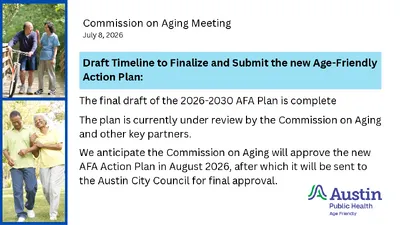
Commission on Aging Meeting July 8, 2026 Draft Timeline to Finalize and Submit the new Age-Friendly Action Plan: The final draft of the 2026-2030 AFA Plan is complete The plan is currently under review by the Commission on Aging and other key partners. We anticipate the Commission on Aging will approve the new AFA Action Plan in August 2026, after which it will be sent to the Austin City Council for final approval.
Commission on Aging Build, Bridge, and Champion Framework for the Age-Friendly Austin Action Plan (2026–2030) The Commission on Aging adopts the following Build, Bridge, and Champion Framework to guide its work in support of the Age-Friendly Austin Action Plan (2026–2030). The Commission recognizes the Age-Friendly Austin Action Plan as the City’s primary roadmap for advancing the health, independence, engagement, inclusion, mobility, housing security, economic security, and overall quality of life of older adults. Since the creation of the original Age-Friendly Austin Action Plan in 2016, the Commission on Aging has played a central role in identifying priorities, engaging community stakeholders, and advancing Austin’s efforts to become a more age-friendly city. As the Age-Friendly Austin initiative has matured, the Commission’s role has evolved to focus on advancing key strategies within the Action Plan, fostering collaboration among partners, elevating the voices of older adults, and promoting accountability for results. The Commission further recognizes that City Council’s adoption of Resolution No. 20250605-084 marked a significant expansion of the City’s commitment to older adults by directing all City departments to incorporate age-friendly principles into their work, designate departmental points of contact, and participate in implementation of the Age-Friendly Austin Action Plan. This increased citywide engagement creates new opportunities for collaboration, coordination, and implementation across City departments and community partners while reinforcing the Action Plan as the City’s guiding framework for advancing the well-being of older adults. Accordingly, the Commission adopts the Age-Friendly Austin Action Plan as its primary organizing framework and the principal basis for establishing its priorities, activities, and areas of focus during the 2026–2030 planning period. Through the Build, Bridge, and Champion Framework, the Commission will focus its efforts on advancing selected strategies within the Action Plan, supporting implementation by City departments and community partners, acting as a force multiplier, and helping ensure that the needs and perspectives of older adults remain central to City decision-making. The Commission views its selected Build, Bridge, and Champion strategies not as a comprehensive list of all issues affecting older adults, but as the areas where the Commission believes it can have the greatest impact during the 2026–2030 planning period. Page 1 of 3 Commission on Aging Build, Bridge, and Champion Framework for the Age-Friendly Austin Action Plan (2026–2030) The Build, Bridge, and Champion strategies adopted by the Commission for each Age- Friendly Austin Action Plan Focus Area shall collectively constitute the Commission’s Age- Friendly Austin …
Draft Age Friendly Austin Action Plan: 2026-2030 Last Updated: June 8, 2026 Focus Area Two: Health, Mobility, and Accessibility Aligns with Domains: 8-Community & Health Services, 2-Transportation, and 1-Outdoors Spaces & Buildings Goal 1: Increase awareness and access to health, safety, and accessibility resources. Objective 1: Reduce use of non-urgent emergency services among seniors. Strategy 1: Support and increase capacity of the Senior Home Safety Program. Partners: Austin-Travis County Emergency Medical Services (ATCEMS), Commission on Aging, Austin Fire, Austin Police. Deadline: 2029 Metric: Year-over-year % decrease in non-injury fall calls for residents 55+. Strategy 2: Develop partnerships to recruit and train volunteers to conduct initial basic home assessments. Partners: University of St. Augustine for Health Sciences, ATCEMS, Austin-Travis County Medical Reserve Corps. Deadline: 2029 Metrics: # of partnerships developed. # of assessments completed by volunteers annually. Strategy 3: Implement senior specific pop-up resource clinics. Partners: ATCEMS, APH Mobile Van Program and Community Health Worker Hub. Deadline: 2029 Metric: # of seniors served annually. Excerpted from: June 8, 2026 version of the Draft Age Friendly Austin Action Plan: 2026-2030 Page 1 of 8 Draft Age Friendly Austin Action Plan: 2026-2030 Last Updated: June 8, 2026 Focus Area Two: Health, Mobility, and Accessibility Aligns with Domains: 8-Community & Health Services, 2-Transportation, and 1-Outdoors Spaces & Buildings Goal 1: Increase awareness and access to health, safety, and accessibility resources. (continued) Objective 2: Reduce the food insecurity score for seniors. Strategy 1: Advocate for increased funding for congregate meal programs at trusted locations of seniors such as senior activity centers, recreation centers, and community centers. Partners: APH, APR, MOWCTX. Deadline: 2029 Metric: # of seniors served at congregate meal sites annually. Strategy 2: Expand home-delivered meal options and grocery delivery programs for home-bound seniors, and seniors living with disabilities. Partners: MOWCTX. Deadline: 2029 Metric: # of home-delivered meals provided to seniors annually. Strategy 3: Distribute multilingual resources on nutritious meal choices through trusted City partners, City spaces most visited by seniors, and Austin Public Health sites and community health workers. Partners: APH, MOWCTX, APL, APR, Central Texas Food Bank. Deadline: 2027 Metric: # of nutrition-related educational resources available in top requested languages (Spanish, Chinese, Vietnamese, Korean). Excerpted from: June 8, 2026 version of the Draft Age Friendly Austin Action Plan: 2026-2030 Page 2 of 8 Draft Age Friendly Austin Action Plan: 2026-2030 Last Updated: June 8, 2026 Focus Area Two: Health, Mobility, and Accessibility …
Draft Age Friendly Austin Action Plan: 2026-2030 Last Updated: June 8, 2026 Focus Area One: Social Engagement, Connection, & Inclusion Aligns with Domains: 4-Social Participation, 5-Respect & Social Inclusion, 7-Communication & Information Focus Area Two: Health, Mobility, and Accessibility Aligns with Domains: 8-Community & Health Services, 2-Transportation, and 1-Outdoors Spaces & Buildings Focus Area Three: Housing & Economic Security Aligns with Domains: 3-Housing and 6-Civic Engagement & Employment July 6, 2026 Page 1 of 1
Commission on Aging Initial Work Plan for Age Friendly Action Plan Focus Area One Goal 1: Improve access to technology and community information. Item Reach Out to Them Check with AF Staff on Their Plans Do We Need Add’l Info? Possibly Defer to Work Group √ √ √ √ √ √ Connect with Technology Commission to explore common goals Connect with APL to learn about their programming for older adults Connect with Digital Lift, AGE Technology Learning Lab and others to explore common goals Focus on internet access where there are gaps, referring to areas in QoL Study. Investigate the possibility of developing or driving an access map, showing areas where internet service isn’t available to older adults. Investigate the possibility of a lending library, not just laptops and hotspots (e.g., include DME). Use our advisory role through our appointing body to drive additional connectivity. √ √ √ √ √ Due 4Q 2026 4Q 2026 4Q 2026 4Q 2026 2Q 2027 3Q 2027 4Q 2026 Compiled by: Richard Bondi Page 1 of 3 07-06-2026 Commission on Aging Initial Work Plan for Age Friendly Action Plan Focus Area One Goal 2: Reduce social isolation through inclusive, diverse community engagement. Item Reach Out to Them Check with AF Staff on Their Plans Do We Need Add’l Info? Possibly Defer to Work Group Due Expand low-cost and free programming at City recreation and senior centers to reduce financial barriers. Raise awareness of social isolation and loneliness as a community issue(educate policy makers, public). Use our advisory role to advocate through our appointing bodies to drive changes. Ensure we’re staying connecting to our appointing bodies. Reduce social isolation for homebound persons – find organizations that visit people’s homes, develop a toolkit for homebound seniors. Explore where the off ramp is from certain programs like Home Health that transition into actual living focusing on free community-based practices including faith and interfaith communities. √ √ √ √ √ √ √ √ √ √ √ √ √ √ √ 4Q 2026 4Q 2026 4Q 2026 4Q 2026 1Q 2027 1Q 2027 Compiled by: Richard Bondi Page 2 of 3 07-06-2026 Commission on Aging Initial Work Plan for Age Friendly Action Plan Focus Area One Goal 3: Integrate older adults into City planning and governance. Item Investigate live streaming our meetings. Research ways to kick-start a Community Ambassador program, possibly with help from Senior/Recreation Center staff and volunteers …
COMMISSION ON AGING MINUTES REGULAR MEETING WEDNESDAY, JULY 8, 2026 The Commission on Aging convened in a regular meeting on Wednesday, July 8, 2026, at Austin City Hall, Boards and Commissions Room 1101, 301 W 2nd Street in Austin, Texas. Chair Bondi called the Commission on Aging Meeting to order at 12:12 p.m. Commissioners in Attendance: Richard Bondi (Chair) Suzanne Anderson Fred Lugo Judi Nudelman Agnieszka Ozarowski Xiaoyi Zeng Commissioners in Attendance Remotely: Teresa Ferguson (Vice Chair) Martin Kareithi Faith Lane Preston Tyree Henry Van de Putte Selina Yee PUBLIC COMMUNICATION: GENERAL None present. APPROVAL OF MINUTES 1. Approve the minutes of the Commission on Aging regular meeting of June 10, 2026. The minutes of the June 10, 2026 meeting were approved on Commissioner Nudelman’s motion, Vice Chair Ferguson’s second on an 11-0 vote. Commissioner Kareithi was off the dais. Commissioners Scott and Tran were absent. STAFF BRIEFINGS 2. Update on a timeline for finalizing Age Friendly Action Plan 2026-2030. Briefing by Halana Kaleel, Community Engagement Specialist, and Nicole Alexander, Age Friendly Austin Program Coordinator, Austin Public Health. 1 The briefing was made by Nicole Alexander, Age Friendly Austin Program Coordinator, Austin Public Health. DISCUSSION ITEMS 3. Update on the July staff report to the Age Friendly Advisory Committee. Update by Chair Bondi. 4. Discussion regarding the Age Friendly Action Plan Focus Area Two. Discussion was held. 5. Update regarding the status of the proclamation recommendations approved at the June 10, 2026 meeting. Update by Chair Bondi. 6. Discussion regarding the Commission on Aging’s 2026 Annual Internal Review and Report. Discussion was held. 7. Discussion on the June 24th Joint Inclusion Committee (JIC) meeting, including Levers of Economic Mobility Index, briefing on the Human Rights Impact Review, new Equity Officer Dr. Joseph Allen, Austin Police Department (APD) Collective Sex Crimes Unit and discussion of APD engagement with the JIC, and newly established Native American and Indigenous Quality of Life Commission. Discussion was held. DISCUSSION AND ACTION ITEMS 8. Discussion reviewing the commission’s working groups, and possible action to change working group membership. The Federal Budget Reduction Working Group, FY2026-26 Budget Recommendation Follow-Up Working Group, and Quality of Life Transition Working Group were dissolved without objection. Commissioner Zeng was added to the Quality of Life Study Analysis Working Group on Commissioner Anderson’s motion, Commissioner Tyree’s second on a 12-0 vote. Commissioners Scott and Tran were absent. 9. Discussion regarding commission priorities …