ITEM07 C15-2026-0005 LATE BACKUP MAR9 OPPOSITION — original pdf
Backup
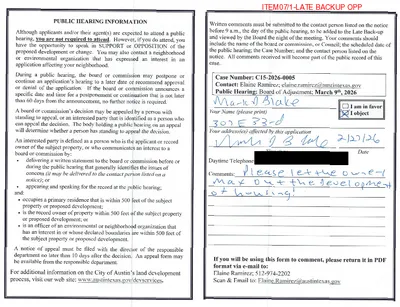
ITEM07/1-LATE BACKUP OPP ITEM07/2-LATE BACKUP OPP accommodate the space they want, in order to meet Austin's impervious cover requirement for their property. By increasing impervious cover, you restore balance between the FAR & IC provisions. This is key: obtain the density improvement that Austin critically needs without driving it upward. Please, DO NOT touch the HOME FAR provisions. Please, DO NOT count attics toward FAR...unless you're a huge fan of flat & low slope roofs, and the cartoonishly ugly McMansion roofs and dormers. Please DO NOT allow these 2 proposed measures to become "uncoupled". Understand them as a packaged deal, a matching set. Be conscientious of horizontal vs vertical area. Keep them balanced. Thank you very much for your time & attention. TRAVIS LUCY, RA PRINCIPAL LLVLL A follow up "in the weeds" note about impervious cover: I heard 2nd hand that during the HOME workshops to draft the ordinance, it was Watershed that shot down any suggestion of impervious cover increase, declaring it a non-starter for stormwater management / safety reasons. I hope that this is negotiable, but if not, there are other, more subtle ways to alleviate the IC pinch: 1. Direct DSD to modify their definition of impervious cover as follows: - Pervious pavements & concretes count as pervious, period, INCLUDING driveways. - Wood decks do not count toward impervious cover: rainwater either evaporates or drops through to the ground below, thus, these have no bearing on flood risk. (Applies to similar open-jointed, perforated assemblies) - Horizontal solid surfaces narrower than 1'-0" width (with +1'-0" uncovered ground on either side) do not count toward impervious cover. (Pool copings, tops of walls, etc.) Similar reasoning to wood decks: these items have a negligible impact on stormwater infiltration, but pose a significant burden on site IC calculations. DSD's current interpretations on these items are unusual and overly conservative, and are contributing to the "upward pressure" we all want to avoid. Simply by defining "impervious" more pragmatically, we'd free up a good amount of 'low' space for housing density. 2. Direct Watershed to design a "rainwater collection incentive" that translates to an impervious cover reduction. They should design a reasonable, acheivable rainwater storage volume -to- impervious area trade, that will incentivize designers, builders and homeowners to start capturing rainwater for irrigation. This is a no- ITEM07/3-LATE BACKUP OPP ITEM07/4-LATE BACKUP OPP ITEM07/5-LATE BACKUP OPP ITEM07/6-LATE BACKUP OPP ITEM07/7-LATE BACKUP OPP ITEM07/8-LATE BACKUP OPP ITEM07/9-LATE BACKUP OPP ITEM07/10-LATE BACKUP OPP