ITEM09 C15-2025-0035 LATE BACKUP NOV10 SUPP — original pdf
Backup
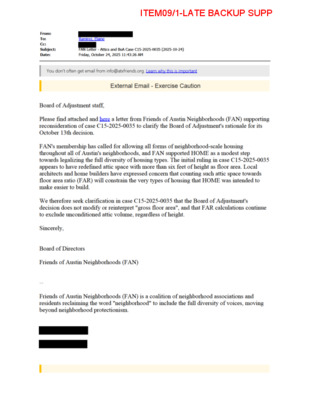
ITEM09/1-LATE BACKUP SUPP An inclusive voice for Austin neighborhoods. Felicity Maxwell Zilker President Roger L. Cauvin Downtown Treasurer October 24, 2025 RE: Board of Adjustment Case C15-2025-0035 Board of Adjustment staff, Friends of Austin Neighborhoods (FAN) supports reconsideration of case C15-2025-0035 to clarify the Board of Adjustment's rationale for its October 13th decision. FAN's membership has called for allowing all forms of neighborhood-scale housing throughout all of Austin's neighborhoods, and FAN supported HOME as a modest step towards legalizing the full diversity of housing types. The initial ruling in case C15-2025-0035 appears to have redefined attic space with more than six feet of height as floor area. Local architects and home builders have expressed concern that counting such attic space towards floor area ratio (FAR) will constrain the very types of housing that HOME was intended to make easier to build. We therefore seek clarification in case C15-2025-0035 that the Board of Adjustment's decision does not modify or reinterpret "gross floor area", and that FAR calculations continue to exclude unconditioned attic volume, regardless of height. Respectfully, Board of Directors of Friends of Austin Neighborhoods (FAN) Friends of Austin Neighborhoods (FAN) is a coalition of neighborhood associations and residents reclaiming the word “neighborhood” to include the full diversity of voices, moving beyond neighborhood protectionism. ITEM09/2-LATE BACKUP SUPP October 24, 2025 Board of Appeals RE: October 13th Board of Appeals Attic Ruling Dear Board of Appeals, A concern has been raised within the AIA Housing Committee regarding a change to the definition of Floor-to-Area-Ratio. The letter below aims to outline the significant implications of this change carefully. We kindly request that the Board of Appeals review these concerns and consider our constructive solutions. Urgent Request: Rescind or Clarify the October 13 BOA Attic Ruling At its October 13, 2025 hearing, its is our understanding that the Austin Board of Adjustment unintentionally created a new citywide policy redefining attic space as “floor area” whenever the head height exceeds six feet, regardless of whether that area is structural, habitable, or accessible. This reinterpretation, inserted spontaneously into a motion at the end of a long and contentious meeting, rewrites how Floor Area Ratio (FAR) is calculated across Austin. The new rule was not fully analyzed, nor intended. Yet it instantly renders thousands of existing homes technically noncompliant, halts numerous projects in progress, and undermines core city goals around housing a9ordability, density, architectural diversity, and good governance. This decision was made under conditions of fatigue, frustration, and bias, by the Board’s own admission. We would urgently request that this be corrected. A Compromised Decision-Making Environment The Board had explicitly agreed to keep the ruling narrow, yet under pressure and exhaustion, it adopted sweeping new language with enormous policy impact. The resulting decision was not the product of reasoned deliberation. What the Motion Did ITEM09/3-LATE BACKUP SUPP The added motion language states that “the definition of floor is not limited to whether the floor is load-bearing or not.” This means any attic space with more than six feet of headroom now counts toward a home’s FAR, even if that space: • Is unfinished or non-structural, • Cannot support normal occupancy, or • Exists only as roof volume enclosing insulation, ductwork, and mechanical systems. This interpretation contradicts long-standing sta9 practice and was not necessary to decide the underlying case. It was a late insertion that has since been treated as precedent by city sta9, creating citywide implications far beyond the parcel in question. Why This Is a Serious Mistake 1. Austin Is Already Drowning in Overlapping Regulations Austin’s built environment is already strangled by complexity. Designers and builders are spending increasing amounts of time decoding contradictions instead of creating housing. Adding attic geometry and ceiling-height micromanagement to this labyrinth is not helping or reforming. 2. Attics Are Geometrically Complex Spaces Attics are irregular, sloped, and multidimensional. They are not cleanly measurable “floors.” The slope of a roof, the position of framing members, and insulation depth all vary continuously. Forcing designers to model every cubic inch of attic volume to prove compliance is unproductive and not possible. It adds days or weeks of work to each permit without improving safety, aesthetics, or livability, and it will increase the cost of design. 3. Functional Attics Are Critical to Livable, E1icient Homes Attics are not aesthetic indulgences, they are essential for serviceability and long-term durability. • HVAC systems, water heaters, and ductwork require adequate clearance. ITEM09/4-LATE BACKUP SUPP • Workers need safe, walkable access to perform maintenance. • Modern energy codes demand insulation and air-sealing assemblies that benefit from usable attic space. • Water Heaters need to be located inside the building envelope to survive Austin's annual freezes. This ruling would force smaller, pinched attics where technicians cannot safely operate, guaranteeing poorer maintenance, lower energy e9iciency, and faster system failures. The result will be worse homes for Austin families hotter, less e9icient, and more expensive to maintain. 4. The City Is E1ectively Confiscating Space From Homeowners By newly counting attic volume as “floor area,” the City has reduced the amount of conditioned space a homeowner can legally build under FAR limits. This change devalues property rights and shrinks usable living space without notice, public debate, or Council action. Thousands of existing homes now technically exceed their legal FAR. Countless projects in review are frozen or must be redesigned. This is regulation by accident, and it inflicts real financial harm to thousands of property owners. 5. It Undermines A1ordability and Density Goals Every square foot lost to attic volume is a square foot that can no longer be used for living space. That means: • Smaller, less functional homes for the same land cost. • Higher prices per square foot of usable space. • Fewer bedrooms within existing envelopes, reducing practical density. This ruling directly contradicts the HOME initiative and the City’s stated goal of enabling more attainable infill housing within established neighborhoods. Instead of unlocking space, it locks it away inside unusable attics. 6. It Disproportionately Harms Lower-Income Homeowners Wealthier builders can redesign around new rules. Larger properties can absorb the extra ITEM09/5-LATE BACKUP SUPP FAR. Smaller builders and homeowners, especially in older East Austin neighborhoods, cannot. They lack the resources to re-engineer roofs, resubmit permits, or pay for new calculations. This ruling therefore deepens Austin’s existing inequities: • • It makes modest infill projects financially infeasible. It punishes those least able to adapt. 7. It Damages Traditional Architectural Styles Austin’s historic rooflines, gable, dormer, and Craftsman forms, depend on attic volume. Under this interpretation, those traditional profiles now “spend” FAR ine9iciently. The ruling thus pushes designers toward flat-roofed boxes, sacrificing character and proportion for compliance. 8. It Produces an Avalanche of Practical and Legal Problems • No grace period: Hundreds of projects currently in review are suddenly noncompliant. • Retroactive nonconformance: Thousands of existing homes now violate FAR limits. • Administrative overload: Plan reviewers will face waves of confusion, appeals, and reinterpretations. • Financial loss: Redesigns, resubmittals, and delays will add thousands of dollars per project. • Legal exposure: Builders and homeowners will rightly argue that this ruling is ultra vires—beyond the Board’s authority. 9. Procedural and Legal Impropriety The Board of Adjustment is empowered to decide individual appeals and interpretations, not to legislate citywide rules. Creating a new standard for how “floor area” is measured, applicable to every zoning district, exceeds the Board’s remit. This issue should have been heard as a separate, noticed interpretation case, allowing input from sta9, AIA Austin, ITEM09/6-LATE BACKUP SUPP builders, and the public. Instead, the ruling was improvised mid-motion after hours of debate. That violates both due process and the spirit of transparent governance. 10. Environmental and Sustainability Impacts Flattened roofs, sealed attics, and reduced ventilation undermine Austin’s energy goals. • Low-slope roofs absorb more heat and increase cooling loads. • Eliminating attic airspace reduces insulation performance. • Forced redesigns waste materials and carbon embodied in existing plans. A policy change this broad deserves environmental review, not accidental midnight adoption. What Should Be Done 1. Rescind or Amend the October 13 Motion Remove the attic/FAR reinterpretation entirely and rea9irm the Board’s intent to rule narrowly on the original case. 2. Restore Sta1 Practice Immediately Direct city sta9 to continue applying the long-standing interpretation: non-load-bearing attic space does not count toward FAR. 3. If Further Study Is Desired, Do It Properly Place the issue on a noticed interpretation docket or direct Council to initiate a policy review with stakeholder participation (AIC, AIA, RECA, neighborhood representatives). 4. Provide a Grace Period for Current Projects Ensure projects already submitted are reviewed under the prior interpretation to prevent chaos in the permitting pipeline. Summary This is not a small error; it is a citywide policy change made unintentionally by a Board that was tired and frustrated. It upends years of established practice, punishes good design, erodes a9ordability, and undermines trust in due process. Bad design creates bad policy. ITEM09/7-LATE BACKUP SUPP The original board case brought to BOA was a non-compliant project to begin with; it should be deemed impermissible and handled discreetly. However, creating policy around this one case only penalizes those who are designing in good faith, which is a vast majority of architects and builders in our community. If allowed to stand, this ruling will make Austin’s housing crisis worse, not better. It will yield uglier buildings, fewer attainable homes, and higher costs for everyone. The Board must rescind this language immediately, or City leadership must intervene to restore rational governance to the process. Sincerely, Blair McKay, AIA AIA Austin Public Role & Advocacy Commissioner, 2025 ITEM09/8-LATE BACKUP SUPP ITEM09/9-LATE BACKUP SUPP ITEM09/10-LATE BACKUP SUPP