REGULAR MEETING OF THE AUSTIN TRAVIS COUNTY PUBLIC HEALTH COMMISSION WEDNESDAY, NOVEMBER 4TH, 2026, AT 2:30 P.M. CITY HALL, BOARD & COMMISSION ROOM, ROOM 1101 301 W. 2nd STREET AUSTIN, TEXAS Some members of the Austin Travis County Public Health Commission may be participating by videoconference. The meeting may be viewed online at: http://www.austintexas.gov/page/watch- atxn-live Public comment will be allowed in-person or remotely via telephone. Speakers may only register to speak on an item once either in-person or remotely and will be allowed up to three minutes to provide their comments. Registration no later than noon the day before the meeting is required for remote participation by remotely, contact Daniela Romero, daniela.romero@austintexas.gov or Juanita Jackson at Juanita.jackson@austintexas.gov. telephone. To to speak register CURRENT BOARD MEMBERS OR COMMISSIONERS: William Rice, Chair Cara Dahlhausen, Vice Chair Jawad Ali Hanan Alwan Lamanda Ballard Martha Lujan Jacob Whity EX-OFFICIO BOARD MEMBERS/COMMISSIONERS: Adrienne Sturrup, Director, Austin Public Health Dr. Desmar Walkes, Austin/Travis County Public Health Authority Ana Almaguel, Division Director, Travis County Health & Human Services Perla Cavazos, Deputy Administrator, Central Health AGENDA CALL TO ORDER PUBLIC COMMUNICATION: GENERAL The first 5 speakers signed up prior to the meeting being called to order will each be allowed a three- minute allotment to address their concerns regarding items not posted on the agenda. APPROVAL OF MINUTES 1. Approve the minutes of the Public Health Commission Regular Meeting on September 2nd, 2026. DISCUSSION ITEMS 2. 3. 4. Presentation from Dr. Katherine Brown regarding the potential public health impacts of the proposed Dogs Head Development Presentation from Kelly Nichols, Carmen Llanes and Chris Reyes on food access and equity. Discussion of future strategic priorities and forward-looking plans. DISCUSSION AND ACTION ITEMS 5. Discuss and approve member nomination of the Public Health Commission to the Joint Sustainability Committee. FUTURE AGENDA ITEMS ADJOURNMENT The City of Austin is committed to compliance with the Americans with Disabilities Act. Reasonable modifications and equal access to communications will be provided upon request. For assistance, please contact the Liaison or TTY users’ route through 711. A person may request language access accommodations no later than 48 hours before the scheduled meeting. Please contact Daniela Romero at Austin Public Health, at daniela.romero@austintexas.gov, or Juanita Jackson at Juanita.jackson@austintexas.gov to request service or for additional information. For more information on the Public Health Commission, please contact Daniela Romero at daniela.romero@austintexas.gov or Juanita Jackson at Juanita.jackson@austintexas.gov.
A S T R A T E G I C I N V I T A T I O N | 2 0 2 7 Beyond the Charter The opportunity to become a continuously learning public health community AU S T IN / T RAV IS C O U NT Y P U BLIC HEALT H C O MMIS S IO N T H E C H A R T E R It began with a clear charge. In 2022, City and County leaders established a joint advisory Commission. “Explore the best/evidence-based public health practices ... and provide recommendations.” City Code § 2-1-174(E)(1) • amended October 23, 2025 ATC PUBLIC HEALTH COMMISSION | 2027 VISION 02 T H E C H A R T E R Five responsibilities. An expansive mandate. The charter tells us what outcomes to seek—not which technologies to use. 01 02 03 04 05 Evidence Identify evidence-based improvements Recommendations Advise City and County on programs and services Equity Address disparities among underserved populations Community voice Incorporate resident input on budgets and programs Accountability Report periodically to elected leaders ATC PUBLIC HEALTH COMMISSION | 2027 VISION 03 T H E O P P O R T U N I T Y A system of systems Community health emerges from interconnected systems—and improves when we (a) understand how they interact and (b) accelerate such interactions. HOUSING TRANSPORT HEALTHCARE ECONOMY COMMUNITY HEALTH ENVIRONMENT SOCIAL SERVICES BRAIN HEALTH All seven domains also interact with one another. ATC PUBLIC HEALTH COMMISSION | 2027 VISION 05 T H E I N F L E C T I O N P O I N T Then the scientific possibilities changed. AI is not just another administrative tool. AGENDA 1 Use AI now AGENDA 2 Advance the science Improve surveillance, evidence synthesis, coordination, communications, and program evaluation. Develop stronger causal, temporal, multiscale, and decision-oriented methods for community health. ATC PUBLIC HEALTH COMMISSION | 2027 VISION 06 A G E N D A 1 | A P P L Y First: make public health work smarter. Near-term AI applications can support the professionals and services already in place. EARLIER WARNING FASTER INSIGHT Detect emerging risks and shifts in service demand Synthesize evidence and compare options BETTER ACCESS STRONGER EVALUATION Identify referral and service bottlenecks Track changes in quality, outcomes, and equity ATC PUBLIC HEALTH COMMISSION | 2027 VISION 07 A G E N D A …
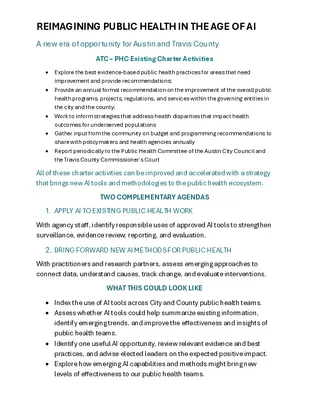
REIMAGINING PUBLIC HEALTH IN THE AGE OF AI A new era of opportunity for Austin and Travis County ATC – PHC Existing Charter Activities • Explore the best evidence-based public health practices for areas that need improvement and provide recommendations; • Provide an annual formal recommendation on the improvement of the overall public health programs, projects, regulations, and services within the governing entities in the city and the county; • Work to inform strategies that address health disparities that impact health outcomes for underserved populations • Gather input from the community on budget and programming recommendations to share with policymakers and health agencies annually • Report periodically to the Public Health Committee of the Austin City Council and the Travis County Commissioner’s Court All of these charter activities can be improved and accelerated with a strategy that brings new AI tools and methodologies to the public health ecosystem. TWO COMPLEMENTARY AGENDAS 1. APPLY AI TO EXISTING PUBLIC HEALTH WORK With agency sta(cid:431), identify responsible uses of approved AI tools to strengthen surveillance, evidence review, reporting, and evaluation. 2. BRING FORWARD NEW AI METHODS FOR PUBLIC HEALTH With practitioners and research partners, assess emerging approaches to connect data, understand causes, track change, and evaluate interventions. WHAT THIS COULD LOOK LIKE • Index the use of AI tools across City and County public health teams. • Assess whether AI tools could help summarize existing information, identify emerging trends, and improve the e(cid:431)ectiveness and insights of public health teams. • Identify one useful AI opportunity, review relevant evidence and best practices, and advise elected leaders on the expected positive impact. • Explore how emerging AI capabilities and methods might bring new levels of e(cid:431)ectiveness to our public health teams.
Public Health Commission November 4 , 2026 th Kelly Nichols, Woollard Nichols Torres Consulting (Food Plan Backbone Lead) Why This Work, Why Now The 2024 Austin/Travis County Food Plan set the vision shaped by 3,500+ community voices and cross- sector leadership. The Collaborative exists to turn the Food Plan from vision into action. Built so the people most affected by food insecurity help lead the work, not just inform it. What We’re Building: The Food Plan Collaborative A cross-sector network for coordination, accountability, and long-term food system change. Quarterly Collaborative meetings, open to anyone Five working groups carry the work between meetings: Grow Local Food Buy & Serve Better Food Support Food Workers Get Food to People Rescue and Reuse Food Who’s at the Table (2026 by the Numbers) 220 total community members engaged 121 active participants, over 1/3 with lived experience Representation across every food system area, with Health & Food Access the largest share (about a third) 62.8%Lived Experience37.2% What’s Ahead for the Collaborative Drafting a Collaborative Charter: purpose, membership, decision-making, evaluation Building shared ways to track progress on Food Plan strategies Pursuing funding for resident-led leadership, so people with lived experience of food insecurity can step into and stay in leadership roles How You Can Help Move the Food Plan Forward 1) Get involved, and bring others with you Join a working group or a quarterly Collaborative meeting. Connect us with people in your networks who work in or are affected by the food system, especially people with lived experience. 2) Partner with the Food Policy Board to bring food and health issues to policymakers.
Dog’s Head What is going on? Dog’s Head Scope & Location: Covers 2,614 acres along a pristine, biodiverse stretch of the Colorado River. Controversy: A 45-year binding agreement negotiated with limited public oversight or review by the Planning or Environmental Commissions. Background • In May 2026, the Austin City Council approved a Tax Increment Reinvestment Zone (TIRZ), based in part, from statements made by the project's developer, Endeavor Real Estate Group who described the Dog’s Head as“bombed out” (blighted) to justify the need for public tax subsidies to finance infrastructure. • This statement disagrees with descriptions by the residents. • A lawsuit has been filed in September 2026 challenging the justification of the TIRZ which can be used for blighted areas. The suit alleges that the deal functions as an unconstitutional gift of public funds to a private entity. It also claims the city unconstitutionally signed away its legislative and regulatory powers by allowing the developer to veto municipal zoning, water quality, and land development regulations for the next 45 years. • dogshead.com is a source of information about the development prepared by the ENDEVOR Real Estate Group Key Concerns (1) • Development Standards: The original agreement sets minimal regulations, allowing up to 100% impervious cover on 2,614 acres. The current estimates are that 79% is allowed for impervious cover.. This leaves 384+ acres for Open Space but this includes the CWQZ (see below), • Water & Floodplain Impact: Shrinks the Critical Water Quality Zone to 200 feet (allowing roads, utilities, and golf cart trails within it) and permits unlimited floodplain modifications. The 200 ft CWQZ increases in some areas. The acreage in this Zone is unclear and estimates have been from 234-266 acres. • This leaves at most 150 acres for Open Space – approximately 93% impervious cover of the area that can be developed outside of the CWQZ. • What is means is loss of green space, urban heat island effects, and increased flooding risks if the allowed amount of impervious cover is implemented in the development. Key Concerns (2) • Unrestricted Cut & Fill: Exempts the entire property from normal city cut-and-fill limits (typically 4–8 ft), exacerbating erosion risks. • Bypassing Regulations: Grants the Director of Development Services sole authority to approve variances to the Land Development Code without public hearings or City Council votes. Key Concerns (3) • Water Quality Ponds: Uses former mining ponds for …
AUSTIN TRAVIS COUNTY PUBLIC HEALTH COMMISSION Wednesday, September 2nd, 2026 AUSTIN TRAVIS COUNTY PUBLIC HEALTH COMMISSION REGULAR MEETING MINUTES Wednesday, September 2nd, 2026 The Austin Travis County Public Health Commission convened in a regular meeting on Wednesday, September 2nd, 2026, at 301 West 2nd Street in Austin, Texas. Vice Chair Cara Dahlhausen called the Austin Travis County Public Health Commission Meeting to order at 2:39 pm. Board Members/Commissioners in Attendance: Cara Dahlhausen, Vice Chair William Rice Jawad Ali Martha Lujan Board Members/Commissioners in Attendance Remotely: Jacob Whitty Board Members/Commissioners Absent: None Ex-Officio and Staff in Attendance: Adrienne Sturrup, Director, Austin Public Health Dr. Desmar Walkes, Austin/Travis County Public Health Authority Ana Almaguel, Division Director, Travis County Health & Human Services Megan Cermak, Director of Public Health Strategy, Policy and Disaster Response, Central Health Dani Romero, Staff Liaison, Austin Public Health Juanita Jackson, Staff Liaison, Austin Public Health Ex-Officio and Staff in Attendance Remotely: NONE Ex-Officio and Staff Absent: Perla Cavazos PUBLIC COMMUNICATION: GENERAL Community Advancement Network (CAN) – Carlos A Soto- Provided information on organizational structure, upcoming events and services they provide for the community. APPROVAL OF MINUTES 1. Approve the minutes of the Austin Travis County Public Health Commission regular meeting on September 2nd, 2026. The minutes for the regular meeting of June 3rd, 2026, were approved on Commissioner’s William Rice motion, Commissioner Martha Lujan second on a 5-0 vote. DISCUSSION AND ACTION ITEMS 2. Conducted officer election for Chair and Vice Chair. The motion to conduct officer election for Chair and Vice Chair was made by Commissioner William Rice and second by Commissioner Martha Lujan Commissioner William Rice was nominated for the position of Chair by Commissioner Jawad Ali. No other nominations were made. Commissioner William Rice was elected as Chair without objections. Commissioner Cara Dahlhausen was nominated for the position of Vice Chair by Commissioner Martha Lujan. No other nominations were made. Commissioner Cara Dahlhausen was elected as Vice chair without objections. 3. Approved the 2027 annual schedule for the Austin Travis County Public Health Commission. The motion to approve the 2027 annual schedule was approved on Commissioner William Rice’s motion, Commissioner Jawad Ali’s second on a 5 -0 vote. 4. Discuss and approve draft recommendation “Sexual Health Funding” created by Commissioner Jacob Whitty. The motion to approve the recommendation to Council titled “Sexual Health Funding” was approved on Commissioner William Rice’s motion, Commissioner Martha Lujan’s second …
REGULAR MEETING OF THE AUSTIN TRAVIS COUNTY PUBLIC HEALTH COMMISSION WEDNESDAY, SEPTEMBER 2nd, 2026, AT 2:30 P.M. CITY HALL, BOARD & COMMISSION ROOM, ROOM 1101 301 W. 2nd STREET AUSTIN, TEXAS Some members of the Austin Travis County Public Health Commission may be participating by videoconference. The meeting may be viewed online at: http://www.austintexas.gov/page/watch- atxn-live Public comment will be allowed in-person or remotely via telephone. Speakers may only register to speak on an item once either in-person or remotely and will be allowed up to three minutes to provide their comments. Registration no later than noon the day before the meeting is required for remote participation by remotely, contact Daniela Romero, daniela.romero@austintexas.gov or Juanita Jackson at Juanita.jackson@austintexas.gov. telephone. To to speak register CURRENT BOARD MEMBERS OR COMMISSIONERS: Cara Dahlhausen, Chair Jawad Ali Martha Lujan William Rice Jacob Whitty EX-OFFICIO BOARD MEMBERS/COMMISSIONERS: Adrienne Sturrup, Director, Austin Public Health Dr. Desmar Walkes, Austin/Travis County Public Health Authority Ana Almaguel, Division Director, Travis County Health & Human Services Perla Cavazos, Deputy Administrator, Central Health AGENDA CALL TO ORDER PUBLIC COMMUNICATION: GENERAL The first 5 speakers signed up prior to the meeting being called to order will each be allowed a three- minute allotment to address their concerns regarding items not posted on the agenda. APPROVAL OF MINUTES 1. Approve the minutes of the Public Health Commission Regular Meeting on June 3rd, 2026. DISCUSSION AND ACTION ITEMS 2. 3. 4. Conduct officer election for Chair and Vice Chair. Approve the 2027 annual schedule of the Austin Travis County Public Health Commission. Discuss and approve draft recommendation “Sexual Health Funding” created by Commissioner Jacob Whitty. FUTURE AGENDA ITEMS ADJOURNMENT The City of Austin is committed to compliance with the Americans with Disabilities Act. Reasonable modifications and equal access to communications will be provided upon request. For assistance, please contact the Liaison or TTY users’ route through 711. A person may request language access accommodations no later than 48 hours before the scheduled meeting. Please contact Daniela Romero at Austin Public Health, at daniela.romero@austintexas.gov, or Juanita Jackson at Juanita.jackson@austintexas.gov to request service or for additional information. For more information on the Public Health Commission, please contact Daniela Romero at daniela.romero@austintexas.gov or Juanita Jackson at Juanita.jackson@austintexas.gov.
RECOMMENDATION TO COUNCIL Austin Travis County Public Health Commission Recommendation Number: [20260902-004]: Sexual Health Funding Preservation Date of Approval: Wednesday, September 2nd, 2026 Recommendation: This recommendation seeks to stabilize long-term funding sources to address sexually transmitted infections (STIs) and Human Immunodeficiency Virus (HIV) in the Austin/Travis County area through prevention, testing, linkage to care, treatment, retention, and supportive services. This recommendation directly addresses priorities outlined by Austin/Travis County as a Fast-Track City to end urban HIV epidemics, including goals to reach 95% of people living with HIV knowing their status, 95% are on treatment, and 95% maintain viral suppression by 2030. Description of Recommendation to Council: WHEREAS gonorrhea, chlamydia, syphilis, and HIV infections are reportable conditions to Austin Public Health (APH), WHEREAS APH provides core public health services not covered by other STI/HIV service providers, WHEREAS there is an overburdened demand for STI/HIV testing and treatment in Austin/Travis County for local service providers, WHEREAS trends for congenital syphilis cases have increased across Texas, leading to preventable infant illness and death, WHEREAS incidence rates for HIV are higher in Texas than the national average, WHEREAS gonorrhea, chlamydia, and syphilis co-infections are more common in people living with HIV and those at highest risk of acquiring HIV, WHEREAS STI/HIV incidence rates are consistently higher in Black and Hispanic people compared with White people, WHEREAS STI/HIV incidence rates are higher in men who have sex with men (MSM) and transgender people compared with their heterosexual and cisgender counterparts, WHEREAS investing in STI/HIV prevention efforts is more cost-effective than treatment, WHEREAS preventing one new HIV infection yields an estimated $300,000+ cost saved for lifetime medical costs, WHEREAS APH’s funding for STI/HIV programs is largely grant-reliant, and Disease Intervention Specialists (DIS)/Public Health Follow-up (PHFU) and HIV Surveillance are completely reliant on grant funding, WHEREAS Austin Public Health performs DIS/PHFU Surveillance for all of Travis County, WHEREAS federal budget negotiations demonstrate a shift in funding priorities and potential loss of STI/HIV funding, WHEREAS federal directives have threatened or already removed targeted approaches that serve people most disproportionately impacted by HIV, WHEREAS STI/HIV community partners are experiencing financial setbacks due to loss of funding and changing federal initiatives, WHEREAS vulnerable populations are at-risk for worse health outcomes with loss of funding, WHEREAS loss of grant funding for DIS/PHFU and HIV Surveillance would affect partner investigations, handling outbreaks, and community health data, WHEREAS any reduction to STI/HIV funding …
RECOMMENDATION TO COUNCIL Austin Travis County Public Health Commission Recommendation Number: [20260902-004]: Sexual Health Funding Preservation Date of Approval: Wednesday, September 2nd, 2026 Recommendation: This recommendation seeks to stabilize long-term funding sources to address sexually transmitted infections (STIs) and Human Immunodeficiency Virus (HIV) in the Austin/Travis County area through prevention, testing, linkage to care, treatment, retention, and supportive services. This recommendation directly addresses priorities outlined by Austin/Travis County as a Fast-Track City to end urban HIV epidemics, including goals to reach 95% of people living with HIV knowing their status, 95% are on treatment, and 95% maintain viral suppression by 2030. Description of Recommendation to Council: WHEREAS gonorrhea, chlamydia, syphilis, and HIV infections are reportable conditions to Austin Public Health (APH), WHEREAS APH provides core public health services not covered by other STI/HIV service providers, WHEREAS there is an overburdened demand for STI/HIV testing and treatment in Austin/Travis County for local service providers, WHEREAS trends for congenital syphilis cases have increased across Texas, leading to preventable infant illness and death, WHEREAS incidence rates for HIV are higher in Texas than the national average, WHEREAS gonorrhea, chlamydia, and syphilis co-infections are more common in people living with HIV and those at highest risk of acquiring HIV, WHEREAS STI/HIV incidence rates are consistently higher in Black and Hispanic people compared with White people, WHEREAS STI/HIV incidence rates are higher in men who have sex with men (MSM) and transgender people compared with their heterosexual and cisgender counterparts, WHEREAS investing in STI/HIV prevention efforts is more cost-effective than treatment, WHEREAS preventing one new HIV infection yields an estimated $300,000+ cost saved for lifetime medical costs, WHEREAS APH’s funding for STI/HIV programs is largely grant-reliant, and Disease Intervention Specialists (DIS)/Public Health Follow-up (PHFU) and HIV Surveillance are completely reliant on grant funding, WHEREAS Austin Public Health performs DIS/PHFU Surveillance for all of Travis County, WHEREAS federal budget negotiations demonstrate a shift in funding priorities and potential loss of STI/HIV funding, WHEREAS federal directives have threatened or already removed targeted approaches that serve people most disproportionately impacted by HIV, WHEREAS STI/HIV community partners are experiencing financial setbacks due to loss of funding and changing federal initiatives, WHEREAS vulnerable populations are at-risk for worse health outcomes with loss of funding, WHEREAS loss of grant funding for DIS/PHFU and HIV Surveillance would affect partner investigations, handling outbreaks, and community health data, WHEREAS any reduction to STI/HIV funding …
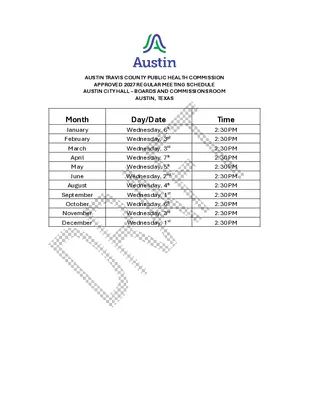
AUSTIN TRAVIS COUNTY PUBLIC HEALTH COMMISSION APPROVED 2027 REGULAR MEETING SCHEDULE AUSTIN CITY HALL – BOARDS AND COMMISSIONS ROOM AUSTIN, TEXAS Month January February March April May June August September October November December Day/Date Wednesday, 6th Wednesday, 3rd Wednesday, 3rd Wednesday, 7th Wednesday, 5th Wednesday, 2nd Wednesday, 4th Wednesday, 1st Wednesday, 6th Wednesday, 3rd Wednesday, 1st Time 2:30 PM 2:30 PM 2:30 PM 2:30 PM 2:30 PM 2:30 PM 2:30 PM 2:30 PM 2:30 PM 2:30 PM 2:30 PM
AUSTIN TRAVIS COUNTY PUBLIC HEALTH COMMISSION Wednesday, September 2nd, 2026 AUSTIN TRAVIS COUNTY PUBLIC HEALTH COMMISSION REGULAR MEETING MINUTES Wednesday, September 2nd, 2026 The Austin Travis County Public Health Commission convened in a regular meeting on Wednesday, September 2nd, 2026, at 301 West 2nd Street in Austin, Texas. Vice Chair Cara Dahlhausen called the Austin Travis County Public Health Commission Meeting to order at 2:39 pm. Board Members/Commissioners in Attendance: Cara Dahlhausen, Vice Chair William Rice Jawad Ali Martha Lujan Board Members/Commissioners in Attendance Remotely: Jacob Whitty Board Members/Commissioners Absent: None Ex-Officio and Staff in Attendance: Adrienne Sturrup, Director, Austin Public Health Dr. Desmar Walkes, Austin/Travis County Public Health Authority Ana Almaguel, Division Director, Travis County Health & Human Services Megan Cermak, Director of Public Health Strategy, Policy and Disaster Response, Central Health Dani Romero, Staff Liaison, Austin Public Health Juanita Jackson, Staff Liaison, Austin Public Health Ex-Officio and Staff in Attendance Remotely: NONE Ex-Officio and Staff Absent: Perla Cavazos PUBLIC COMMUNICATION: GENERAL Community Advancement Network (CAN) – Carlos A Soto- Provided information on organizational structure, upcoming events and services they provide for the community. APPROVAL OF MINUTES 1. Approve the minutes of the Austin Travis County Public Health Commission regular meeting on September 2nd, 2026. The minutes for the regular meeting of June 3rd, 2026, were approved on Commissioner’s William Rice motion, Commissioner Martha Lujan second on a 5-0 vote. DISCUSSION AND ACTION ITEMS 2. Conducted officer election for Chair and Vice Chair. The motion to conduct officer election for Chair and Vice Chair was made by Commissioner William Rice and second by Commissioner Martha Lujan Commissioner William Rice was nominated for the position of Chair by Commissioner Jawad Ali. No other nominations were made. Commissioner William Rice was elected as Chair without objections. Commissioner Cara Dahlhausen was nominated for the position of Vice Chair by Commissioner Martha Lujan. No other nominations were made. Commissioner Cara Dahlhausen was elected as Vice chair without objections. 3. Approved the 2027 annual schedule for the Austin Travis County Public Health Commission. The motion to approve the 2027 annual schedule was approved on Commissioner William Rice’s motion, Commissioner Jawad Ali’s second on a 5 -0 vote. 4. Discuss and approve draft recommendation “Sexual Health Funding” created by Commissioner Jacob Whitty. The motion to approve the recommendation to Council titled “Sexual Health Funding” was approved on Commissioner William Rice’s motion, Commissioner Martha Lujan’s second …
REGULAR MEETING OF THE AUSTIN TRAVIS COUNTY PUBLIC HEALTH COMMISSION WEDNESDAY, JUNE 3RD, 2026, AT 2:30 P.M. CITY HALL, BOARD & COMMISSION ROOM, ROOM 1101 301 W. 2nd STREET AUSTIN, TEXAS Some members of the Austin Travis County Public Health Commission may be participating by videoconference. The meeting may be viewed online at: http://www.austintexas.gov/page/watch- atxn-live Public comment will be allowed in-person or remotely via telephone. Speakers may only register to speak on an item once either in-person or remotely and will be allowed up to three minutes to provide their comments. Registration no later than noon the day before the meeting is required for remote participation by remotely, contact Daniela Romero, daniela.romero@austintexas.gov or Juanita Jackson at Juanita.jackson@austintexas.gov. telephone. To to speak register CURRENT BOARD MEMBERS OR COMMISSIONERS: Natalie Poindexter, Chair Cara Dahlhausen, Vice Chair Jawad Ali Chris Crookham Jacob Whitty Martha Lujan William Rice EX-OFFICIO BOARD MEMBERS/COMMISSIONERS: Adrienne Sturrup, Director, Austin Public Health Dr. Desmar Walkes, Austin/Travis County Public Health Authority Ana Almaguel, Division Director, Travis County Health & Human Services Perla Cavazos, Deputy Administrator, Central Health AGENDA CALL TO ORDER PUBLIC COMMUNICATION: GENERAL The first 5 speakers signed up prior to the meeting being called to order will each be allowed a three- minute allotment to address their concerns regarding items not posted on the agenda. APPROVAL OF MINUTES 1. Approve the minutes of the Public Health Commission Regular Meeting on May 6th, 2026. DISCUSSION ITEMS 2. 3. Receive updates from commissioners on assigned action items. Discuss agenda schedule for the remainder of FY 2026 regular meetings. DISCUSSION AND ACTION ITEMS 4. 5. 6. Discuss and approve “Bridging Public Health Funding” recommendation created by Commissioner Chris Crookham. Discuss and approve draft recommendation “Sexual Health Funding” created by Commissioner Jacob Whitty. Discuss and approve draft recommendation “Heat-Related Illness Prevention for Outdoor Workers” created by Vice Chair Cara Dahlhausen. FUTURE AGENDA ITEMS ADJOURNMENT The City of Austin is committed to compliance with the Americans with Disabilities Act. Reasonable modifications and equal access to communications will be provided upon request. For assistance, please contact the Liaison or TTY users’ route through 711. A person may request language access accommodations no later than 48 hours before the scheduled meeting. Please contact Daniela Romero at Austin Public Health, at daniela.romero@austintexas.gov, or Juanita Jackson at Juanita.jackson@austintexas.gov to request service or for additional information. For more information on the Public Health Commission, please contact Daniela Romero …
RECOMMENDATION TO COUNCIL Austin Travis County Public Health Commission Recommendation Number: [YYYYMMDD-XXX] (XXX is the agenda item number): Sexual Health Funding Preservation Date of Approval: Recommendation: This recommendation seeks to stabilize long-term funding sources to address sexually transmitted infections (STIs) and Human Immunodeficiency Virus (HIV) in the Austin/Travis County area through prevention, testing, linkage to care, treatment, retention, and supportive services. This recommendation directly addresses priorities outlined by Austin/Travis County as a Fast-Track City to end urban HIV epidemics, including goals to reach 95% of people living with HIV knowing their status, 95% are on treatment, and 95% maintain viral suppression by 2030. Description of Recommendation to Council: WHEREAS gonorrhea, chlamydia, syphilis, and HIV infections are reportable conditions to Austin Public Health (APH), WHEREAS APH provides core public health services not covered by other STI/HIV service providers, WHEREAS there is an overburdened demand for STI/HIV testing and treatment in Austin/Travis County for local service providers, WHEREAS trends for congenital syphilis cases have increased across Texas, leading to preventable infant illness and death, WHEREAS incidence rates for HIV are higher in Texas than the national average, WHEREAS gonorrhea, chlamydia, and syphilis co-infections are more common in people living with HIV and those at highest risk of acquiring HIV, WHEREAS STI/HIV incidence rates are consistently higher in Black and Hispanic people compared with White people, WHEREAS STI/HIV incidence rates are higher in men who have sex with men (MSM) and transgender people compared with their heterosexual and cisgender counterparts, WHEREAS investing in STI/HIV prevention efforts is more cost-effective than treatment, WHEREAS preventing one new HIV infection yields an estimated $300,000+ cost saved for lifetime medical costs, WHEREAS APH’s funding for STI/HIV programs is largely grant-reliant, and Disease Intervention Specialists (DIS)/Public Health Follow-up (PHFU) and HIV Surveillance are completely reliant on grant funding, WHEREAS federal budget negotiations demonstrate a shift in funding priorities and potential loss of STI/HIV funding, WHEREAS federal directives have threatened or already removed targeted approaches that serve people most disproportionately impacted by HIV, WHEREAS STI/HIV community partners are experiencing financial setbacks due to loss of funding and changing federal initiatives, WHEREAS vulnerable populations are at-risk for worse health outcomes with loss of funding, WHEREAS loss of grant funding for DIS/PHFU and HIV Surveillance would affect partner investigations, handling outbreaks, and community health data, WHEREAS any reduction to STI/HIV funding would negatively impact the Austin/Travis County community. Rationale: NOW THEREFORE …
. RECOMMENDATION TO COUNCIL Austin Travis County Public Health Commission Recommendation Number: 20260603-004 BRIDGING PUBLIC HEALTH FUNDING: WHEREAS according to the 2025 Austin-Travis County Community Health Assessment (CHA), the foundation of health in Austin and Travis County is shaped by longstanding structural conditions. Historical patterns of racial segregation, economic exclusion, and neighborhood disinvestment continue to influence present-day access to education, income, and opportunity. These inequities are especially pronounced in East Austin, where residents face compounded disadvantages, and WHEREAS the City of Austin 1928 Master Plan designated then East Avenue as the dividing racial line between East and West Austin, which was later replaced by Interstate 35, serving as a reinforced physical barrier between East and West Austin, and WHEREAS the CHA demonstrates that Interstate 35 traffic and congestion have exacerbated health disparities of those living in East Austin, leading to less access to quality care and healthy foods, increased rates of chronic diseases such as diabetes and infectious disease, poor maternal health outcomes, and increased socioeconomic inequities, and WHEREAS the CHA shows that Interstate 35 creates chronic stressors such as traffic noise, heat, and pollution, leading to poor mental health and stress of those living nearby, and WHEREAS City Council has touted Cap and Stitch as a once in a generation opportunity to repair the physical divide created by Interstate 35 and assist in repairing over 100 years of segregation, and WHEREAS City Council has welcomed the creation of new public spaces for civic participation and unlocking long-term economic and community benefits, and WHEREAS the CHA clearly illustrates that neighborhoods east of Interstate 35 tend to have a lower life expectancy compared to neighborhoods west of Interstate 35, ranging as low as 69 years old in East Austin and as high as 88 years old in West Austin. Data show that residents in historically underserved areas, particularly in East Austin, continue to experience shorter lifespans due to higher rates of chronic disease, fewer health care options, and limited access to other key . resources, pointing to the urgent need for place-based investments and equity-focused public health strategies to close the life expectancy gap and improve outcomes for all residents, and WHEREAS according to the CHA, the conditions of the neighborhoods where people live have a direct and lasting impact on health outcomes. Insecure housing, poor walkability, exposure to traffic dangers, and gaps in infrastructure don’t just limit mobility, they compound …
AUSTIN TRAVIS COUNTY PUBLIC HEALTH COMMISSION Wednesday, May 6th, 2026 AUSTIN TRAVIS COUNTY PUBLIC HEALTH COMMISSION REGULAR MEETING MINUTES Wednesday, May 6th, 2026 The Austin Travis County Public Health Commission convened in a regular meeting on Wednesday, May 6th, 2026, at 301 West 2nd Street in Austin, Texas. Chair Natalie Poindexter called the Austin Travis County Public Health Commission Meeting to order at 2:35 pm. Board Members/Commissioners in Attendance: Natalie Poindexter, Chair Chris Crookham Jawad Ali Board Members/Commissioners in Attendance Remotely: Cara Dahlhausen, Vice Chair Martha Lujan Jacob Whitty William Rice Board Members/Commissioners Absent: None Ex-Officio and Staff in Attendance: Adrienne Sturrup, Director, Austin Public Health Dr. Desmar Walkes, Austin/Travis County Public Health Authority Alicia Ramirez, Government Affairs, Central Health Dani Romero, Staff Liaison, Austin Public Health Juanita Jackson, Staff Liaison, Austin Public Health Ex-Officio and Staff in Attendance Remotely: None Ex-Officio and Staff Absent: Ana Almaguel Perla Cavazos Megan Cermak PUBLIC COMMUNICATION: GENERAL Nicholas Littlejohn raised urgent safety and maintenance concerns regarding the Dove Springs Public Health Clinic. He reported a lack of facility upkeep, noting holes in the walls, potholes, debris like needles and diapers in the parking lot, missing restroom sharps containers, and the alleged use of banned Glyphosate. Additionally, Mr. Littlejohn highlighted critical security issues, including an adjacent encampment where individuals with weapons have reportedly harassed clinic staff, and noted operational problems with broken electric vehicle charging stations and outdated information. He concluded by stating he has compiled a complete list of these ongoing issues for the Commission's review. APPROVAL OF MINUTES 1. Approve the minutes of the Austin Travis County Public Health Commission regular meeting on May 6th, 2026. The minutes for the regular meeting of April 1st, 2026, were approved on Commissioner William Rice’s motion, Commissioner Chris Crookham’s second on a 7-0 vote. DISCUSSION ITEMS 1. Presentation and demonstration of RADD Platform by APH staff. The presentation was made by Phillip Bays, Christopher Collins and Brian Morris. 2. Receive updates from commissioners on assigned action items. Discussed. 3. Discuss draft recommendation “Sexual Health Funding” created by Commissioner Jacob Whitty. Commissioner Whitty presented the draft recommendation. Commissioners and ex- officio’s provided input and proposed changes. Commissioner Whitty will take input and rework the recommendation. 4. Discuss draft recommendation “Heat-Related Illness Prevention for Outdoor Workers”. Commissioner Dahlhausen presented the draft recommendation. Commissioners and ex-officio’s provided input and proposed changes. Commissioner Whitty will take input and rework …
. RECOMMENDATION TO COUNCIL Austin Travis County Public Health Commission Recommendation Number: 20260603-004 BRIDGING PUBLIC HEALTH FUNDING: WHEREAS according to the 2025 Austin-Travis County Community Health Assessment (CHA), the foundation of health in Austin and Travis County is shaped by longstanding structural conditions. Historical patterns of racial segregation, economic exclusion, and neighborhood disinvestment continue to influence present-day access to education, income, and opportunity. These inequities are especially pronounced in East Austin, where residents face compounded disadvantages, and WHEREAS the City of Austin 1928 Master Plan designated then East Avenue as the dividing racial line between East and West Austin, which was later replaced by Interstate 35, serving as a reinforced physical barrier between East and West Austin, and WHEREAS the CHA demonstrates that Interstate 35 traffic and congestion have exacerbated health disparities of those living in East Austin, leading to less access to quality care and healthy foods, increased rates of chronic diseases such as diabetes and infectious disease, poor maternal health outcomes, and increased socioeconomic inequities, and WHEREAS the CHA shows that Interstate 35 creates chronic stressors such as traffic noise, heat, and pollution, leading to poor mental health and stress of those living nearby, and WHEREAS City Council has touted Cap and Stitch as a once in a generation opportunity to repair the physical divide created by Interstate 35 and assist in repairing over 100 years of segregation, and WHEREAS City Council has welcomed the creation of new public spaces for civic participation and unlocking long-term economic and community benefits, and WHEREAS the CHA clearly illustrates that neighborhoods east of Interstate 35 tend to have a lower life expectancy compared to neighborhoods west of Interstate 35, ranging as low as 69 years old in East Austin and as high as 88 years old in West Austin. Data show that residents in historically underserved areas, particularly in East Austin, continue to experience shorter lifespans due to higher rates of chronic disease, fewer health care options, and limited access to other key . resources, pointing to the urgent need for place-based investments and equity-focused public health strategies to close the life expectancy gap and improve outcomes for all residents, and WHEREAS according to the CHA, the conditions of the neighborhoods where people live have a direct and lasting impact on health outcomes. Insecure housing, poor walkability, exposure to traffic dangers, and gaps in infrastructure don’t just limit mobility, they compound …
AUSTIN TRAVIS COUNTY PUBLIC HEALTH COMMISSION Wednesday, June 3rd, 2026 AUSTIN TRAVIS COUNTY PUBLIC HEALTH COMMISSION REGULAR MEETING MINUTES Wednesday, June 3rd, 2026 The Austin Travis County Public Health Commission convened in a regular meeting on Wednesday, June 3rd, 2026, at 301 West 2nd Street in Austin, Texas. Chair Natalie Poindexter called the Austin Travis County Public Health Commission Meeting to order at 2:38 pm. Board Members/Commissioners in Attendance: Natalie Poindexter, Chair Chris Crookham Jacob Whitty Board Members/Commissioners in Attendance Remotely: Jawad Ali William Rice Board Members/Commissioners Absent: None Cara Dahlhausen, Vice Chair Martha Lujan Ex-Officio and Staff in Attendance: Adrienne Sturrup, Director, Austin Public Health Dr. Desmar Walkes, Austin/Travis County Public Health Authority Ana Almaguel, Division Director, Travis County Health & Human Services Dani Romero, Staff Liaison, Austin Public Health Juanita Jackson, Staff Liaison, Austin Public Health Ex-Officio and Staff in Attendance Remotely: Megan Cermak Ex-Officio and Staff Absent: Perla Cavazos PUBLIC COMMUNICATION: GENERAL NONE APPROVAL OF MINUTES 1. Approve the minutes of the Austin Travis County Public Health Commission regular meeting on June 3rd, 2026. The minutes for the regular meeting of May 6th, 2026, were approved on Commissioner Jacob Whitty’s motion, Commissioner William Rice second on a 5-0 vote. DISCUSSION ITEMS 2. 3. Received updates from commissioners on assigned action items. Discussed. Discussed agenda schedule for the remainder of FY 2026 regular meetings Discussed. DISCUSSION AND ACTION ITEMS 4. 5. 6. Discuss and approve “Bridging Public Health Funding” recommendation created by Commissioner Chris Crookham. The motion to approve the recommendation to Council titled “Bridging Public Health Funding” was approved on Commissioner Jacob Whitty motion, Commissioner Jawad Ali’s second on a 5-0 vote. Discuss and approve draft recommendation “Sexual Health Funding” created by Commissioner Jacob Whitty. No action was taken at this time. Discuss and approve draft recommendation “Heat-Related Illness Prevention for Outdoor Workers” created by Vice Chair Cara Dahlhausen. No action was taken at this time. FUTURE AGENDA ITEMS 7. 8. 9. Discuss Texas Harm Reduction Discuss Communities in Schools of Central Texas Discuss and potentially vote on recommendations ADJOURNMENT Chair Natalie Poindexter adjourned the meeting at 3:25 p.m. without objection. The minutes were approved at the September 2nd, 2026 meeting on Commissioner William Rice motion, Commissioner Martha Lujan’s second with a 5-0 vote. 2
REGULAR MEETING OF THE AUSTIN TRAVIS COUNTY PUBLIC HEALTH COMMISSION WEDNESDAY, MAY 6TH, 2026, AT 2:30 P.M. CITY HALL, BOARD & COMMISSION ROOM, ROOM 1101 301 W. 2nd STREET AUSTIN, TEXAS Some members of the Austin Travis County Public Health Commission may be participating by videoconference. The meeting may be viewed online at: http://www.austintexas.gov/page/watch- atxn-live Public comment will be allowed in-person or remotely via telephone. Speakers may only register to speak on an item once either in-person or remotely and will be allowed up to three minutes to provide their comments. Registration no later than noon the day before the meeting is required for remote participation by remotely, contact Daniela Romero, daniela.romero@austintexas.gov or Juanita Jackson at Juanita.jackson@austintexas.gov. telephone. To to speak register CURRENT BOARD MEMBERS OR COMMISSIONERS: Natalie Poindexter, Chair Cara Dahlhausen, Vice Chair Jawad Ali Chris Crookham Jacob Whitty Martha Lujan William Rice EX-OFFICIO BOARD MEMBERS/COMMISSIONERS: Adrienne Sturrup, Director, Austin Public Health Dr. Desmar Walkes, Austin/Travis County Public Health Authority Ana Almaguel, Division Director, Travis County Health & Human Services Perla Cavazos, Deputy Administrator, Central Health AGENDA CALL TO ORDER PUBLIC COMMUNICATION: GENERAL The first 5 speakers signed up prior to the meeting being called to order will each be allowed a three- minute allotment to address their concerns regarding items not posted on the agenda. APPROVAL OF MINUTES 1. Approve the minutes of the Public Health Commission Regular Meeting on April 1st, 2026. DISCUSSION ITEMS 2. 3. 4. 5. 6. Presentation and demonstration of RADD Platform by Phillip Bays, Christopher Collins and Brian Morris. Receive updates from commissioners on assigned action items. Discuss draft recommendation “Sexual Health Funding” created by Commissioner Jacob Whitty. Discuss draft recommendation “Heat-Related Illness Prevention for Outdoor Workers”. Discuss commissioner terms. DISCUSSION AND ACTION ITEMS 7. 8. Discuss and approve “Bridging Public Health Funding” recommendation created by Commissioner Chris Crookham. Approve commission bylaws. FUTURE AGENDA ITEMS ADJOURNMENT The City of Austin is committed to compliance with the Americans with Disabilities Act. Reasonable modifications and equal access to communications will be provided upon request. For assistance, please contact the Liaison or TTY users’ route through 711. A person may request language access accommodations no later than 48 hours before the scheduled meeting. Please contact Daniela Romero at Austin Public Health, at daniela.romero@austintexas.gov, or Juanita Jackson at Juanita.jackson@austintexas.gov to request service or for additional information. For more information on the Public Health Commission, please contact Daniela …
RECOMMENDATION TO COUNCIL Austin Travis County Public Health Commission Recommendation Number: [YYYYMMDD-XXX] (XXX is the agenda item number): Sexual Health Funding Preservation Date of Approval: Recommendation: This recommendation seeks to stabilize long-term funding sources to address sexually transmitted infections (STIs) and Human Immunodeficiency Virus (HIV) in the Austin/Travis County area through prevention, testing, linkage to care, treatment, retention, and supportive services. This recommendation directly addresses priorities outlined by Austin/Travis County as a Fast-Track City to end urban HIV epidemics, including goals to reach 95% of people living with HIV knowing their status, 95% are on treatment, and 95% maintain viral suppression by 2030. Description of Recommendation to Council: WHEREAS gonorrhea, chlamydia, syphilis, and HIV infections are reportable conditions to Austin Public Health (APH), WHEREAS APH provides core public health services not covered by other STI/HIV service providers, WHEREAS there is an overburdened demand for STI/HIV testing and treatment in Austin/Travis County for local service providers, WHEREAS trends for congenital syphilis cases have increased across Texas, leading to preventable infant illness and death, WHEREAS incidence rates for HIV are higher in Texas than the national average, WHEREAS gonorrhea, chlamydia, and syphilis co-infections are more common in people living with HIV and those at highest risk of acquiring HIV, WHEREAS STI/HIV incidence rates are consistently higher in Black and Hispanic people compared with White people, WHEREAS STI/HIV incidence rates are higher in men who have sex with men (MSM) and transgender people compared with their heterosexual and cisgender counterparts, WHEREAS investing in STI/HIV prevention efforts is more cost-effective than treatment, WHEREAS preventing one new HIV infection yields an estimated $300,000+ cost saved for lifetime medical costs, WHEREAS APH’s funding for STI/HIV programs is largely grant-reliant, and Disease Intervention Specialists (DIS)/Public Health Follow-up (PHFU) and HIV Surveillance are completely reliant on grant funding, WHEREAS federal budget negotiations demonstrate a shift in funding priorities and potential loss of STI/HIV funding, WHEREAS federal directives have threatened or already removed targeted approaches that serve people most disproportionately impacted by HIV, WHEREAS STI/HIV community partners are experiencing financial setbacks due to loss of funding and changing federal initiatives, WHEREAS vulnerable populations are at-risk for worse health outcomes with loss of funding, WHEREAS loss of grant funding for DIS/PHFU and HIV Surveillance would affect partner investigations, handling outbreaks, and community health data, WHEREAS any reduction to STI/HIV funding would negatively impact the Austin/Travis County community. Rationale: NOW THEREFORE …
. RECOMMENDATION TO COUNCIL Austin Travis County Public Health Commission Recommendation Number: 20260506-007 BRIDGING PUBLIC HEALTH FUNDING: WHEREAS according to the 2025 Austin-Travis County Community Health Assessment (CHA), the foundation of health in Austin and Travis County is shaped by longstanding structural conditions. Historical patterns of racial segregation, economic exclusion, and neighborhood disinvestment continue to influence present-day access to education, income, and opportunity. These inequities are especially pronounced in East Austin, where residents face compounded disadvantages, and WHEREAS the City of Austin 1928 Master Plan designated then East Avenue as the dividing racial line between East and West Austin, which was later replaced by Interstate 35, serving as a reinforced physical barrier between East and West Austin, and WHEREAS the CHA demonstrates that Interstate 35 traffic and congestion have exacerbated health disparities of those living in East Austin, leading to less access to quality care and healthy foods, increased rates of chronic diseases such as diabetes and infectious disease, poor maternal health outcomes, and increased socioeconomic inequities, and WHEREAS the CHA shows that Interstate 35 creates chronic stressors such as traffic noise, heat, and pollution, leading to poor mental health and stress of those living nearby, and WHEREAS City Council has touted Cap and Stitch as a once in a generation opportunity to repair the physical divide created by Interstate 35 and assist in repairing over 100 years of segregation, and WHEREAS City Council has welcomed the creation of new public spaces for civic participation and unlocking long-term economic and community benefits, and WHEREAS the CHA clearly illustrates that neighborhoods east of Interstate 35 tend to have a lower life expectancy compared to neighborhoods west of Interstate 35, ranging as low as 69 years old in East Austin and as high as 88 years old in West Austin. Data show that residents in historically underserved areas, particularly in East Austin, continue to experience shorter lifespans due to higher rates of chronic disease, fewer health care options, and limited access to other key . resources, pointing to the urgent need for place-based investments and equity-focused public health strategies to close the life expectancy gap and improve outcomes for all residents, and WHEREAS according to the CHA, the conditions of the neighborhoods where people live have a direct and lasting impact on health outcomes. Insecure housing, poor walkability, exposure to traffic dangers, and gaps in infrastructure don’t just limit mobility, they compound …
1 2 3 4 5 6 7 8 9 10 11 12 13 14 15 16 17 18 19 20 21 22 23 24 25 26 27 28 29 30 31 32 33 34 35 36 37 38 39 40 41 42 43 44 45 46 BYLAWS OF THE AUSTIN/TRAVIS COUNTY PUBLIC HEALTH COMMISSION ARTICLE 1. NAME. The name of the board is Austin/Travis County Public Health Commission. ARTICLE 2. PURPOSE AND DUTIES. The purpose and duties of the board are as follows: The global COVID-19 pandemic illustrates the importance of having policy, plans, programs and operations ready to address public health crisis at a national, state and local level. The pandemic also reveals the importance of collaborative efforts to support public health and prioritize addressing health disparities as a central goal. The purpose of the joint Austin/Travis County Public Health Commission (“Commission”) is to: 1. Explore the best/evidence-based public health practices for areas that need improvement and provide recommendations; 2. Provide an annual recommendation for Austi City Council (“Council”) and Travis County Commissioners Court (“Commissioners Court”) action on the improvement of overall public health programs, projects, and services within the governing entities in the city and county; 3. Work to inform strategies that address health disparities that impact health outcomes for underserved patients and populations; 4. Gather input from the community on budget and programing recommendations to share with policy makers and health agencies annually; and 5. Report periodically to the Public Health Committee of the Council and to the Commissioners Court (or the appropriate committee thereof). ARTICLE 3. MEMBERSHIP. (A) The Commission shall include a balanced and diverse membership that represents a broad range of health and human services interests and lived experiences with members jointly appointed by the Council and the Commissioners Court. The Commission is composed of nine (9) regular members who serve staggered four-year terms, with four (4) or five (5) members, as appropriate, jointly appointed each even-numbered year by the Council and the Commissioners Court. 1 2 3 4 5 6 7 8 9 10 11 12 13 14 15 16 17 18 19 20 21 22 23 24 25 26 27 28 29 30 31 32 33 34 35 36 37 38 39 40 41 42 43 44 45 46 47 (B) The Austin Travis County Health Authority and one designee each from Austin Public Health, Travis County Health and Human Services, and …
Enabling Timely Public Health Response Austin Public Health Department | 05.06.2026 The Gap Public health needs are clear, but execution is constrained. Data is slow Systems are disconnected New tools take too long 2 What We Built A rapid application development platform and an AI capability: 1. Inside City systems 2. Secure (Microsoft Azure-based) 3. Reusable + scalable 4. Already delivering working tools 3 What It Does From data to insight to action, this AI-enabled capability: 1. Detect signals earlier 2. Connect data across systems 3. Generate usable insights 4. Support real-time decisions 5. Support faster response 4 Proof: Austin Service Guide A working ‘Services’ navigator for Austin residents, built in days, with modern tools on existing data. What does it do? A resident has a conversation in ANY language and is matched to city, county, state, federal, and Nonprofit programs they qualify for. It includes an interactive map and no account is required; best of all, no forms to fill out to see if you qualify. The admin console gives staff a live view of demand, equity, and service gaps, by district, by language, by life event. 5 Missed Opportunity We are not using this at scale Recent initiatives required new funding External solutions were used Internal capability already exists 6 The Risk More missed opportunities Continued fragmentation Uncoordinated AI usage Higher long-term cost Slower response 7 The Recommendation 1. Recognize this as a City capability 2. Align it with governance (ATS + RADD) 3. Enable a path: pilot → review → production 8 What We Need From This Commission Use your role Acknowledge the public health value Support this as infrastructure Elevate to Council 9 Closing We built it. It works. It’s not scaled. Next step is alignment……. 10
AUSTIN TRAVIS COUNTY PUBLIC HEALTH COMMISSION Wednesday, April 1st, 2026 AUSTIN TRAVIS COUNTY PUBLIC HEALTH COMMISSION REGULAR MEETING MINUTES Wednesday, April 1st, 2026 The Austin Travis County Public Health Commission convened in a regular meeting on Wednesday, April 1st, 2026, at 301 West 2nd Street in Austin, Texas. Chair Natalie Poindexter called the Austin Travis County Public Health Commission Meeting to order at 2:35 pm. Board Members/Commissioners in Attendance: Natalie Poindexter, Chair Cara Dahlhausen Chris Crookham Jacob Whitty Board Members/Commissioners in Attendance Remotely: Jawad Ali Martha Lujan William Rice Board Members/Commissioners Absent: Enrique Lin Shiao, Vice Chair Ex-Officio and Staff in Attendance: Dr. Desmar Walkes, Austin/Travis County Public Health Authority Daniela Romero, Staff, Austin Public Health Juanita Jackson, Staff, Austin Public Health Ex-Officio and Staff in Attendance Remotely: Ana Almaguel Ex-Officio and Staff Absent: Adrienne Sturrup Perla Cavazos Megan Cermak PUBLIC COMMUNICATION: GENERAL None APPROVAL OF MINUTES 1. Approve the minutes of the Austin Travis County Public Health Commission regular meeting on April 1st, 2026. The minutes for the regular meeting of March 4th, 2026, were approved on Commissioner William Rice’s motion, Commissioner Jacob Whitty’s second on a 6-0 vote. (Absent: Commissioner Enrique Lin Shiao, Off-Dais: Commissioner Jawad Ali) DISCUSSION ITEMS 2. 3. Presentation by Communities in Schools of Central Texas. Presentation by Jacob Reach, Chief of Operations and Maria I. Campos, Chief Advocacy Officer. Received updates from commissioners on assigned action items. Food Plan Update: Commissioner Lujan provided an update on the Austin/Travis County Food Plan implementation. CHW Workforce Advocacy: Commissioner Lujan reintroduced the topic of Community Health Workers (CHWs). Raised concerns regarding employment barriers for certified workers. Commissioner also requests a follow-up with Ricardo Garay and potentially inviting him back for a future presentation on CHW workforce data. Refugee Health Initiative: Commissioner Ali met with the refugee community to discuss health outcomes and explore opportunities to integrate members of the refugee community into Central Health’s Community Health Worker program. UT Engagement: Commissioner Crookham and Rice met with a UT School of Pharmacy professor regarding data and public health funding. While the contact was not the right match for the current Public Health funding recommendation, the relationship will be maintained for future technical or data-related needs. AI Integration: Commissioner Rice reported his research on incorporating AI into Public Health initiatives. Proposed starting a dialogue with the University of Texas to potentially have experts present on the practical applications of …
AUSTIN TRAVIS COUNTY PUBLIC HEALTH COMMISSION Wednesday, May 6th, 2026 AUSTIN TRAVIS COUNTY PUBLIC HEALTH COMMISSION REGULAR MEETING MINUTES Wednesday, May 6th, 2026 The Austin Travis County Public Health Commission convened in a regular meeting on Wednesday, May 6th, 2026, at 301 West 2nd Street in Austin, Texas. Chair Natalie Poindexter called the Austin Travis County Public Health Commission Meeting to order at 2:35 pm. Board Members/Commissioners in Attendance: Natalie Poindexter, Chair Chris Crookham Jawad Ali Board Members/Commissioners in Attendance Remotely: Cara Dahlhausen, Vice Chair Martha Lujan Jacob Whitty William Rice Board Members/Commissioners Absent: None Ex-Officio and Staff in Attendance: Adrienne Sturrup, Director, Austin Public Health Dr. Desmar Walkes, Austin/Travis County Public Health Authority Alicia Ramirez, Government Affairs, Central Health Dani Romero, Staff Liaison, Austin Public Health Juanita Jackson, Staff Liaison, Austin Public Health Ex-Officio and Staff in Attendance Remotely: None Ex-Officio and Staff Absent: Ana Almaguel Perla Cavazos Megan Cermak PUBLIC COMMUNICATION: GENERAL Nicholas Littlejohn raised urgent safety and maintenance concerns regarding the Dove Springs Public Health Clinic. He reported a lack of facility upkeep, noting holes in the walls, potholes, debris like needles and diapers in the parking lot, missing restroom sharps containers, and the alleged use of banned Glyphosate. Additionally, Mr. Littlejohn highlighted critical security issues, including an adjacent encampment where individuals with weapons have reportedly harassed clinic staff, and noted operational problems with broken electric vehicle charging stations and outdated information. He concluded by stating he has compiled a complete list of these ongoing issues for the Commission's review. APPROVAL OF MINUTES 1. Approve the minutes of the Austin Travis County Public Health Commission regular meeting on May 6th, 2026. The minutes for the regular meeting of April 1st, 2026, were approved on Commissioner William Rice’s motion, Commissioner Chris Crookham’s second on a 7-0 vote. DISCUSSION ITEMS 1. Presentation and demonstration of RADD Platform by APH staff. The presentation was made by Phillip Bays, Christopher Collins and Brian Morris. 2. Receive updates from commissioners on assigned action items. Discussed. 3. Discuss draft recommendation “Sexual Health Funding” created by Commissioner Jacob Whitty. Commissioner Whitty presented the draft recommendation. Commissioners and ex- officio’s provided input and proposed changes. Commissioner Whitty will take input and rework the recommendation. 4. Discuss draft recommendation “Heat-Related Illness Prevention for Outdoor Workers”. Commissioner Dahlhausen presented the draft recommendation. Commissioners and ex-officio’s provided input and proposed changes. Commissioner Whitty will take input and rework …
REGULAR MEETING OF THE AUSTIN TRAVIS COUNTY PUBLIC HEALTH COMMISSION WEDNESDAY, APRIL 1st, 2026, AT 2:30 P.M. CITY HALL, BOARD & COMMISSION ROOM, ROOM 1101 301 W. 2nd STREET AUSTIN, TEXAS Some members of the Austin Travis County Public Health Commission may be participating by videoconference. The meeting may be viewed online at: http://www.austintexas.gov/page/watch- atxn-live Public comment will be allowed in-person or remotely via telephone. Speakers may only register to speak on an item once either in-person or remotely and will be allowed up to three minutes to provide their comments. Registration no later than noon the day before the meeting is required for remote participation by remotely, contact Daniela Romero, daniela.romero@austintexas.gov or Juanita Jackson at Juanita.jackson@austintexas.gov. telephone. To to speak register CURRENT BOARD MEMBERS OR COMMISSIONERS: Natalie Poindexter, Chair Enrique Lin Shiao, Vice Chair Jawad Ali Chris Crookham Cara Dahlhausen Jacob Whitty Martha Lujan William Rice EX-OFFICIO BOARD MEMBERS/COMMISSIONERS: Adrienne Sturrup, Director, Austin Public Health Dr. Desmar Walkes, Austin/Travis County Public Health Authority Ana Almaguel, Division Director, Travis County Health & Human Services Perla Cavazos, Deputy Administrator, Central Health AGENDA CALL TO ORDER PUBLIC COMMUNICATION: GENERAL The first 5 speakers signed up prior to the meeting being called to order will each be allowed a three- minute allotment to address their concerns regarding items not posted on the agenda. APPROVAL OF MINUTES 1. Approve the minutes of the Public Health Commission Regular Meeting on March 4th, 2026. DISCUSSION ITEMS 2. 3. 4. 5. 6. 7. Presentation by Communities In Schools of Central Texas. Presentation by Sharon Vigil, CEO. Receive updates from commissioners on assigned action items. Discuss draft recommendation “Sexual Health Funding” created by Commissioner Jacob Whitty. Discuss draft recommendation “Bridging Public Health Funding” created by Commissioner Chris Crookham. Discuss draft recommendation “Heat-Related Illness Prevention for Outdoor Workers”. Discuss commissioner terms. DISCUSSION AND ACTION ITEMS 8. Conduct officer elections for the Chair and Vice Chair. FUTURE AGENDA ITEMS ADJOURNMENT The City of Austin is committed to compliance with the Americans with Disabilities Act. Reasonable modifications and equal access to communications will be provided upon request. For assistance, please contact the Liaison or TTY users’ route through 711. A person may request language access accommodations no later than 48 hours before the scheduled meeting. Please contact Daniela Romero at Austin Public Health, at daniela.romero@austintexas.gov, or Juanita Jackson at Juanita.jackson@austintexas.gov to request service or for additional information. For more information on …
RECOMMENDATION TO COUNCIL Austin Travis County Public Health Commission Recommendation Number: [YYYYMMDD-XXX] (XXX is the agenda item number): Sexual Health Funding Preservation Date of Approval: Recommendation: This recommendation seeks to stabilize long-term funding sources to address sexually transmitted infections (STIs) and Human Immunodeficiency Virus (HIV) in the Austin/Travis County area through prevention, testing, linkage to care, treatment, retention, and supportive services. This recommendation directly addresses priorities outlined by Austin/Travis County as a Fast-Track City to end urban HIV epidemics, including goals to reach 95% of people living with HIV knowing their status, 95% are on treatment, and 95% maintain viral suppression by 2030. Description of Recommendation to Council: WHEREAS gonorrhea, chlamydia, syphilis, and HIV infections are reportable conditions to Austin Public Health (APH), WHEREAS APH provides core public health services not covered by other STI/HIV service providers, WHEREAS there is an overburdened demand for STI/HIV testing and treatment in Austin/Travis County for local service providers, WHEREAS trends for congenital syphilis cases have increased across Texas, leading to preventable infant illness and death, WHEREAS gonorrhea, chlamydia, and syphilis co-infections are more common in people living with HIV and those at highest risk of acquiring HIV, WHEREAS STI/HIV incidence rates are consistently higher in Black and Hispanic people compared with White people, WHEREAS STI/HIV incidence rates are higher in men who have sex with men (MSM) and transgender women compared with their heterosexual and cisgender counterparts, WHEREAS HIV and syphilis rates have stabilized or declined in MSM and transgender subgroups but increased among cisgender women, WHEREAS investing in STI/HIV prevention efforts is more cost-effective than treatment, WHEREAS APH’s funding for STI/HIV programs is largely grant-reliant, and Disease Intervention Specialists (DIS)/Public Health Follow-up (PHFU) and HIV Surveillance are completely reliant on grant funding, WHEREAS federal budget negotiations demonstrate a shift in funding priorities and potential loss of STI/HIV funding, WHEREAS federal directives have threatened or already removed targeted approaches that serve people most disproportionately impacted by HIV, WHEREAS STI/HIV community partners are experiencing financial setbacks due to loss of funding and changing federal initiatives, WHEREAS vulnerable populations are at-risk for worse health outcomes with loss of funding, WHEREAS loss of grant funding for DIS/PHFU and HIV Surveillance would affect partner investigations, handling outbreaks, and community health data, WHEREAS any reduction to STI/HIV funding would negatively impact the Austin/Travis County community. Rationale: NOW THEREFORE BE IT RESOLVED that the Austin Travis County Public Health …
CIS Central Texas Services and Outcomes for Austin/Del Valle Students The Need for CIS Services • 1 in 3 children in Central Texas lives below 200% of the poverty line. • 1 in 4 children in Central Texas is food insecure. • 1 in 5 students has experienced sexual abuse or assault nationally. • 1 in 4 children nationally has experienced physical abuse by a caregiver. • 1 / 4 Americans had an alcoholic parent • 1 / 8 Americans witnessed their mother in an abusive relationship 3 How Trauma Impacts Students • Trauma changes how the brain processes information – survival mode over learning mode. • Students may struggle with memory, focus, and attention in class. • Trauma triggers can lead to fight, flight, or freeze responses, often seen as misbehavior. • Emotions live in the body – students may experience headaches, stomachaches, or restlessness. • Safety and connection are prerequisites for learning; without them, academic success is limited. • Consistent, supportive relationships are key to helping students regulate and re-engage. 4 Integrated Student Support (ISS) Model Menu of Case Management Services Enrichment: Mental & Behavioral Health: • Behavior Intervention, Skill Building Activities, Conflict Resolution, Crisis Intervention • Mentoring • Professional Mental Health Services • Safety Intervention Student /Teacher Conferences • Field Trips Summer Camps and activities • • Creative Arts/ Recreation activities • Before and after school activities • School Climate activities Case Management/ Academics & Attendance: Goal Setting & Monitoring: • Individual goal setting for academic, attendance, and behavior needs • Goal-related intervention planning with student; monitoring check-ins • Case consultation, staffing, service coordination • Tutoring and Homework Assistance Student / Teacher Conferences • • Attendance Interventions • Language Acquisition Support (Emergent Bilingual) Parent/ Family Engagement: • Home visits • Parent Conferences • Family referrals to community resources • Care Coordination & ASPIRE multi-generational learning programs Health & Human Services: • Basic Needs Assistance: (food, clothing, household, rental assistance, utilities) • Transportation assistance • Independent Living Skills Development • Agency Referrals Behavior Improvement by Targeted Need Area 7 Who We Serve in Austin 72 Schools 55 Austin ISD 13 Del Valle ISD 4 Harmony Public Schools 8 2024-25 Austin ISD Services 28,245 students received school-wide supports 5,114 students received intensive case management $433,569 direct assistance to students & families 94% of student body receive school- wide supports 81 community partnerships provided service 9 Total …
WHEREAS The foundation of health in Austin and Travis County is shaped by longstanding structural conditions. Historical patterns of racial segregation, economic exclusion, and neighborhood disinvestment continue to influence present- day access to education, income, and opportunity. These inequities are especially pronounced in East Austin, where residents face compounded disadvantages, and WHEREAS the City of Austin 1928 Master Plan designated then East Avenue as the dividing racial line between East and West Austin, and WHEREAS Interestate 35 later replaced East Avenue, serving as a reinforced physical barrier between East and West Austin, and WHEREAS Interstate 35 tra(cid:431)ic and congestion have exacerbated health disparities of those living in East Austin, leading to less access to quality care and healthy foods, increased rates of chronic diseases such as diabetes and infectious disease, poor maternal health outcomes, and increased socioeconomic inequities, and WHEREAS Interstate 35 creates chronic stressors such as tra(cid:431)ic noise, heat, and pollution, leading to poor mental health and stress of those living nearby, and WHEREAS City Council has touted Cap and Stitch as a once in a generation opportunity to repair the physical divide created by Interstate 35 and assist in repairing over 100 years of segregation, and WHEREAS City Council has welcomed the creation of new public spaces for civic participation and unlocking long-term economic and community benefits, and WHEREAS Neighborhoods east of Interstate 35 tend to have a lower life expectancy compared to neighborhoods west of Interstate 35, ranging as low as 69 years old in east Austin and as high as 88 years old in west Austin, reflecting long-standing inequities in the social and economic conditions that shape health outcomes, and WHEREAS Data show that residents in historically underserved areas, particularly in East Austin, continue to experience shorter lifespans due to higher rates of chronic disease, fewer health care options, and limited access to other key resources, pointing to the urgent need for place-based investments and equity-focused public health strategies to close the life expectancy gap and improve outcomes for all residents, and WHEREAS The conditions of the neighborhoods where people live have a direct and lasting impact on health outcomes. Insecure housing, poor walkability, exposure to tra(cid:431)ic dangers, and gaps in infrastructure don’t just limit mobility, they compound stress, restrict access to services, and contribute to chronic disease, injury, and mental health challenges. These disparities reflect systemic patterns of underinvestment and exclusion, particularly in east Austin, …
BOARD/COMMISSION RECOMMENDATION Austin Travis County Public Health Commission Recommendation Number: 20250604-005: Heat-Related Illness Prevention for Outdoor Workers Brief Description of the Topic: The Austin-Travis County Public Health Commission recommends that the city of Austin establish a program to incentivize employers to provide 10-minute water breaks every three hours during high-temperature months (May-September) without affecting employee wages. This recommendation responds to historical extreme heat conditions in Austin and the associated morbidity and mortality. Employers who participate in the program would self-certify their compliance, agree to on-site inspections, and receive discounted city services such as waste disposal and utilities. BOARD/COMMISSION RECOMMENDATION: WHEREAS the CDC has identified outdoor workers and laborers as a high-risk population vulnerable to extreme heat exposure and heat-related illnesses. WHEREAS Occupational Safety and Health Administration (OSHA), requires all employers of outdoor laborers to provide access to shade and water, implement heat acclimatization protocols for new and returning workers, and conduct training on heat-related illness prevention. Texas does not impose additional heat-related protective regulations beyond these federal requirements. WHEREAS The Texas Regulatory Consistency Act, House Bill 2127 restricts the authority of cities and counties to enact local ordinances, such as mandating water breaks for outdoor workers. WHEREAS Between May 1, 2024, and September 30, 2024, there were 18 days with a max temperature of 100 degrees Fahrenheit and 73 days with highs over 100 degrees Fahrenheit. WHEREAS Between May 1, 2024, and September 30, 2024, there were a total of 15 heat related deaths in the Austin metro area. NOW THEREFORE BE IT RESOLVED that the Austin Travis County Public Health Commission recommends that the City of Austin: 1. Establish a program to incentivize employers of outdoor workers to provide 10-minute water breaks every three hours during high-temperature months (May-September), without affecting employee wages. 2. Employers who participate will: a. Self-certify that they provide 10-minute water breaks every three hours. b. Agree to on-site inspections or monitoring to ensure adherence to their self- certification c. Receive discounted city services and permitting. These services include, but are not limited to: 1. Residential construction and remodeling permits 2. Commercial building and trade services permits 3. Waste collection services 4. Site plan permits Date of Approval: _____________________________ Record of the vote: Attest: _____________________________________________ (Staff or board member can sign)
AUSTIN TRAVIS COUNTY PUBLIC HEALTH COMMISSION Wednesday, March 4th, 2026 AUSTIN TRAVIS COUNTY PUBLIC HEALTH COMMISSION REGULAR MEETING MINUTES Wednesday, March 4th, 2026 The Austin Travis County Public Health Commission convened in a regular meeting on Wednesday, March 4th, 2026, at 301 West 2nd Street in Austin, Texas. Chair Natalie Poindexter called the Austin Travis County Public Health Commission Meeting to order at 2:39 pm. Board Members/Commissioners in Attendance: Natalie Poindexter, Chair Chris Crookham Jacob Whitty Board Members/Commissioners in Attendance Remotely: Enrique Lin Shiao, Vice Chair Jawad Ali William Rice Martha Lujan Cara Dahlhausen Board Members/Commissioners Absent: NONE Ex-Officio and Staff in Attendance: Adrienne Sturrup, Direcor, Austin Public Health Dr. Desmar Walkes, Austin/Travis County Public Health Authority Daniela Romero, Staff, Austin Public Health Ex-Officio and Staff in Attendance Remotely: Ana Almaguel Megan Cermak Juanita Jackson Ex-Officio and Staff Absent: Perla Cavazos PUBLIC COMMUNICATION: GENERAL None APPROVAL OF MINUTES 1. Approve the minutes of the Austin Travis County Public Health Commission regular meeting on March 4th, 2026. The minutes for the regular meeting of February 4th, 2026, were approved on Commissioner Jacob Whitty’s motion, Commissioner William Rice second on a 6-0 vote. (Off-dais: Commissioner Enrique Lin Shiao and Commissioner Martha Lujan) DISCUSSION ITEMS 2. 3. Presentation by the Refugee Collective. Presentation by Meg Erskine, Co-Founder and CEO. Review and discuss goals set for FY 2026. The Commission reviewed the five primary goals established for the next six months of the 2026 fiscal year. The Chair emphasized defining these goals within the specific scope and capabilities of Public Health. Commissioners will be assigned to each goal by the chair and will be discussed in next months agenda. Goal 1: Food Plan and Support: Focus on the Food Plan Advisory Board and associated committee work. Goal 2: Community Partnerships: Exploring data-sharing and asset mapping with partners like the University of Texas (UT) to support ongoing commission work. Goal 3: Refugee Equity and Health: Addressing the health needs of the refugee community; noted the attendance of the Refugee Collective at the current meeting. Goal 4: Public Health Education and Awareness: Increasing information dissemination to connected communities and amplifying the work of Ex-Officios. Commissioner Crookham will discuss topic with sustainability committee and report back with updates. Goal 5: Economic Impacts of Public Health: Analyzing the preventative value of public health and the economic consequences when it is not prioritized in policy conversations. After discussing, this …
AUSTIN TRAVIS COUNTY PUBLIC HEALTH COMMISSION Wednesday, April 1st, 2026 AUSTIN TRAVIS COUNTY PUBLIC HEALTH COMMISSION REGULAR MEETING MINUTES Wednesday, April 1st, 2026 The Austin Travis County Public Health Commission convened in a regular meeting on Wednesday, April 1st, 2026, at 301 West 2nd Street in Austin, Texas. Chair Natalie Poindexter called the Austin Travis County Public Health Commission Meeting to order at 2:35 pm. Board Members/Commissioners in Attendance: Natalie Poindexter, Chair Cara Dahlhausen Chris Crookham Jacob Whitty Board Members/Commissioners in Attendance Remotely: Jawad Ali Martha Lujan William Rice Board Members/Commissioners Absent: Enrique Lin Shiao, Vice Chair Ex-Officio and Staff in Attendance: Dr. Desmar Walkes, Austin/Travis County Public Health Authority Daniela Romero, Staff, Austin Public Health Juanita Jackson, Staff, Austin Public Health Ex-Officio and Staff in Attendance Remotely: Ana Almaguel Ex-Officio and Staff Absent: Adrienne Sturrup Perla Cavazos Megan Cermak PUBLIC COMMUNICATION: GENERAL None present APPROVAL OF MINUTES 1. Approve the minutes of the Austin Travis County Public Health Commission regular meeting on April 1st, 2026. The minutes for the regular meeting of March 4th, 2026, were approved on Commissioner William Rice’s motion, Commissioner Jacob Whitty’s second on a 6-0 vote. (Absent: Commissioner Enrique Lin Shiao, Off-Dais: Commissioner Jawad Ali) DISCUSSION ITEMS 2. Presentation by Communities in Schools of Central Texas. 3. 4. The presentation was made by Jacob Reach, Chief of Operations and Maria I. Campos, Chief Advocacy Officer. Received updates from commissioners on assigned action items. Discussed. Discussed draft recommendation “Sexual Health Funding” created by Commissioner Jacob Whitty. Commissioner Whitty presented the draft recommendation. Commissioners and ex- officio’s provided input and proposed changes. Commissioner Whitty will take input and rework the recommendation. Plan to have final available for next meeting and hopefully vote on it. 5. Discussed draft recommendation “Bridging Public Health Funding” created by Commissioner Chris Crookham. Commissioner Crookham is currently refining the draft recommendation by incorporating previous feedback. An updated version with these technical insights and revised language will be presented at the May meeting. 6. Discussed draft recommendation “Heat-Related Illness Prevention for Outdoor Workers”. Commissioner Dahlhausen presented the draft recommendation. Commissioners and ex-officio’s provided input and proposed changes. Commissioner Dahlhausen will take input and rework recommendation. Plan to have final available for next meeting and hopefully vote on it. 7. Discussed commissioner terms Discussed. DISCUSSION AND ACTION ITEMS 8. Conducted officer election for Chair and Vice Chair. 2 Commissioner Crookham and Commissioner Dahlhausen were nominated …
REGULAR MEETING OF THE AUSTIN TRAVIS COUNTY PUBLIC HEALTH COMMISSION WEDNESDAY, MARCH 4TH, 2026, AT 2:30 P.M. CITY HALL, BOARD & COMMISSION ROOM, ROOM 1101 301 W. 2nd STREET AUSTIN, TEXAS Some members of the Austin Travis County Public Health Commission may be participating by videoconference. The meeting may be viewed online at: http://www.austintexas.gov/page/watch- atxn-live Public comment will be allowed in-person or remotely via telephone. Speakers may only register to speak on an item once either in-person or remotely and will be allowed up to three minutes to provide their comments. Registration no later than noon the day before the meeting is required for remote participation by remotely, contact Daniela Romero, daniela.romero@austintexas.gov or Juanita Jackson at Juanita.jackson@austintexas.gov. telephone. To to speak register CURRENT BOARD MEMBERS OR COMMISSIONERS: Natalie Poindexter, Chair Enrique Lin Shiao, Vice Chair Jawad Ali Chris Crookham Cara Dahlhausen Jacob Whitty Martha Lujan William Rice EX-OFFICIO BOARD MEMBERS/COMMISSIONERS: Adrienne Sturrup, Director, Austin Public Health Dr. Desmar Walkes, Austin/Travis County Public Health Authority Ana Almaguel, Division Director, Travis County Health & Human Services Perla Cavazos, Deputy Administrator, Central Health AGENDA CALL TO ORDER PUBLIC COMMUNICATION: GENERAL The first 5 speakers signed up prior to the meeting being called to order will each be allowed a three- minute allotment to address their concerns regarding items not posted on the agenda. APPROVAL OF MINUTES 1. Approve the minutes of the Public Health Commission Regular Meeting on February 4th, 2026. DISCUSSION ITEMS 2. 3. 4. 5. Presentation by the Refugee Collective. Presentation by Meg Erskine, Co-Founder and CEO. Review and discuss goals set for FY 2026. Receive updates from commissioners on assigned action items. Discussion of draft recommendation “Bridging Public Health Funding” created by Commissioner Chris Crookham. FUTURE AGENDA ITEMS ADJOURNMENT The City of Austin is committed to compliance with the Americans with Disabilities Act. Reasonable modifications and equal access to communications will be provided upon request. For assistance, please contact the Liaison or TTY users’ route through 711. A person may request language access accommodations no later than 48 hours before the scheduled meeting. Please contact Daniela Romero at Austin Public Health, at daniela.romero@austintexas.gov, or Juanita Jackson at Juanita.jackson@austintexas.gov to request service or for additional information. For more information on the Public Health Commission, please contact Daniela Romero at daniela.romero@austintexas.gov or Juanita Jackson at Juanita.jackson@austintexas.gov.
T H E R E F U G E E C O L L E C T I V E 2024 Impact Report Producing Possibilities for Refugees Through Food & Fiber C E O R E F L E C T I O N S To Our Beloved Community: In 2024 we celebrated 15 years of creatively responding to the needs of Austin's refugee community. Our story has deep roots. It begins with four unlikely friends who met serendipitously and shared their unique perspectives and experiences to form the Multicultural Refugee Coalition in 2009. From 1946-1966, Central Presbyterian Church sponsored a family to support community development efforts in rural DR Congo, one of which was to teach sewing to local women. This was the family of our co-founder Sarah Stranahan, who many years later, taught sewing to refugee women here in Austin that began our work in the textile space. We cherish the beautiful light-filled space we get to work out of in the historic Central Presbyterian Church today for our office and textile studio, and love knowing that these roots run deep. During the Civil War in Liberia in 1989, Johnson Doe and Paul Tiah were from opposing counties. After many years in refugee camps in the Ivory Coast and Sierra Leone, both made their way to Austin, Texas through the federal refugee resettlement program. Paul arrived first in 2003 and invited Johnson over for dinner once he had arrived in 2004, since they were from the same country and spoke the same dialect. Even though they were supposed to be considered enemies, through love, acceptance, and reconciliation efforts they not only became the best of friends but consider themselves brothers. It is through their love and perseverance that they wanted to start an organization to support other refugees resettled to Austin and provide encouragement and resources to ease their journey. Finally, as a conservation biologist, I was yearning for a more international experience and the world came to me in my own community when I began teaching ESL to refugees in 2006 and met so many people sharing their desires and dreams in their new city of Austin that it changed my life forever. Some of these shared dreams included getting their hands in the dirt growing culturally desired food for their communities and being able to have the resources to sew things for their families. Through our …
-Providing Livelihood Opportunities for Refugees in Austin, Texas -Food Access for the Refugee Community -Implementing Texas’ First Resilient Farm Plan therefugeecollective.org Refugee Collective Farm Staff Matt Simon- Farm Director Matt Simon has been the Refugee Collective Farm Director since 2020. Prior to taking on this role, he managed another certified organic farm, Green Gate Farms, in nearby Bastrop, Texas. His knowledge of all aspects of vegetable production anchor the farm’s food access and regenerative agriculture efforts. Sarah Sims- Community Farmer Program Manager Sarah Sims brings over a decade of experience in refugee-serving organizations, with a focus on program design, data systems, and continuous improvement. Prior to joining The Refugee Collective, she led state- and federal-level mental and physical health promotion initiatives. Sarah is passionate about designing programs that are both data- informed and deeply responsive to the lived experiences of participants. The Refugee Collective Producing Possibilities through Food and Fiber -20 acre Certified Organic farm employs 8 year round refugee team members and 4 seasonal team members growing organic vegetables and eggs for our CSA and Wholesale Outlets -Textile Studio employs 4 year round team members in private label production and our own line of “Farm to Fiber” products which utilize natural dyes grown at the farm. Also piloting flax fiber production. -Wraparound Support for our refugee team members including rides to and from the farm for work and paid English instruction What is Regenerative Agriculture? -Includes common Organic practices such as crop rotation, cover cropping, compost application, and refraining from using chemical inputs that destroy life in the soil -In addition Regenerative Agriculture employs No-till planting methods, the establishment of Trees and other Perennials, and the integration of Animals into the Cropping System. -These are all codified in our Resilient Farm Plan, the First of its kind in Texas -Focus is on increasing biodiversity both above and below ground to build a more resilient, carbon rich system that produces more nutrient dense vegetables and animal products, leading to improved health outcomes Farm Livelihoods and Food Access for the Refugee Community -Through ARPA funding and other sources, we’ve built the capacity to send 50-80 Weekly CSA Shares to Refugee Households through partners including Global Impact Initiative, World Relief, IACT, and Literacy Coalition -Community Farmer Program provides education and resources to empower refugees to feed their own communities -78,000 lbs. of Organic Produce To Refugee Households since Fall of ‘22 through …
NEW LEAF AGRICULTURE EVALUATION REPORT 2024 TABLE OF CONTENTS 01 02 03 04 05 06 07 Introduction Methods, Quantitative Data Results, Quantitative Data Methods, Qualitative Data Results, Qualitative Data Conclusion Acknowledgements UTHealth | New Leaf Agriculture Report 2024 INTRODUCTION The Multicultural Refugee Coalition (MRC) is a non-profit organization in Austin, Texas, which creates refugee livelihoods through employment, training, and education. Since its inception in 2009, MRC has supported nearly 1,000 refugees from 20 countries by employing and training refugee farmers ensuring their long-term success as engaged community members. One of MRC’s programs, New Leaf Agriculture, is based on a 20- acre USDA-certified organic farm where refugee farmers learn about Central Texas agriculture methods and practice organic and regenerative farming techniques. The program is also designed to provide supplemental income to farmers and increase farmers’ families’ and their communities’ healthy food access. One component of the New Leaf Agriculture program focuses on primary farmers. Primary farmers are refugee farmers who work on the 20-acre farm and are full-time employees of MRC. They have a scheduled work time, are paid a wage, and receive additional benefits such as free transportation and English as a Second Language (ESL) classes. A second component of the New Leaf Agriculture program focuses on community farmers. Community farmers are refugee farmers who each manage a 750 sq. ft. production-size plot on the New Leaf Agriculture farm and earn supplemental income through produce sales. Before receiving a plot, farmers participate in a six-week training course on regenerative farming practices in Central Texas. New Leaf Agriculture provides supplies, land, education, and culturally specific seeds to the community farmers. Farmers choose which crops to grow, focusing on what they and their community desire, and farm according to their schedule. Produce grown by farmers is bought by MRC and then distributed either by the farmers to their communities or through partnerships with local organizations. UTHealth | New Leaf Agriculture Report 2024 As recipients of the Refugee Agricultural Partnership Program (RAPP) grant, MRC is expanding its New Leaf Agriculture program by providing agricultural land and training for at least 80 refugees. Evaluation of the program will be conducted yearly by The University of Texas Health Science Center School of Public Health (UTHealth) research team over three years. The evaluation is formative in design and fulfills the purpose of tracking the program’s progress toward anticipated short- and long-term outcomes while contributing to continuous …