REGULAR MEETING OF THE 2024 CHARTER REVIEW COMMISSION Thursday February 29, 2024, at 5:30 P.M. Austin City Hall, Boards & Commissions Rm 301 W 2nd St AUSTIN, TEXAS Public comment will be allowed in-person or remotely via telephone. Speakers may only register to speak on an item once either in-person or remotely and will be allowed up to three minutes to provide their comments. Registration no later than noon the day before the meeting is required for remote participation by telephone. To register to speak remotely, please call Myrna Rios, (512) 974-2210, 2024 or email your request to myrna.rios@austintexas.gov. CURRENT COMMISSIONERS: Jessica Palvino, Chair Ryan Botkin Cynthia Van Maanen Julio Altamirano Randy Ortega Betsy Greenberg Alejandro Garcia, Vice Chair JC Dwyer Brian McGiverin Michael O Cowles Megan Lasch AGENDA CALL TO ORDER PUBLIC COMMUNICATION: GENERAL The first 10 speakers signed up prior to the meeting being called to order will each be allowed a three-minute allotment to address their concerns regarding items not posted on the agenda. APPROVAL OF MINUTES 1. Approve the minutes of the 2024 Charter Review Commission regular meeting of February 15, 2024. STAFF BRIEFINGS 2. Law Department briefing regarding staff proposed charter revisions. DISCUSSION AND ACTION ITEMS 3. Discussion and possible action on the City Attorney Working Group initial recommendation report. (Chair Palvino, Commissioners Garcia and McGiverin) 4. Discussion and possible action on the Initiative/Charter/Referendum Mechanics Work Groups initial recommendation on proposition lettering. (Commissioners Altamirano, Botkin, and Ortega) 5. Discussion and possible action on the Petition Process Working Groups initial recommendation report on revisions to the petition process. (Commissioners Cowles, Dwyer, and McGiverin) 6. Discussion and possible action on Recall Petitions Work Group recommendations. (Commissioner Van Maanen) 7. Discussion and possible action regarding community engagement of the Charter Review process from the Outreach Work Group. 8. Discussion and possible action on the review and finalization of the draft report to Council. 9. Discussion and possible action of future meetings and meeting location. FUTURE AGENDA ITEMS 10. The Commission may discuss and identify future agenda items, topics, or presentations. ADJOURNMENT The City of Austin is committed to compliance with the American with Disabilities Act. Reasonable modifications and equal access to communications will be provided upon request. Meeting locations are planned with wheelchair access. If requiring Sign Language Interpreters or alternative formats, please give notice at least 2 days (48 hours) before the meeting date. Please call Myrna …
2024 CHARTER REVIEW COMMISSION MINUTES REGULAR MEETING February 29, 2024 The 2024 Charter Review Commission convened in a regular meeting on Thursday, February 29, 2024, Austin City Hall, 301 W. Second Street, Room 1029, Austin, Texas. Chair Palvino called the Commission Meeting to order at 5:32 p.m. Commissioner Botkin absent. Commissioner Cowles Commissioner Lasch Commissioner Van Maanen Commissioner Ortega Commissioner Greenberg Commission Members in Attendance: Chair Palvino Vice Chair Garcia Commissioner Botkin (absent) Commissioner Dwyer Commissioner McGivern Commission Altamirano Staff in Attendance: Myrna Rios, City Clerk’s Office Neal Falgoust, Law Department Wajiha Rizvi, Law Department (virtual) PUBLIC COMMUNICATION: GENERAL Miriam Schoenfield Joe Riddell APPROVAL OF MINUTES 1. Approve the minutes of the 2024 Charter Review Commission regular meeting of February 15, 2024. Withdrawn STAFF BRIEFINGS 2. Law Department briefing regarding staff proposed charter revisions. The presentation was made by Neal Falgoust, Law Department. DISCUSSION AND ACTION ITEMS 3. Discussion and possible action on the City Attorney Working Group initial recommendation report. (Chair Palvino, Commissioners Garcia and McGiverin) 1 The presentation on the City Attorney Working Group “Recommendation #2 Council is assigned a designated attorney with the city attorney’s office” was made by Vice Chair Garcia. The motion to approve recommendation #2 was made by Chair Palvino, seconded by Commissioner Altamirano on an 8-2 vote. Commissioners Ortega and Greenberg voted no. Commissioner Botkin absent. 4. Discussion and possible action on the Initiative/Charter/Referendum Mechanics Work Groups initial recommendation on proposition lettering. (Commissioners Altamirano, Botkin, and Ortega) No further action required. 5. Discussion and possible action on the Petition Process Working Groups initial recommendation report on revisions to the petition process. (Commissioners Cowles, Dwyer, and McGiverin) The presentation on the Petition Process Working Group “Letter of Intent” recommendation was presented by Commissioner Van Maanen. The motion to approve the recommendation was made by Commissioner Cowles, seconded by Commissioner Dwyer on a 10-0 vote. Commissioner Botkin absent. The presentation on the Petition Process Working Group “3.5 % Signature Threshold” was presented by Commissioner Dwyer. The motion to approve the “5% signature threshold” was made by Commissioner Dwyer, seconded by Commissioner Cowles on a 1-9 vote. Commissioner Dwyer voted yes. Those voting no: Chair Palvino, Vice Chair Garcia, Commissioner’s Altamirano, Greenberg, McGiverin, Van Maanen, Lasch, Cowles, and Ortega. Commissioner Botkin absent. The motion failed. The motion to approve the “3.5% signature threshold” was made by Commissioner Dwyer, seconded by Commissioner Altamirano on a 5-5 vote. …
City of Austin Staff Proposed Charter Amendments On March 9, 2023, the City Council directed the City Manager to establish a Charter Review Commission under Resolution 20230309-25. The commission was tasked with issuing a report on topics including, but not limited to, initiative, referendum, and Charter amendment petition and election requirements. Through a parallel process, City staff performed an exhaustive review of the charter and recommend the following revisions for Council consideration. Many of these revisions are a non- substantive, routine harmonizations of language such as: 1) deletion of legacy and transitional text that addresses interim matters solely relevant to the timing of the charter provision’s original adoption; 2) updates to legal citations; 3) updates for compliance with changes in the law; 4) references to controlling state law; and 5) recommendations based on current practices due to advances in technology and practice since the charter’s adoption. Substantive changes have been summarized by topic below. Disposition of City Property (Article I, § 3) The city currently holds possession of goods that may be damaged or have no value for the purposes for which the goods were originally intended, known as salvage property. The city also obtains property that is not necessary or valuable for the city’s needs, or surplus property. 1 Under the city’s current practice, these items are indefinitely kept in storage without a procedure for disposition. This recommendation adds language to the charter to allow the city to implement procedures for the disposition of the city’s salvage or surplus property. If adopted, the specific procedure for disposition would be developed and set out in an ordinance subject to council review and approval at a later date. Annexation (Article I, § 6 and § 7) References to landowner consent have been removed to remain consistent with HB 347, which revised the municipal annexation process. HB 347 became effective in May 2019 at the conclusion of the 86th Legislature. Notice and hearing requirements for limited purpose annexations are also recommended to be removed given the controlling state law, addressing notice and hearing requirements for both limited and full purpose annexations.2 The city will continue to follow such requirements to ensure interested members of the public have the opportunity to be heard. Redistricting (Article II, § 3) Independence & Timing (Article II, § 3(B) & (G)) A new definition is recommended to clarify what is meant by the word “independent” in the …
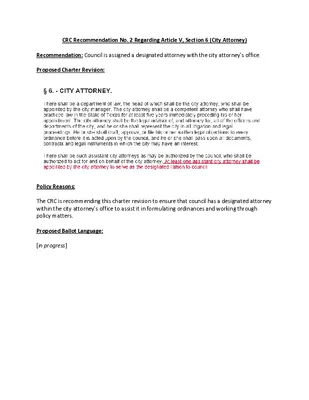
CRC Recommendation No. 2 Regarding Article V, Section 6 (City Attorney) Recommendation: Council is assigned a designated attorney with the city attorney’s office. Proposed Charter Revision: Policy Reasons: The CRC is recommending this charter revision to ensure that council has a designated attorney within the city attorney’s office to assist it in formulating ordinances and working through policy matters. Proposed Ballot Language: [in progress]

Item 5 2024 Charter Review Commission, 2/29/24 Background City Council Resolution 20230309-025 establishing the 2024 Charter Review Commission to make recommendations to the Council to, in part, “improve and enhance transparency and the general functions of city government….” The City Charter does not currently require public disclosure of the intent to collect signatures for a petition, the identity of the person(s) initiating the petition and responsible for collecting petition signatures, or contact information for the petitioners, among other disclosures commonly required in citizen-initiated petition policies in other cities, nor does the Charter require that the parties responsible for collecting and submitting petition signatures be residents of Austin. As such, the current petition process does not encourage or require the level of transparency that Austin residents deserve. Draft Recommendation Amended language for City Charter Article IV, Section 3: Subsection 1: Notice of Intent. A signature presented as part of a petition for a ballot initiative, referendum, recall, or for a Charter amendment to the extent allowable under state law, is considered valid only if: a) The signer is a qualified voter in the jurisdiction impacted by the petition; b) The signature includes the signer’s printed name, residence address, date of birth or Voter Unique Identifier (VUID), the date of signing, and the signer’s live signature, as described in Texas Election Code Sec. 277.002 (a); and c) The signature was collected during the effective period of a Notice of Intent filed with and accepted by the City Clerk. i) Notices of Intent are considered to be in effect once they are reviewed and accepted by the City Clerk, until the date the collected petition signatures are submitted to the City Clerk, for a period not exceeding 180 days. d) The signature was submitted as part of the petition before the 90th day before the date by which an election must be ordered for the next general municipal election date for petitions for initiative, referendum, and to the extent allowable under state law, Charter amendments. e) The signature was collected on a standardized petition form prescribed by the City Clerk, which at a minimum: i) ii) iii) Contact information for the Clerk’s office; The URL of the page on the City’s website where Notices of Intent are posted, as well as a QR code directing to that URL; The following information provided on the Notice of Intent: 1) The type of petition; 2) …

Recommendation: Background Item 5 City Council Resolution 20230309-025 establishing the 2024 Charter Review Commission indicated City Council’s intent to hold an election in November 2024 to allow voters to decide on several important changes to the charter including “changes to petition requirements for initiative and referendum or City Charter amendments including (…) Use of a durable signature threshold that utilizes a percentage of the total number of registered voters in the City.” Among the reasons cited for this change, the Resolution stated: “WHEREAS, in November 2012, voters approved a Charter amendment to change the number of required signatures for initiative and referendum petitions to be equal to the number of signatures required by state law to initiate a Charter amendment: 5% of qualified voters or 20,000, whichever number is smaller, and this change resulted in petitioners needing fewer than half the number of signatures than before;” and “WHEREAS, in 2012, when the change was made, 20,000 signatures was 4% of qualified voters,but this fixed number represents a steadily decreasing percentage of Austin voters as the City's population continues to grow;” and “WHEREAS, an October 2019 report by the City Auditor regarding citizen initiatives to amend the City Code noted that most peer cities require more signatures for citizen initiatives than Austin and that only Austin provides for a set number of signatures required or a percentage requirement, whichever is smaller”. The Charter Review Commission established the Petition Process Working Group on October 2nd, 2023. Its membership consisted of Commissioners Cowles, Dwyer, Greenberg, McGivern and Van Maanen. This recommendation was presented to the full Commission on XX/XX/XXXX. It was adopted/rejected by a X-X vote. Substance of the Proposed Amendments, Revisions or Repeals to the Charter This recommendation sets a durable signature threshold for the approval of citizen initiative and referendum petitions at 3.5% of qualified Austin voters. The Charter Review Commission recommends amending Article IV, § 1 by replacing the current language: “Any initiated ordinance may be submitted to the council by a petition signed by qualified voters of the city equal in number to the number of signatures required by state law to initiate an amendment to this Charter.” with the following amended language: “Any initiated ordinance may be submitted to the council by a petition signed by three and a half percent of qualified voters of the city.” and amending Article IV, § 2 by replacing the current language: …

Item 6 - Back-up Item 1 2024 Charter Review Commission, 2/29/24 Background City Council Resolution 20230309-025 establishing the 2024 Charter Review Commission to make recommendations to the Council to, in part, “improve and enhance transparency and the general functions of city government….” Through the regular electoral process, candidates for mayor and City Council must comply with limits on campaign funds, contributions, and expenditures imposed in the City Charter, Article III Section 8. The following are some, but not all, of these limitations: limits on individual campaign contributions and a limit on the total amount of contributions received outside of Austin, limitations on contributions from political committees, and the prohibition of soliciting and accepting campaign contributions outside of the 180-day period preceding of an election for mayor or council member, or the recall election of the mayor or a council member. The City Charter does not currently require any public disclosure or campaign finance reporting on contributions received or expenditures made in connection with collecting petition signatures in order to recall a mayor council member, or for any kind of petition, which means that it is generally not possible to determine which interests are backing the use of petitions to change policy or to recall the representatives that Austinites elect to serve them on City Council. Recommendation Added language for City Charter Article IV, Sec. 6: Any person or entity responsible for initiating and submitting a petition (“the petitioner”) to recall the mayor or a council member shall file a campaign treasurer appointment with the City Clerk, and shall submit reports of all contributions received and expenditures made in connection with a recall petition per the City of Austin’s campaign finance rules. Additionally, petitioners for the recall of the mayor or a council member shall comply with limits on campaign contributions and expenditures, similar to those described in City Charter Article III, Sec. 8, to the extent allowed by applicable law. If any provision of this section, or the application of that provision to any persons or circumstances, shall be held invalid, then the remainder of this section, to the extent that it can be given effect, and the application of that provision to persons or circumstances other than those to which it was held invalid, shall not be affected thereby, and to this extent the provisions of this section are severable. Policy Reasons for the Recommendation The expressed intent of …

Item 6 - Back-up Item 2 2024 Charter Review Commission, 2/29/24 Background The current recall structure outlined in the City Charter was written for an at-large Council system, in which each Council Member was elected by the entire voting population of the city. Thus, a 10% threshold translated to approximately 50,000 signatures as of the November 2012 election, in which Austin voters chose to adopt a single-member district system of representation, rejecting the at-large system. Each Council District now is made of approximately one-tenth the number of residents that at-large districts were. Under the at-large system, each Austinite had multiple Council Members that they elected to represent them. If any one at-large Council Member failed to adequately represent a community in Austin, that community had multiple other representatives accountable to them from which they could seek relief. In the event of a recall, no community was left without representation on City Council. A single-member district system offers more community-centered representation more directly responsive to each geographic area of the city. However, in the event of a recall in a single-member district system, one-tenth of the city is left without directly responsive representation, leaving that area with no voice on City Council for the possibly months-long period before a special election occurs, which could leave that community virtually powerless in extremely consequential policymaking and budget decisions that directly impact them. The single-member district system of representation is fundamentally different from an at-large system, and offers more community-centered, more direct and responsive representation. However, the recall structure was not amended when Austin adopted a single-member district system, and is not appropriate for a new system of representation. As such, the current recall system is not an institutional choice allowing for a last-resort tool to achieve fair, competent, and adequate representation, but rather an oversight that compromises our system of government by allowing anyone–including corporations, people who do not live in Austin, and people who do not live in and are not represented by Council Members they wish to recall–to abuse this system to overturn an election as a means of influencing policy, especially when combined with the absence of transparency and accountability that currently exists in the City Charter. Recall is an important tool for holding elected representatives accountable, but because the consequences of a recall are so potentially severe, it is a tool that must be carefully structured and protected from …
Topics For Next Time The below set of topics represent policy questions that the Charter Review Commission (CRC) did not have enough time to adequately explore but may be of interest to the City Council or future CRCs. The topics are listed in alphabetical order. “Democracy Dollars” In the May 2021 Austin election, a similar public campaign finance voucher proposal received 43% of the cast votes in favor. The 2018 Charter Revision Commission recommended the creation of a system of publicly-financed City Council campaign contribution vouchers. According to the 2018 CRC: The purpose of the Democracy Dollars program is to ensure that all people of Austin have equal opportunity to participate in political campaigns and are heard by candidates, to strengthen democracy, to fulfill the purposes of single-member districts, to enhance candidate competition, and prevent corruption. DRAFT The current CRC discussed Commissioner Betsy Greenberg’s Independent Ethics Commission proposal. Many CRC members expressed an interest in reviewing the design and function of the City’s overall ethics apparatus. At the same time, Commissioners voiced concerns about being able to meet the CRC’s report deadline and tackling such a complex topic that was not specifically mentioned in the City Council resolution creating the 2024 CRC. An updated version of the proposal that addresses the community concerns raised during the May 2021 election may gain widespread community support. A future CRC could be constituted with a clear mandate and ample time to allow a proper consideration of an Independent Ethics Commission. Independent Ethics Commission Limit on Aggregate Campaign Contributions Outside of Austin (“Zip Code Envelope”) Article III § 8 A.3 of the Charter states: This provision was challenged in Court by former City Council member Don Zimmerman but survived. From the opinion issued by the Fifth Circuit U.S. Court of Appeals: No candidate and his or her committee shall accept an aggregate contribution total of more than $30,000.00 per election, and $20,000.00 in the case of a runoff election, from sources other than natural persons eligible to vote in a postal zip code completely or partially within the Austin city limits. The amount of the contribution limit shall be modified each year with the adoption of the budget to increase or decrease in accordance with the most recently published federal government Bureau of Labor Statistics Indicator, Consumer Price Index (CPI-W U.S. City Average) U.S. City Average. The most recently published Consumer Price Index on …